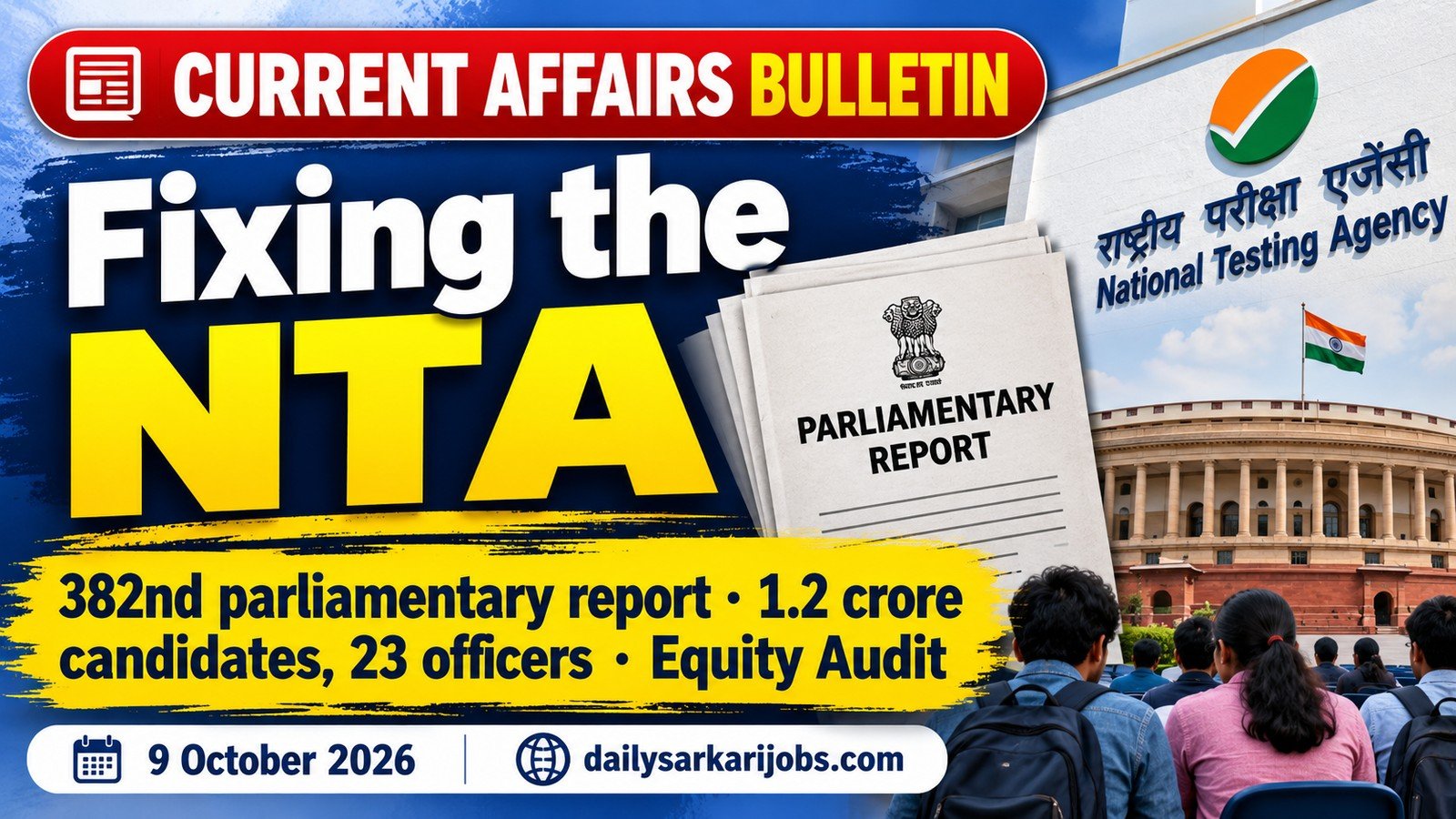
About 1.2 crore students sit an exam run by the National Testing Agency every year. The Agency has 23 officers. Not 23 thousand, not 23 hundred. Twenty-three people in post against 39 sanctioned, a vacancy rate of 41 per cent — and for twenty-one months its Director General was somebody holding the job as additional charge alongside his own.
On 9 October 2026 a Parliamentary Standing Committee presented its 382nd Report, on reforms and strengthening of the National Testing Agency. If you are preparing for an exam, this is the rare current-affairs story that is about you. Explained in plain language for SSC, RRB NTPC, State PSC, banking general awareness and UPSC Prelims.
⚡ QUICK FACTS
Report
382nd Report on Reforms and Strengthening of the NTA
Committee
Standing Committee on Education, Women, Children, Youth and Sports
Chairman
Shri Mukul Wasnik, Rajya Sabha
Adopted
25 August 2026
Presented
9 October 2026, to the Chairman, Rajya Sabha
Candidates a year
About 1.2 crore
The Hinge: Count the People Before You Read the Policy
Every discussion of exam reform in India is about technology — biometrics, encrypted papers, computer-based testing, artificial intelligence. The Committee looked at the staffing table instead, and that is where the story is.
What it is
The number
Candidates sitting NTA exams each year
About 1.2 crore
Candidates in NEET-UG alone
More than 22 lakh
Sanctioned posts in the NTA
39
Officers actually in position
23
Vacancy rate
41 per cent
Posts filled through the Central Staffing Scheme, that is by deputation
16
Period the Director General’s post was held as additional charge
23 June 2024 to 1 April 2026
Read the last two rows together and the picture is complete. Of the 23 officers present, 16 posts are filled by officers on deputation — people who come from another service, stay a few years and go back. And for nearly two years after the crisis of 2024, the person in charge was doing the job part-time.
The Committee’s recommendation follows directly: the NTA must hire its own permanent staff, specifically in psychometrics, security, digital infrastructure, analytics and logistics. Those are five skills you cannot borrow for three years at a time.
The device here is worth taking away: when an institution keeps failing, look at the headcount before you look at the policy. A body that cannot keep its own staff cannot build institutional memory, and institutional memory is exactly what catching a repeat offender requires.
What Went Wrong, in the Committee’s Own Assessment
The Committee is blunt, and the bluntest sentence is about what happened after the reforms that followed 2024: NEET (UG) 2026 was cancelled despite all these measures. That single fact is why the report exists.
Blacklisted vendors keep winning contracts, because there is no mechanism to prevent it — nobody keeps the list
The NTA has no data on who succeeds, only on who registers. It cannot say how candidates fare by State, gender, board or social category
There is no public record of paper leaks or the resulting police cases
Communication with students is largely one-way, which the Committee links directly to the collapse in trust
The Agency runs recruitment exams that have nothing to do with higher-education admission, spreading itself across work it was not built for
NEET-UG has no upper age limit and no limit on attempts, which has produced candidates over the age of seventy
The blacklisted-vendor point deserves a sentence of its own, because it is the cheapest problem on the list to fix. The Committee asks for a public National Registry of Blacklisted Examination Vendors. A blacklist that is not written down anywhere is not a blacklist; it is a memory, and memory is exactly what an agency staffed by rotating deputationists does not have.
The Big Recommendation: Computer-Based Testing, but on Government Premises
The Committee supports moving NEET-UG to computer-based testing — taking the exam on a screen rather than on paper — but the conditions it attaches are the real content.
Condition
Why it matters
Only government-owned centres, with no sub-contracted private centres
The Committee’s view is that the weak point is not paper, it is who owns the building and who the staff answer to
1,000 secure government computer-based testing centres, as the Radhakrishnan Committee recommended
The infrastructure must exist before the switch, not after
At least one test centre in every district
Otherwise a screen-based exam quietly becomes an exam for candidates who can afford to travel
Phased transition, with a hybrid print-at-centre model in the meantime
Printing at the centre removes the long transport chain where papers have historically leaked
Normalisation method published and audited before the switch
When an exam runs in several shifts, scores must be adjusted for difficulty. If nobody can check the formula, the adjustment itself becomes the grievance
Free mock tests, and funding school and college IT labs in exchange for exam access
A rural candidate who has never used a mouse under time pressure is not sitting the same exam as an urban one
That normalisation row is the one most people skip and the one most likely to be asked. Multi-shift exams need a statistical adjustment so that a candidate who got a harder paper is not punished for it. The Committee’s point is procedural rather than technical: publish the method first, have it audited, and only then switch, because a formula nobody has seen cannot command confidence.
Beyond that, the Committee wants Computer Adaptive Testing — where the difficulty of the next question depends on whether you got the last one right — but only once the digital infrastructure has matured.
The Quiet Recommendation That May Matter Most
Buried among the thirty-odd recommendations is an annual Equity Audit: the NTA should publish, every year, how candidates actually fared broken down by State, gender, board, medium of instruction and social category.
At present the Agency knows who registered and does not know who succeeded. That means nobody can say, with evidence, whether a Hindi-medium candidate from a State board in a small district faces the same exam as anybody else. Every argument about coaching, language and access currently runs on anecdote because the data has never been published.
You cannot fix a gap you have not measured, and the Committee is asking for the measurement. For the readers of this site, that single recommendation is probably worth more than all the technology in the report.
Fairness on the Day Itself
Some recommendations are small, practical and immediately recognisable to anyone who has sat a competitive exam.
A separate 15-minute window for the invigilator’s formalities, outside the exam time — so that filling forms does not eat into answering
Late arrivals to be allowed in after signing an undertaking, with no extra time given
The Public Examinations (Prevention of Unfair Means) Act, 2024 to be amended so that District Administrations withhold permission for rallies and gatherings on exam days
Mental health counselling and a calm environment around exams and results
Reasonable age and attempt limits for major exams, with UGC-NET excepted
A protocol and support system for candidates with disabilities
A duty of care to candidates, including compensation when an exam is cancelled for administrative reasons, and time limits for deciding grievances
The compensation point is genuinely new. When an exam is cancelled, the candidate loses the fee, the travel, the accommodation and often a year. Until now that loss has simply sat where it fell.
Transparency, and the UPSC Comparison
The Committee recommends publishing results transparently following the practice of the Union Public Service Commission, which releases marks, cut-offs and answer keys after the process is over. That is a pointed comparison: the UPSC is a constitutional body under Article 315 with its own protections, while the NTA is a society registered under an ordinary law. The Committee is asking a body with no constitutional standing to behave like one that has it.
It goes further and asks for a Parliamentary framework for NTA accountability and an independent examinations mechanism reporting to the Ministry. In plain words: somebody outside the Agency should be able to call it to account, the way the Public Accounts Committee does with public money.
What Has to Happen Next
A Standing Committee report is a recommendation, not an order. The Government replies with an Action Taken Note, and the Committee later reports on whether the action was in fact taken. Three things in this report need more than a decision inside the Ministry:
A Parliamentary accountability framework needs Parliament to create it
1,000 government testing centres need a budget line, which means they appear, or fail to appear, in a Union Budget
The Committee also notes that of the Radhakrishnan Committee’s 101 recommendations, sixty relate to 2025 and 2026 and are still being worked through. Its instruction is to speed those up rather than start again.
The Honest Caution
This is a report, presented today. Nothing in it has yet changed any rule, any exam or any date. If a question asks what the 382nd Report did, the verb is “recommended”. Watch for the Action Taken Note, for any amendment to the Public Examinations Act, and for a budget line for the testing centres.
One number in this post will also move: the NTA’s staffing. 23 officers in 39 posts is the position the Committee found, not a permanent fact. Recheck it before quoting it in an interview.
Practice Questions
Q1. The 382nd Report on reforms and strengthening of the National Testing Agency was presented by the Standing Committee on… (a) Finance (b) Home Affairs (c) Education, Women, Children, Youth and Sports (d) Science and Technology Answer: (c) Education, Women, Children, Youth and Sports Department-related Standing Committees are organised by subject, and examinations for admission to higher education fall under the department that handles them. The report pertains to the Department of Higher Education in the Ministry of Education.
Q2. According to the report, roughly how many candidates sit NTA examinations each year? (a) About 22 lakh (b) About 50 lakh (c) About 1.2 crore (d) About 3 crore Answer: (c) About 1.2 crore One of the wrong options is the NEET-UG figure on its own, which is the trap. The right answer covers every examination the Agency conducts, of which the medical entrance test is only the largest single one.
Q3. The Committee recommended that computer-based testing centres should be… (a) Owned by private operators under contract (b) Owned by the Government, with no sub-contracted private centres (c) A mix, decided State by State (d) Set up only in State capitals Answer: (b) Owned by the Government, with no sub-contracted private centres The Committee’s reasoning is that the vulnerability lies in who controls the premises and the staff rather than in the medium of the paper. It also asked for at least one centre in every district, and for a thousand such centres in all.
Q4. What is the National Registry of Blacklisted Examination Vendors that the Committee recommended? (a) A list of candidates caught cheating (b) A list of coaching centres under investigation (c) A public register of firms barred from examination contracts (d) A register of approved test-centre operators Answer: (c) A public register of firms barred from examination contracts The problem it answers is that firms already barred have kept winning contracts because no single list exists for anybody to check. Making it public is the point — a record nobody can see cannot stop a procurement officer.
Q5. The Equity Audit recommended by the Committee would require the NTA to publish annual data on candidate outcomes broken down by… (a) Coaching institute attended (b) Family income (c) State, gender, board, medium of instruction and social category (d) Age and number of attempts Answer: (c) State, gender, board, medium of instruction and social category At present the Agency records who registers but not who succeeds, so every debate about access runs on anecdote. The breakdown asked for is the one that would show whether the examination treats comparable candidates comparably.
Ten more questions on this and today’s Static GK capsule are waiting on our Test Your Knowledge page, with a free PDF. Today’s capsule is on how India measures inflation — and why almost every revision note now has the wrong base year.
Sources: the Press Information Bureau release of 9 October 2026 on the presentation of the 382nd Report of the Department-related Parliamentary Standing Committee on Education, Women, Children, Youth and Sports, chaired by Shri Mukul Wasnik, which gives the adoption date of 25 August 2026, the witnesses examined, the staffing figures of 23 officers in position against 39 sanctioned posts and 16 Central Staffing Scheme posts, the additional-charge period for the Director General from 23 June 2024 to 1 April 2026, the figures of about 1.2 crore candidates a year and more than 22 lakh in NEET-UG, the revenue surplus of ₹590 crore across 2018-19 to 2024-25, the 101 recommendations of the High-Level Committee of Experts chaired by Dr. K. Radhakrishnan of which sixty relate to 2025 and 2026, the recommendation of 1,000 secure government computer-based testing centres, and every recommendation summarised above with its paragraph number. The statement that NEET (UG) 2026 was cancelled despite earlier measures is the Committee’s own. This post describes recommendations only; none of them has yet changed any rule or examination, and the staffing figures are the position the Committee found rather than a permanent fact.