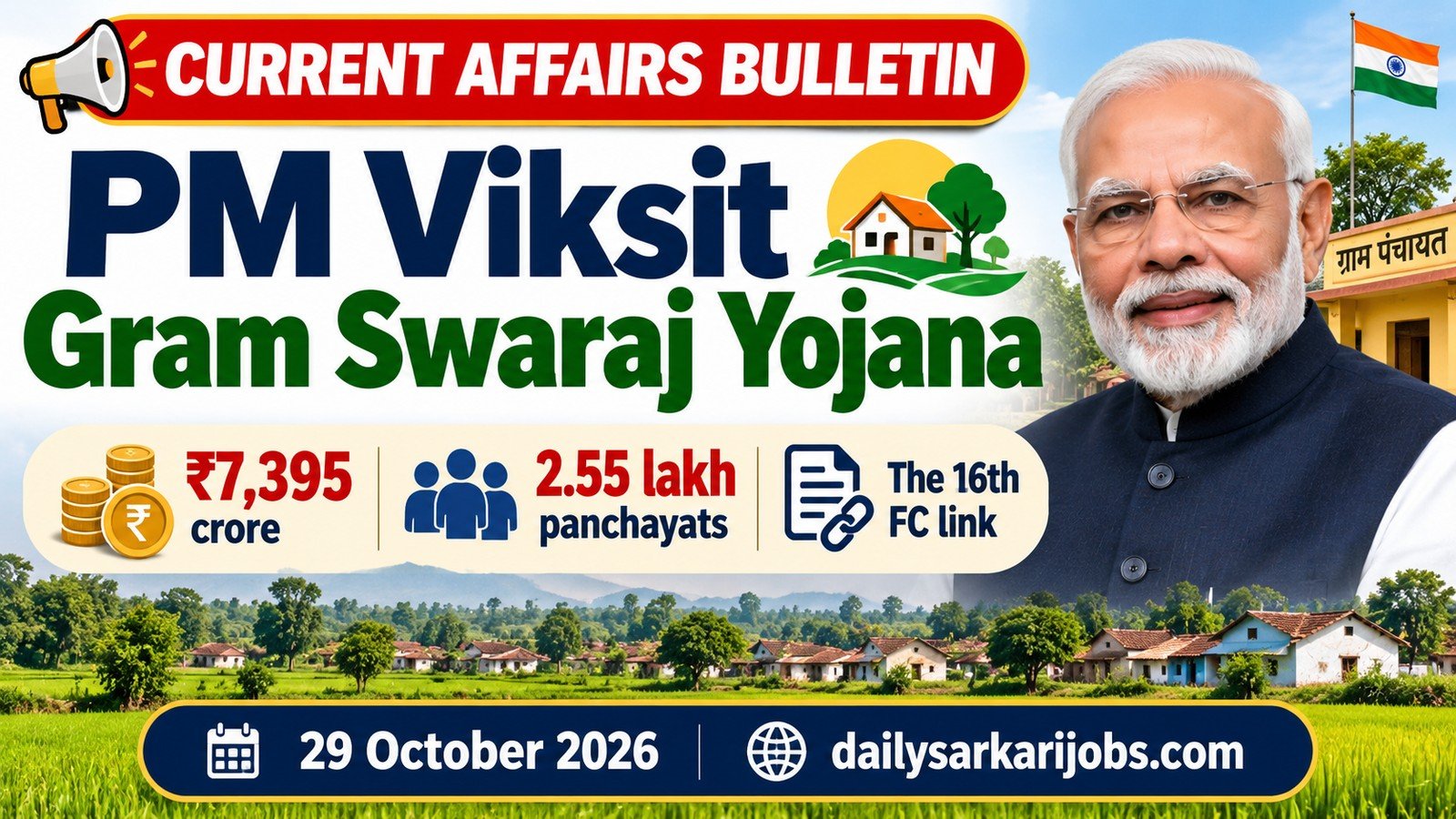
On 28 October 2026 the Union Cabinet approved the Pradhan Mantri Viksit Gram Swaraj Yojana (PM VGSY) as a Centrally Sponsored Scheme for 2026-27 to 2030-31, with a total outlay of ₹7,395.55 crore.
A new scheme with a new name is always worth a capsule, because examiners ask about schemes within months of their approval. But this one is more interesting than its press release suggests, and the reason is a number that is not in the headline.
⚡ QUICK FACTS
Approved on
28 October 2026, by the Union Cabinet
Type
Centrally Sponsored Scheme
Period
2026-27 to 2030-31
Total outlay
₹7,395.55 crore
Centre : State share
₹4,869.48 crore : ₹2,526.07 crore
Covers
Over 2.55 lakh Panchayats and Traditional Local Bodies
The Hinge: the Scheme’s Money Is Not the Money That Matters
Put two figures side by side.
PM VGSY’s own outlay: ₹7,395.55 crore over five years.
Grants the Sixteenth Finance Commission has recommended for Rural Local Bodies over the same five years: about ₹4.35 lakh crore.
The second figure is roughly fifty-nine times the first. So PM VGSY is not really a spending scheme at all. It is the machinery that lets a much larger flow of money be planned, spent and audited by village councils that have never handled sums like this before.
Once you see that, the scheme’s design stops looking like a list and starts looking inevitable. Look at what it actually funds: plans, awareness, training and audits. Not a single road, tank or building. That is exactly what you would build if your problem were capacity rather than cash.
And it explains the period. The scheme runs 2026-27 to 2030-31 because that is co-terminus with the Sixteenth Finance Commission’s award period — the plumbing is laid for exactly as long as the water flows. Whenever you meet a scheme whose dates match a Finance Commission cycle, ask what grant it is built around. Our capsule on the Finance Commission explains where those grants come from and why Article 280 makes them recur every five years.
The Four Things It Will Do
Component
What it means in plain terms
Gram Panchayat Development Plans (GPDPs)
Every panchayat prepares a holistic annual plan, uploaded on the eGramSwaraj Portal, so that spending follows a written plan rather than the moment
Awareness generation
Telling villagers what schemes exist, through PANCHAM and the Gram Sabha
Capacity building
Training elected representatives and panchayat staff — the people who must write and execute those plans
Audit and revenue
Online audits through AuditOnline, proper accounting, public disclosure, and raising the panchayat’s Own Source Revenue
Jargon, defined once.Own Source Revenue is money a panchayat raises itself — local taxes, fees, rent on its own property — as opposed to money handed down from above. It matters because a body that raises nothing of its own is an office, not a government, which is the argument running under this entire scheme.
The Targets, Which Are Unusually Specific
2.55 lakh GPDPs prepared every year.
At least 1 crore citizens reached in each awareness exercise.
About 32 lakh elected representatives, functionaries and other stakeholders trained every year.
At least 2.55 lakh online audit plans prepared every year.
Two more operational facts that are easy marks because almost nobody reads this far: no permanent posts will be created under the scheme — only need-based contractual staff at State, District and Block level — and States and Union Territories must submit Annual Action Plans, which a designated Central Empowered Committee appraises and approves.
Why 2.55 Lakh, and Why ‘Traditional Local Bodies’
The coverage figure is worth a second look. The scheme reaches over 2.55 lakh Panchayats and Traditional Local Bodies, including non-Part IX areas where Panchayats do not exist.
That last clause is the exam-worthy part.Part IX of the Constitution, inserted by the 73rd Amendment, is what created the panchayat system — but it does not apply everywhere. Certain tribal and hill areas are outside it and are governed by their own traditional councils instead. A scheme that says “and non-Part IX areas” is quietly telling you that India’s local government map has holes in it. We set the system out in our capsule on Panchayati Raj and the 73rd and 74th Amendments.
Centrally Sponsored, and Why the Label Matters
PM VGSY is a Centrally Sponsored Scheme, and the split given in the Cabinet release shows what that means: ₹4,869.48 crore from the Centre and ₹2,526.07 crore from the States.
Type
Who pays
Example
Central Sector Scheme
The Centre alone, fully
Typically subjects on the Union List
Centrally Sponsored Scheme
Centre and States share the cost in a fixed ratio
PM VGSY, and most schemes in State-List subjects
This is one of the most frequently confused pairs in the economy section.Central Sector = central money only; Centrally Sponsored = shared money. The reason PM VGSY has to be the second kind is constitutional: local government is a State subject, so the Centre cannot simply run it. Our capsule on taxation and the divisible pool covers how money moves between the two levels.
Why a Reader Should Care
New schemes are among the safest predictions in General Awareness, and the questions follow a fixed shape: the outlay, the period, the ministry, the coverage figure. For this one, carry ₹7,395.55 crore, 2026-27 to 2030-31, Panchayati Raj, 2.55 lakh panchayats and you have answered most of what can be asked.
The more durable lesson is the hinge. A small scheme attached to a large grant is a recurring pattern in Indian public finance, and spotting it tells you what a scheme is really for. The same reading helps with PM Dhan-Dhaanya Krishi Yojana, which also works by converging money that already exists rather than by creating new money.
Today’s Static GK capsule is about a different kind of plumbing — vitamins, deficiency diseases and how India fortifies its food. It shares one idea with this scheme: the cheapest public programmes are usually the ones that add something small to a system that already reaches everybody.
What the Release Does Not Say
Three gaps worth noting. The Cabinet release does not name the scheme it replaces or subsumes, though the Ministry of Panchayati Raj has run an earlier scheme in this space, so watch for that clarification. It gives no State-wise allocation. And the ₹4.35 lakh crore figure is a Finance Commission recommendation, which is not the same as money released — recommendations on grants are accepted by the Government and then disbursed year by year. Quote it as recommended, not as spent.
Practice Questions
Q1. The Pradhan Mantri Viksit Gram Swaraj Yojana was approved for which period? (a) 2025-26 to 2029-30 (b) 2026-27 to 2030-31 (c) 2026-27 to 2031-32 (d) 2027-28 to 2031-32 Answer: (b) 2026-27 to 2030-31 The window is deliberately co-terminus with the Sixteenth Finance Commission’s award period, which is the quickest way to remember it.
Q2. What is the total outlay of PM VGSY? (a) ₹5,911 crore (b) ₹10,000 crore (c) ₹7,395.55 crore (d) ₹4,869.48 crore Answer: (c) ₹7,395.55 crore The last option is a real figure from the same release but is only the Central share; the States contribute ₹2,526.07 crore on top.
Q3. PM VGSY is a Centrally Sponsored Scheme. What does that mean? (a) The Centre bears the entire cost (b) The States bear the entire cost (c) The Centre and the States share the cost (d) It is funded entirely by the Finance Commission Answer: (c) The Centre and the States share the cost A scheme funded wholly by the Centre is called a Central Sector Scheme instead, and that is the distinction this question tests.
Q4. Approximately how many Panchayats and Traditional Local Bodies does the scheme cover? (a) 1.5 lakh (b) 2.55 lakh (c) 3.5 lakh (d) 6 lakh Answer: (b) 2.55 lakh The figure includes non-Part IX areas, where traditional councils take the place of panchayats.
Q5. Gram Panchayat Development Plans under the scheme are to be uploaded on which portal? (a) eGramSwaraj (b) PFMS (c) AuditOnline (d) PANCHAM Answer: (a) eGramSwaraj The third option is the portal used for the scheme’s online audits and the fourth is used for awareness generation, so all three appear in the same release.
30-Second Revision
PM Viksit Gram Swaraj Yojana, approved 28 October 2026: a Centrally Sponsored Scheme for 2026-27 to 2030-31, outlay ₹7,395.55 crore (Centre ₹4,869.48 crore, States ₹2,526.07 crore), covering over 2.55 lakh Panchayats and Traditional Local Bodies.
Four components: GPDPs on eGramSwaraj, awareness through PANCHAM and the Gram Sabha, capacity building, and AuditOnline plus Own Source Revenue. No permanent posts; States submit Annual Action Plans to a Central Empowered Committee.
The hinge: the scheme is co-terminus with the Sixteenth Finance Commission, which has recommended about ₹4.35 lakh crore for Rural Local Bodies over the same years — about fifty-nine times the scheme’s own outlay. The scheme buys capacity, not construction.
Sources
Cabinet decision of 28 October 2026, Cabinet approves Pradhan Mantri Viksit Gram Swaraj Yojana as a Centrally Sponsored Scheme for 2026-27 to 2030-31, as published on the Prime Minister’s Office website — the outlay and its Centre-State split, the period and its link to the Sixteenth Finance Commission, the four components, the 2.55 lakh coverage figure, the annual targets, the staffing position and the Annual Action Plan process.
Press Information Bureau release listing of 28 October 2026, under the Cabinet and the Ministry of Panchayati Raj. PIB served only the headline for this decision, so the detail above is taken from the Government’s own published text of the same Cabinet decision.