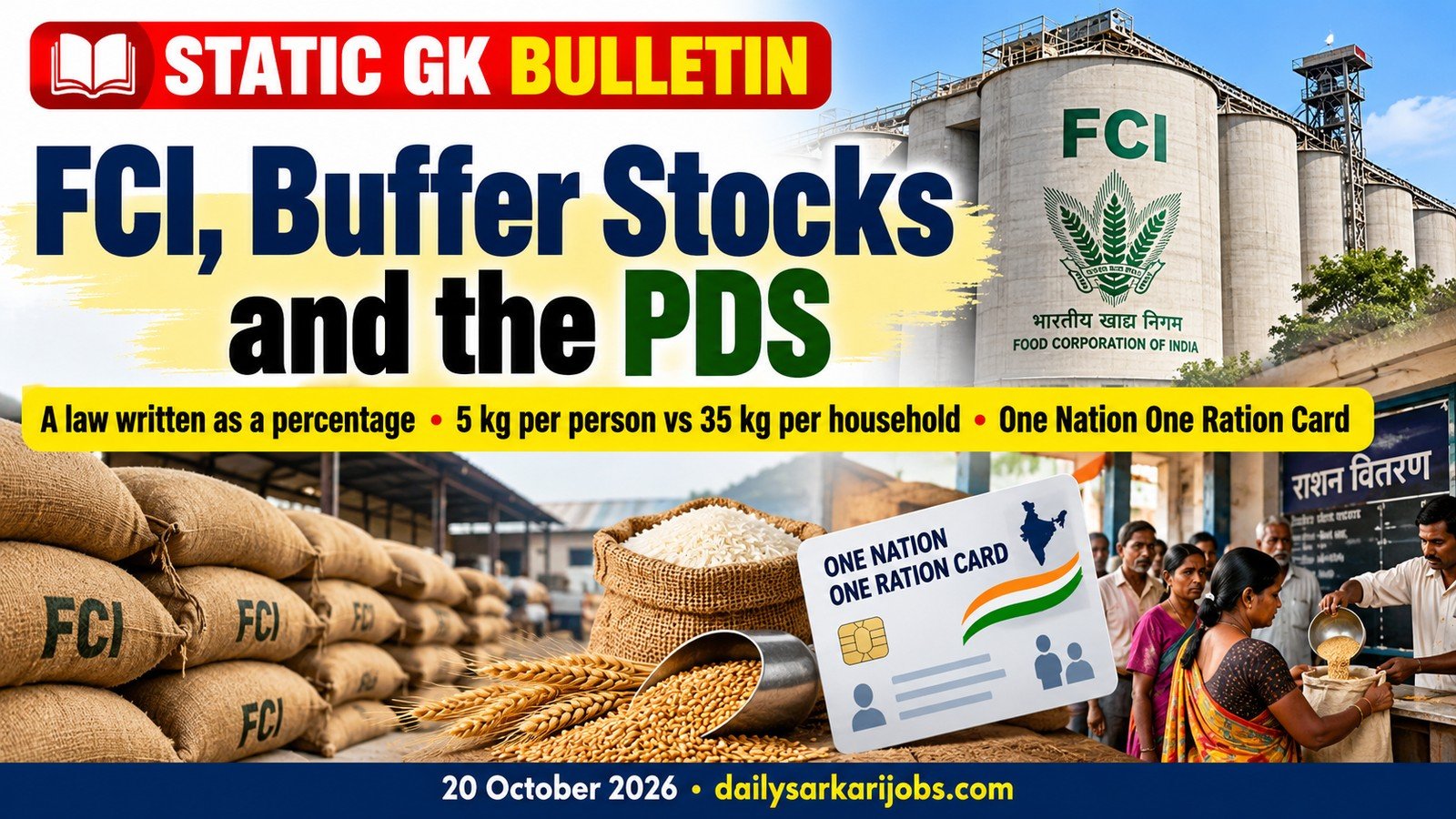
Yesterday’s capsule ended on a question: an announced price means nothing until somebody actually buys the crop. Today’s begins where that purchase ends. Once the Government has bought the grain, it owns a mountain of it — and it has to store that mountain, pay for it, and move it to about 80 crore people.
This is the second capsule in our series on agriculture and the rural economy, explained in plain language for SSC, RRB NTPC, banking exams, State PSC and UPSC Prelims.
⚡ QUICK FACTS
Who buys and stores
The Food Corporation of India, into the Central Pool
The law
The National Food Security Act, 2013
Coverage
Up to 75 per cent of the rural and 50 per cent of the urban population
Which came to
About 81.35 crore persons at the 2011 Census
Priority Household entitlement
5 kg per person per month
Antyodaya entitlement
35 kg per household per month
What it costs the family now
Nothing — grain is free for both categories
One Nation One Ration Card
Live in all 36 States and Union Territories
The Hinge: a Law Written as a Percentage Is Frozen to a Census
Read the coverage rule exactly as the Act states it. The National Food Security Act covers up to 75 per cent of the rural population and up to 50 per cent of the urban population. It does not name a number of people. It names a share.
A share has to be applied to something, and the something is a population count. Applied to the 2011 Census, those percentages produced about 81.35 crore persons, roughly two-thirds of the country.
The transferable habit: whenever a law gives you a percentage, find out what it is a percentage of, and when that denominator was last measured. It is the same question yesterday’s capsule asked about the word cost, asked here about the word population.
Read the Unit Before You Read the Number
The two entitlements are not measured the same way, and almost every exam question on this turns on that.
Category
Who they are
Entitlement
Priority Households
Identified by State Governments and Union Territory administrations under their own criteria
5 kg per person per month
Antyodaya Anna Yojana
The poorest of the poor, identified against Central criteria
35 kg per household per month
One is per person; the other is per family. So a Priority Household’s entitlement grows with the family, while an Antyodaya household gets the same 35 kg whether it has three members or eight. Two numbers, two different units, and a reader who misses that will answer confidently and wrongly.
The Antyodaya criteria are worth one reading, because they describe a particular kind of vulnerability rather than an income line: households headed by a widow, a terminally ill person, a person with disability or an elderly person without support; single women or men with no family or societal support; all primitive tribal households; landless labourers, marginal farmers, rural artisans, slum dwellers and informal daily wage earners.
Under the Act the grain carries prices set in Schedule-I, but it is at present supplied free of cost to both Antyodaya and Priority Households. The price in the statute and the price at the shop are two different things, and both are examinable.
The Buffer Is a Floor, Not a Target
The Government sets stocking norms — the quantity the Central Pool should not fall below. It is worth putting the norm beside the actual stock.
On 1 July 2025
Stocking norm
Actual Central Pool stock
Rice
135.40 lakh tonnes
377.83 lakh tonnes
Wheat
275.80 lakh tonnes
358.78 lakh tonnes
Rice stocks were close to three times the norm. That is not an accident and it is not necessarily a mistake — but it is a choice, and it has a bill attached, because every extra tonne has to be stored, guarded, insured and eventually moved.
The reusable idea is that a minimum and a target behave very differently. A norm says “do not go below this”. It says nothing about how far above it is sensible to go, so the number that actually sits in the warehouse is set by how much was procured, not by how much was needed. Yesterday’s capsule explained why procurement is concentrated in paddy and wheat — and this table is what that concentration looks like at the other end of the pipe.
Who Buys It: Two Routes
Route
How it works
Centralised procurement
The FCI, or a State agency acting for it, buys the grain and hands it to the FCI to store and distribute
Decentralised procurement
The State Government itself buys, stores and distributes grain for the Act and other schemes, and sends the FCI only whatever is left over above its own allocation
Decentralised procurement exists because moving grain across the country is expensive and slow. If a State can buy locally and distribute locally, the grain never makes the journey. The FCI then handles the surplus and the shortfall rather than the whole flow, which is a very different job from buying everything itself.
One Nation One Ration Card, and What It Actually Fixed
A ration card used to tie a family to one shop in one place. That is a reasonable rule until the earner moves to another State for work — at which point the entitlement stays behind with the card.
One Nation One Ration Card lets a beneficiary draw their grain from any Fair Price Shop, using the ration card or Aadhaar with biometric authentication on an electronic point-of-sale device. It is live in all 36 States and Union Territories, and about 191 crore portability transactions had been recorded by October 2025.
The second thing it does is less advertised and just as important: it makes duplicate ration cards much harder, because one identity cannot quietly exist in two States at once. A reform sold as convenience for migrants is also, underneath, a deduplication exercise.
The plumbing behind it is nearly complete: all ration cards and beneficiary databases are digitised, about 99.9 per cent are Aadhaar-seeded, and about 99.6 per cent of Fair Price Shops — 5.41 lakh out of 5.43 lakh — use electronic point-of-sale devices.
Free Grain: How It Became the Normal Position
PMGKAY — Pradhan Mantri Garib Kalyan Anna Yojana — began as relief during the pandemic and ran in seven phases, the last ending on 31 December 2022.
From 1 January 2023, grain under the Act was supplied free to Antyodaya and Priority Households.
That arrangement was extended for five years from 1 January 2024, with an estimated outlay of about ₹11.80 lakh crore, borne entirely by the Centre.
About 78.90 crore beneficiaries were receiving free foodgrains as of October 2025.
Fortified rice — rice with added nutrients — was approved for universal supply under central schemes until December 2028, at about ₹17,082 crore.
And it sits on the same seam as yesterday’s capsule.Food carries the largest single weight in the consumer price basket, so the same grain that supports a farmer’s price at one end of the pipe keeps a household’s plate full at the other. Procurement and distribution are not two policies. They are one machine, and the warehouse is the middle of it.
Practice Questions
Q1. Under the National Food Security Act, 2013, coverage extends to (a) 50 per cent of rural and 75 per cent of urban population (b) 75 per cent of rural and 50 per cent of urban population (c) 100 per cent of the rural population only (d) Two-thirds of every State’s population equally Answer: (b) 75 per cent of rural and 50 per cent of urban population Applied to the 2011 Census those shares came to about 81.35 crore persons, which is why the covered number moves only when a fresh count is taken.
Q2. The monthly entitlement of a Priority Household under the Act is (a) 35 kg per household (b) 5 kg per person (c) 10 kg per person (d) 25 kg per household Answer: (b) 5 kg per person The other measure in the options belongs to the Antyodaya category, and the difference between a per-person and a per-household unit is the whole trap.
Q3. Antyodaya Anna Yojana households receive (a) 5 kg per person per month (b) 35 kg per household per month (c) 35 kg per person per month (d) No entitlement under the Act Answer: (b) 35 kg per household per month Because the quantity is fixed per family rather than per head, a larger household in this category receives less per person than a smaller one.
Q4. One Nation One Ration Card allows a beneficiary to (a) Buy grain at market price anywhere (b) Draw entitled foodgrains from any Fair Price Shop (c) Transfer the card to another family (d) Claim a cash payment instead of grain Answer: (b) Draw entitled foodgrains from any Fair Price Shop Authentication is biometric on an electronic point-of-sale device, and the system also makes duplicate cards across States much harder to hold.
Q5. Decentralised procurement means that (a) Private traders buy grain on the Government’s behalf (b) The State Government itself buys, stores and distributes the grain (c) Grain is imported rather than bought locally (d) Farmers sell directly to consumers Answer: (b) The State Government itself buys, stores and distributes the grain Anything above the State’s own requirement goes to the Food Corporation of India, so the national agency handles the surplus rather than the whole flow.