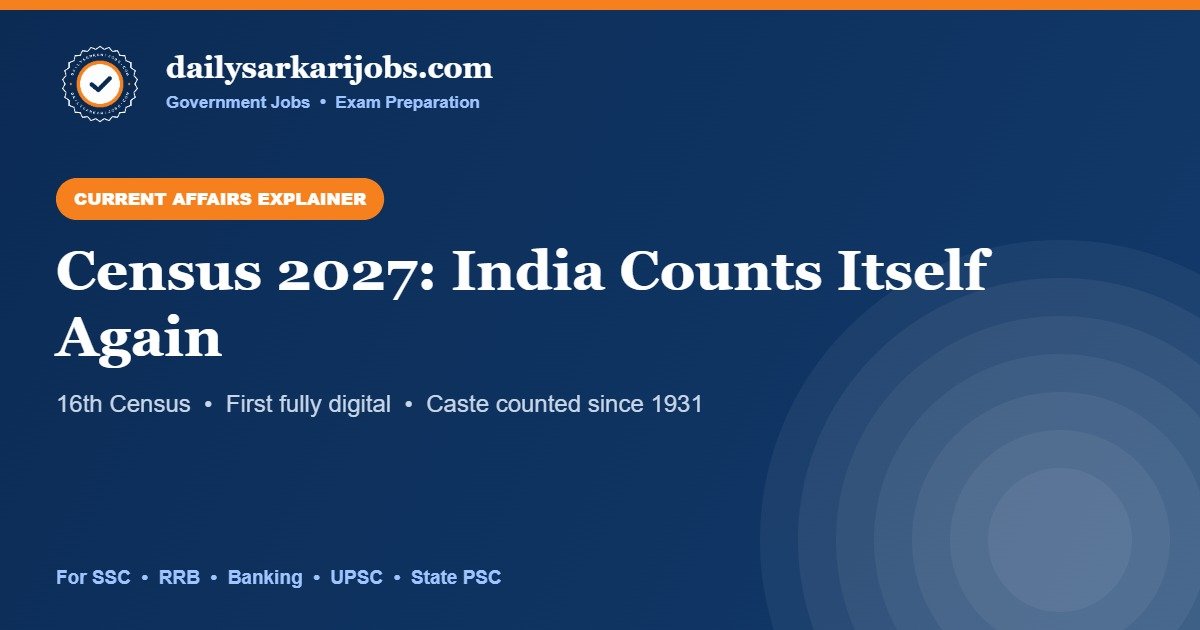
India is in the middle of counting itself for the first time since 2011. The 16th Census of India — the 8th since Independence — began its first phase in April 2026 and will finish with the headcount in February 2027. It is the first fully digital census India has run, and the first to record caste since 1931. This explainer says, in plain words, what a census actually does, why the gap since 2011 matters more than it sounds, and the facts likely to be asked in SSC CGL and CHSL, RRB NTPC, banking general awareness, UPSC and State PSC.
⚡ QUICK FACTS
🔢 Which census
16th overall, 8th since 1947
📅 Reference date
1 March 2027 (1 Oct 2026 in snow-bound areas)
⚖️ Legal basis
Census Act, 1948
🆕 Two firsts
Fully digital; caste counted since 1931
A Census Is Not a Headcount
Almost everyone describes the census as “counting people”. That is what it does, but it badly undersells what it is for, and the undersell is why candidates lose marks on this topic.
A census is the exercise that decides how the country divides everything it has. Think about what actually keys off those numbers:
Seats in Parliament and in state assemblies. How many members a state sends depends on its population. That redrawing is called delimitation.
Money. The Finance Commission uses population when it decides what share of central taxes each state receives. A state undercounted is a state underfunded.
Reservation and welfare. Quotas, and the number of people a scheme must plan for, are worked out from census figures.
Everything planners build. How many schools, hospital beds, houses and ration cards a district needs is estimated from census data.
Now the point that makes the current census significant. The last one was in 2011. The 2021 census was postponed because of the pandemic. So for sixteen years, every one of those divisions above has been made using the population of a country that no longer exists — an India that was smaller, less urban and differently distributed.
That is the whole story in one line:India has been dividing a 2026 cake using a 2011 recipe. The census is not news because people are being counted. It is news because the numbers everything else depends on are finally being refreshed.
The Two Phases, and the Reference Date
The census runs in two stages, and candidates routinely mix them up.
Phase
What Happens
When
Phase 1 — House Listing Operations
Every building and household is listed, along with what the house is made of and what the family owns — electricity, toilet, drinking water, vehicles, and so on. This phase also allows self-enumeration, where households fill in their own details.
From 1 April 2026, running through 30 September 2026.
Phase 2 — Population Enumeration
The actual headcount. Name, age, relationship to head of household, education, occupation, religion, caste, disability and migration are recorded.
February 2027.
The reference date is the detail examiners love. A census needs one single moment that everyone is counted as at, otherwise births, deaths and movement would make the total meaningless. For Census 2027 that moment is 00:00 hours on 1 March 2027 for most of India.
The exception: in snow-bound and non-synchronous areas — parts of Ladakh, Jammu and Kashmir, Himachal Pradesh and Uttarakhand — the reference date is 1 October 2026, five months earlier. The reason is practical rather than administrative: by March those areas are under snow and physically unreachable, so they are counted before winter closes them off. Two reference dates in one census is exactly the kind of thing a question is built around.
What Is New This Time
What Changed
Why It Matters
The first fully digital census
Enumerators use a mobile app instead of paper forms, with a web portal for monitoring. Data reaches the centre in near real time, so results should arrive far sooner than the years it once took.
Self-enumeration
Households can fill their own details online, in 16 languages, verified against an identity document. A first for India.
Caste enumeration
Caste will be recorded for the whole population for the first time since 1931. Scheduled Castes and Scheduled Tribes have always been counted; what returns after 96 years is the counting of other castes.
Digital mapping
Enumeration blocks are drawn using web-mapping tools, and households are geo-tagged, which reduces both double-counting and missed households.
Be precise about the caste point, because it is easy to get half-right. India has counted SC and ST populations in every census since Independence. The 1931 census was the last to enumerate all castes. So the correct statement is that full caste enumeration returns after 1931 — not that caste has never been counted.
Who Runs It, and Under What Law
The census is conducted under the Census Act, 1948, and the 2027 census was notified under Section 3 of that Act.
It is carried out by the Office of the Registrar General and Census Commissioner of India, which sits under the Ministry of Home Affairs. The same office also maintains the Civil Registration System, which records births and deaths.
Census is a Union subject. It appears at Entry 69 of the Union List in the Seventh Schedule — so it is Parliament, not the states, that legislates on it. Our Constitution capsule covers the Seventh Schedule in full.
Information given to a census enumerator is confidential by law and cannot be used as evidence against the person who gave it. That guarantee is what makes honest answers possible.
A Short History You Should Know
Year
What Happened
1872
The first census in India, under Viceroy Lord Mayo. It was not taken everywhere at the same time, so it is described as non-synchronous.
1881
The first synchronous census, under Viceroy Lord Ripon. From here the census becomes a regular, once-in-ten-years exercise.
1931
The last census to enumerate all castes.
1948
The Census Act gives the exercise its legal footing.
2011
The 15th census — the most recent completed one, and the source of the figures India has been using ever since.
2027
The 16th census, and the 8th since Independence.
The 1872 and 1881 pair is asked constantly.Mayo started it, Ripon synchronised it. If a question asks for the “first census” the answer is 1872; if it asks for the first synchronous or first complete census, it is 1881. Read which word is in the question.
The 2011 Figures, Still the Official Ones
Until the 2027 results are published, these remain the numbers in every official document, and they are still what exams ask for.
Population: about 121.08 crore.
Density:382 persons per square kilometre.
Sex ratio:943 females per 1,000 males.
Literacy rate:74.04 per cent.
Decadal growth 2001–2011: about 17.7 per cent.
Knowing that these are 2011 figures is itself worth a mark. A question that asks “as per the latest census” is asking about 2011 until the 2027 data is out.
Why the Delay Was Costly
It is worth understanding the consequence, because it turns a date into an argument you can use in an interview or a descriptive paper.
Scheme entitlements are often calculated as a share of population. If the share is applied to a 2011 count while the actual population has grown, the number of people covered falls short of the number who exist. Researchers have argued this has left millions outside food-security coverage simply because the denominator was old. Nobody decided to exclude them; the arithmetic did it quietly.
The same staleness affects delimitation, which has been frozen using older population figures, and it weakens every per-person economic figure — a point that matters when reading growth numbers, as we explain in our piece on what India’s 7.8% GDP number actually means. And because caste data feeds directly into reservation policy, the 2027 count will re-open arguments that touch the Right to Equality itself.
Practice Questions
Q1. Census 2027 will be which census in the series? (a) 15th (b) 16th (c) 17th (d) 8th Answer: (b) 16th The 16th census overall and the 8th since Independence. “8th” is offered as a trap because it is also true — but only of the post-Independence count, not the series.
Q2. The reference date for Census 2027 in snow-bound areas is: (a) 1 March 2027 (b) 1 October 2026 (c) 1 April 2026 (d) 1 January 2027 Answer: (b) 1 October 2026 Five months before the rest of the country, because those areas are unreachable under snow in March. For the rest of India it is 1 March 2027.
Q3. Caste was last enumerated in full in the census of: (a) 1921 (b) 1931 (c) 1941 (d) 1951 Answer: (b) 1931 Scheduled Castes and Scheduled Tribes have been counted in every census since Independence; what returns after 96 years is the enumeration of all other castes.
Q4. The first synchronous census in India was conducted in: (a) 1872 under Lord Mayo (b) 1881 under Lord Ripon (c) 1891 under Lord Lansdowne (d) 1901 under Lord Curzon Answer: (b) 1881 under Lord Ripon The first census of any kind was 1872 under Lord Mayo, but it was not taken everywhere simultaneously — the word synchronous decides the answer.
Q5. The Census is conducted under which law and by which office? (a) Census Act 1948, Registrar General and Census Commissioner of India (b) Statistics Act 2008, National Statistical Office (c) Census Act 1948, National Sample Survey Office (d) Registration of Births and Deaths Act 1969, NITI Aayog Answer: (a) Census Act 1948, Registrar General and Census Commissioner of India Administered under the Ministry of Home Affairs. The NSO and NSSO run surveys, which sample a population rather than count all of it.
Common Mistakes to Avoid
Saying caste has never been counted since Independence. SC and ST have always been counted. It is full caste enumeration that returns after 1931.
Confusing 1872 with 1881. Mayo began it; Ripon made it synchronous.
Giving one reference date. There are two — 1 March 2027, and 1 October 2026 for snow-bound areas.
Mixing up the phases. House listing came first, in 2026. The population headcount, including caste, is the second phase in February 2027.
Quoting 2027 figures. There are none yet. Until the results are published the official numbers remain those of 2011.
Calling a census a survey. A census counts everyone; a survey samples a portion and estimates the rest.
Test Yourself
Reading an explainer is not the same as recalling it under time pressure. Our Test Your Knowledge page carries free current affairs and Static GK quizzes, each with an explanation for every answer and a downloadable PDF for offline revision.
Sources: the Census Act, 1948 and the Gazette notification for the 16th Census; Office of the Registrar General and Census Commissioner of India material on the two phases, reference dates and digital enumeration; and official announcements on the phase-one schedule and caste enumeration. Population figures quoted are from Census 2011 and remain the official figures until the 2027 results are released. Dates for phase two may be revised — check the latest official notification before an exam.