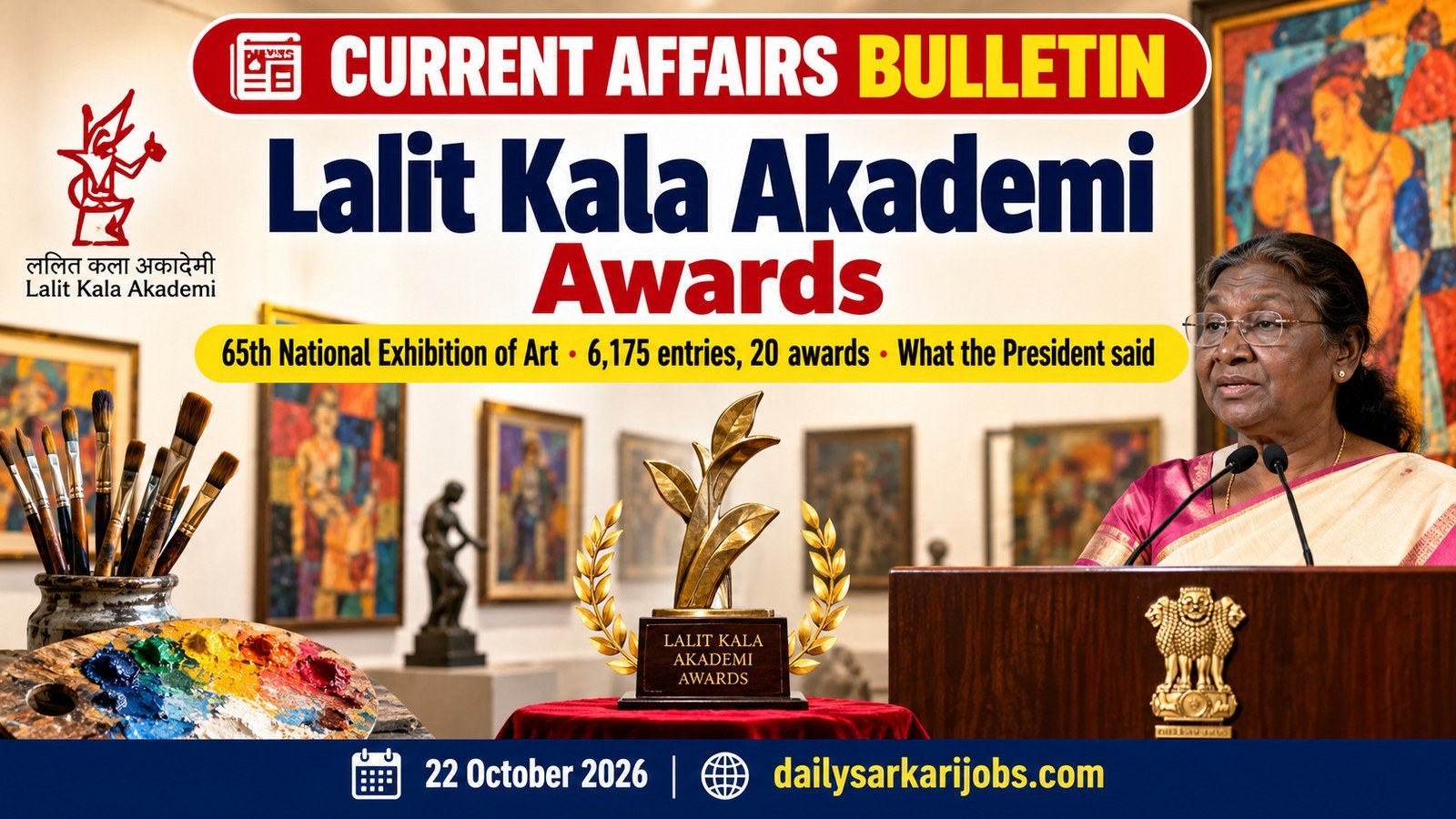
On 21 October 2026 the President of India presented the Lalit Kala Akademi Awards to the winning artists of the 65th National Exhibition of Art in New Delhi, and also felicitated the Grand Prize winners of the 3rd Print Biennale India. Twenty artists were honoured. The number worth looking at is not twenty.
This is a Current Affairs explainer written in plain language for SSC, RRB NTPC, banking exams, State PSC and UPSC Prelims.
⚡ QUICK FACTS
What happened
The President presented the Lalit Kala Akademi Awards
When
21 October 2026, New Delhi
Which exhibition
The 65th National Exhibition of Art
Works submitted
6,175
Artists who entered
2,495, from 27 States and Union Territories
Works actually displayed
270, chosen by a first-tier jury
Awards given
20, chosen by a second-tier jury
Also felicitated
Winners of the 3rd Print Biennale India, 2026
The Hinge: Do the Arithmetic Before You Read the Prize List
A prize list tells you who won. The entry figures tell you what winning means. Set the four numbers in a row and the exhibition stops being a ceremony and becomes a measurement.
Stage
Number
What it means
Works submitted
6,175
By 2,495 artists from 27 States and Union Territories
Works displayed
270
Selected by the first-tier jury — about 1 in 23 got on the wall
Works awarded
20
Selected by the second-tier jury — about 1 in 309 of everything sent in
That is the useful sentence: roughly one work in every three hundred submitted won an award, and roughly one in twenty-three was even shown.The capsule on the National Testing Agency made the same move — count the people before you read the policy. Here, counting the entries before reading the prize list is what turns a photo-opportunity into a fact.
The Number Nobody Mentioned: Twenty-Seven
Entries came from 27 States and Union Territories. India has 36. So nine sent nothing, or nothing that was recorded — and no release says which, or why. This is not a scandal and it is not an accusation; it is simply a gap in the published record, and noticing gaps is a habit worth having.
A national exhibition is only as national as its entry list. The President said at the ceremony that traditional artists in remote areas should be trained in new technologies and contemporary techniques so that they can reach wider platforms. Read that beside the figure 27, and the two fit together rather neatly.
What the President Actually Said, and Why It Is Unusual
Art is more than paintings and sculptures — it carries a society’s memory, its present and its hopes.
Artists need financial support, wider markets and contact with collectors, and she welcomed the efforts of the Akademi and the Ministry of Culture to encourage the sale of art.
Art should not stay inside galleries; it should reach schools, universities and public spaces.
Young and emerging artists should be given room to try new mediums.
Notice the second one, because a Head of State does not usually say it at a prize ceremony. The point being made is that recognition is not income. An award names an artist; it does not create a buyer. The capsule on awards and honours lists what India’s major prizes carry — and almost every one of them is a citation, a shawl, a plaque and a modest sum.
The National Exhibition of Art, in Context
It began in 1955, the year after the Lalit Kala Akademi itself was founded, and is held every year.
In 1955 there were ten awards of ₹1,000 each.
A Gold Plaque for the best exhibit was added from 1956.
A section for invited artists was added in 1986, the same year the prize money went to ₹10,000.
Prize money was ₹25,000 in 2001 and ₹40,000 in 2002; by the 46th exhibition it was ₹50,000 with a citation and a memento.
Digital photography was accepted in the graphic art category from 2006.
There is a small lesson hiding in that list. A prize that was worth ₹1,000 in 1955 is a very different thing from a prize worth ₹1,000 today, and the Akademi’s own record shows it climbing in steps over seventy years. Whenever a historical prize amount is quoted at you, ask what year it belongs to.
Why a Reader Should Care
Because art questions in exams are almost always institution questions. Papers rarely ask you to judge a painting; they ask which body gives which award, when it was set up and which ministry it sits under. Today’s Static GK capsule covers all three National Akademis — Sangeet Natak, Lalit Kala and Sahitya — and the one building they share. The capsule on classical dances and festivals is the other half of the same syllabus.
The honest caution, and it is a real one.No release states what the 2026 award carries — no cash figure, no description of the plaque or citation, and no list of the award categories in official form. The space economy explainer made the same point by printing the blank rows of its table: a gap in an official announcement is itself information, and it is more honest to show it than to fill it from a coaching note.
Practice Questions
Q1. The Lalit Kala Akademi Awards of October 2026 were presented by (a) The Prime Minister (b) The President of India (c) The Vice-President (d) The Union Minister of Culture Answer: (b) The President of India The same ceremony also felicitated the Grand Prize winners of the 3rd Print Biennale India.
Q2. How many artists received Lalit Kala Akademi Awards at the 65th National Exhibition of Art? (a) Ten (b) Fifteen (c) Twenty (d) Twenty-seven Answer: (c) Twenty One of the other options is the number of States and Union Territories the entries came from, which is a common place to slip.
Q3. The National Exhibition of Art is organised by (a) The Sahitya Akademi (b) The Sangeet Natak Akademi (c) The Indian Council for Cultural Relations (d) The Lalit Kala Akademi Answer: (d) The Lalit Kala Akademi Each wrong option is a real cultural body, so the question is really asking whether the three Akademis have been told apart.
Q4. The National Exhibition of Art was first held in (a) 1947 (b) 1952 (c) 1955 (d) 1962 Answer: (c) 1955 It started the year after the organising body itself was founded, and it has been an annual event since.
Q5. At the 65th National Exhibition of Art, how many works were selected for display? (a) 270 (b) 20 (c) 6,175 (d) 2,495 Answer: (a) 270 The other three figures are the awards, the total submissions and the number of participating artists, so the question tests whether the funnel has been read in order.