
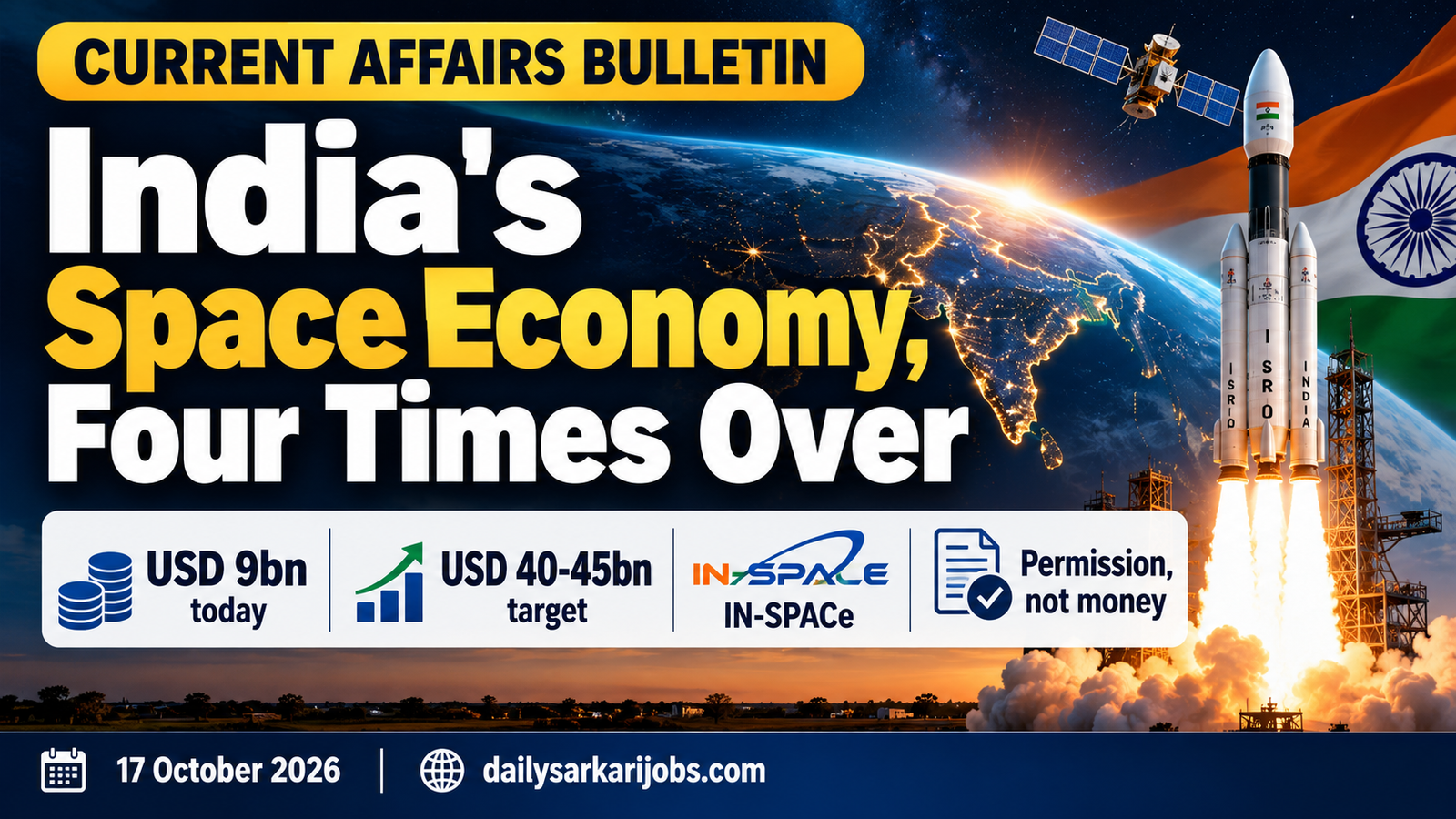
On 17 October 2026 the Union Minister of State for Science and Technology said India’s space economy, worth about USD 9 billion today, should reach USD 40 to 45 billion in the next seven to eight years. He was speaking at a media roundtable in New Delhi titled Space, Sovereignty and New Economy.
That is roughly a fourfold to fivefold rise, and the number is not the interesting part. The interesting part is what the Minister said had caused it: not a budget, not a mission, but a change in who is allowed to do things.
The Hinge: the Constraint Was Never Capability, It Was Permission
India has been building and launching rockets since the 1960s. What it did not have was anybody who could say yes to a private company.
Before the reforms the Minister referred to, a private Indian firm could manufacture parts for a space agency, because that is ordinary contracting. What it could not readily do was own a satellite, operate one, or sell the service on its own account, because there was no body whose job it was to authorise that. The gap was not technical and it was not financial. It was administrative.
That is why a promotion-and-authorisation centre was the reform, and the word “authorisation” in its name is the whole point. The export-control explainer made the same observation from the opposite direction: in a regulated field the serious gate is not price or product, it is permission to be in the room. Space is the version of that sentence where the room had no door at all.
Do the Arithmetic Before You Repeat the Number
USD 9 billion to USD 40 to 45 billion is between four and five times over, in seven to eight years. Set it beside the thing it is a share of and the claim comes into focus.
| Figure | What the release gives |
|---|---|
| Space economy now | About USD 9 billion |
| Target | USD 40 to 45 billion |
| Period | Seven to eight years from October 2026 — no calendar year is stated |
| Growth implied | Four to five times over, which is far faster than the economy as a whole is expected to grow |
| Start-up count | Not given |
| Private investment so far | Not given |
| India’s share of the global space market | Not given |
Three of those rows are blank, and a reader should notice that. This site has made the point before about progress claims: a target stated as a multiple, with no base year printed and no component figures, is an ambition rather than a measurement. It may well be right. It is simply not yet evidence.
What a Space Economy Is Made Of
The phrase sounds like rockets. Most of it is not. A space economy has an upstream and a downstream, and the downstream is where the money usually is.
| Part | What it means | Examples |
|---|---|---|
| Upstream | Building and launching the hardware | Satellites, launch vehicles, ground stations, components |
| Downstream | Selling what the hardware makes possible | Imagery, navigation, communications, weather and crop data |
| Enabling | The services around both | Insurance, finance, analytics, regulatory and legal work |
The Minister’s own list of uses makes the point: project clearances, monitoring of implementation timelines, geotagging of development works, agriculture, disaster management and defence — and space-based disaster management support provided to Myanmar, Bangladesh and Sri Lanka. Almost none of that is a rocket. It is data, sold or given to somebody who needed it.
Which is the same shape as the brain atlas story: a shared reference is only valuable if everybody uses it. A satellite over a district is worth nothing until a revenue officer, an insurer and a farmer are all reading the same image.
The Words That Will Be Asked
| Term | In plain words |
|---|---|
| IN-SPACe | Indian National Space Promotion and Authorisation Centre — the single window that promotes and authorises private space activity |
| Upstream | Making and launching space hardware |
| Downstream | Selling the services that space hardware makes possible |
| Anchor customer | A buyer, usually the Government, who commits to purchase early so that a new product has a market before it exists |
| Proof of concept | A small working demonstration built to show that an idea can be made to work at all |
| Space economy | Everything earned from making, launching and using space systems, not only the launches |
Why a Reader Should Care
The honest version of this story is a question, not a number. The Minister put it plainly himself: India must move from demonstrating technological capability to building globally competitive commercial companies. Those are different achievements and the second is much harder.
The semiconductor mission faces the identical problem and is further along in admitting it. A country can be excellent at the engineering and still have no company anybody abroad wants to buy from, because commercial success needs delivery dates, warranties, spare parts and someone to answer the telephone. Capability is a laboratory question. Competitiveness is an organisational one.
And the measure to watch is not the headline figure but the ordinary ones underneath it: how long an installation or export licence takes, and whether a first-time customer is the Government or somebody else. India’s overall growth will not be moved by a sector of this size for many years; what the sector can move, much sooner, is the cost of knowing what is happening on the ground.
Practice Questions
Q1. At the October 2026 roundtable, India’s space economy was described as worth about
(a) USD 9 billion (b) USD 40 billion (c) USD 45 billion (d) USD 2 billion
Answer: (a) USD 9 billion The target named for seven to eight years out is four to five times larger, and two of the wrong options are that target rather than the present size.
Q2. IN-SPACe stands for
(a) Indian Space Commerce Centre (b) Indian National Space Promotion and Authorisation Centre (c) International Space Partnership Centre (d) Indian Satellite Procurement and Allocation Centre
Answer: (b) Indian National Space Promotion and Authorisation Centre Both halves of the name matter: it promotes private activity and it authorises it, and the second function is what did not exist before.
Q3. In a space economy, downstream activity means
(a) Manufacturing launch vehicles (b) Building satellites (c) Selling the services that space systems make possible (d) Training astronauts
Answer: (c) Selling the services that space systems make possible Imagery, navigation, communications and weather data are the usual examples, and this is the part where most of the revenue sits.
Q4. An anchor customer is
(a) The largest shareholder in a company (b) A buyer who commits to purchase early so a new product has a market (c) A foreign buyer of defence equipment (d) The regulator of a new sector
Answer: (b) A buyer who commits to purchase early so a new product has a market The idea is that somebody guarantees demand before the product exists, which is often the only way a first-of-its-kind supplier can raise money at all.
Q5. The reform credited with the growth in India’s private space activity is
(a) A new tax exemption for satellite exports (b) The creation of a sovereign space fund (c) The opening of the sector to private participation in 2019-20 (d) The merger of the space and defence ministries
Answer: (c) The opening of the sector to private participation in 2019-20 What changed was who was permitted to own and operate space assets, rather than how much money was available for them.