
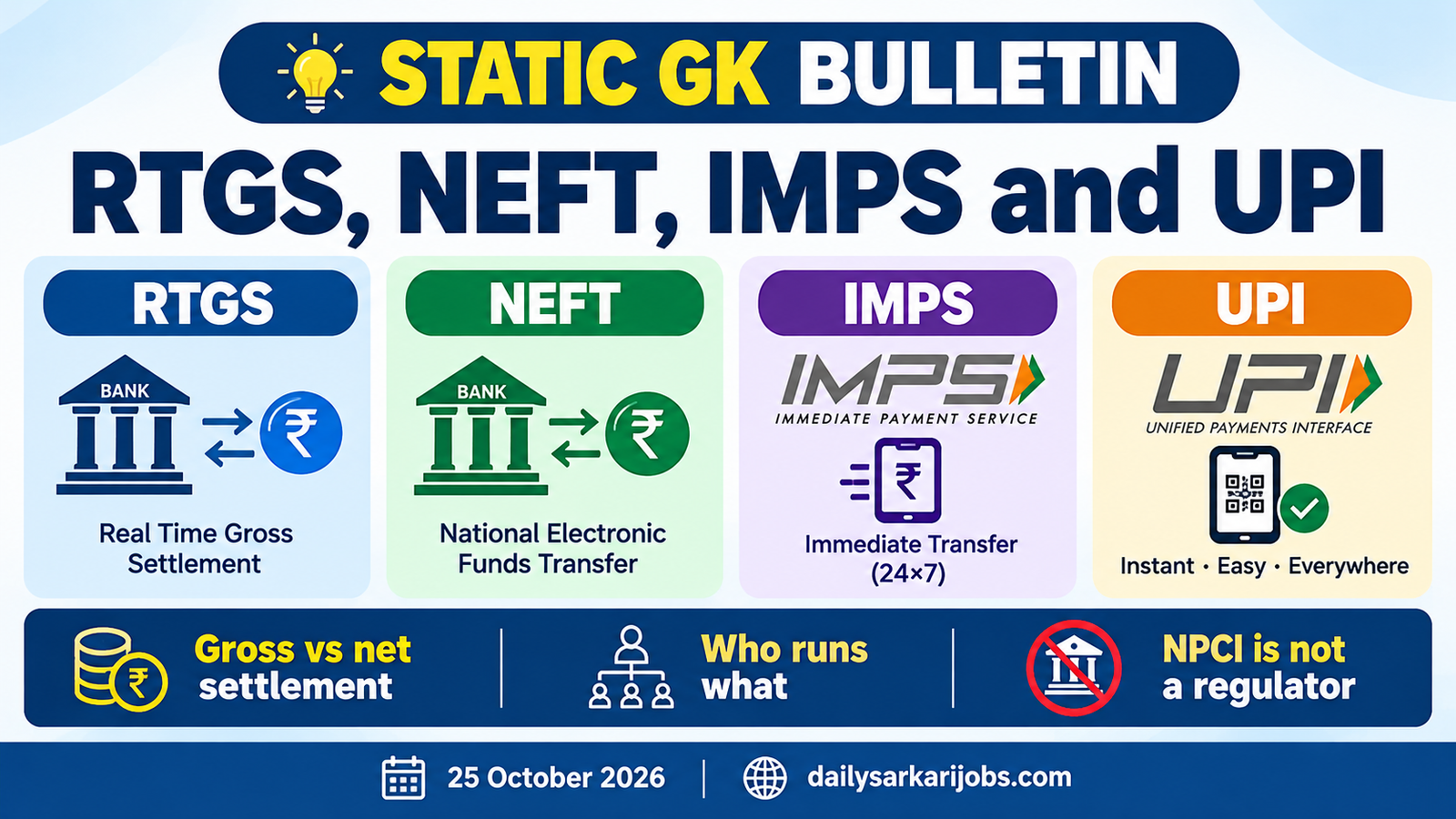
Today’s Current Affairs explainer covered the RBI’s new data centre, built to keep India’s payment and settlement systems running. This capsule is what those systems actually are.
Explained in plain language for SSC, RRB NTPC, banking exams, State PSC and UPSC Prelims.
The Hinge: Gross or Net Decides Everything Else
There are only two ways to settle a payment, and once you know which one a system uses, every other feature of it becomes predictable.
| Settlement | How it works | What follows from it |
|---|---|---|
| Gross | Each transaction is settled one at a time, immediately and finally | Instant and irrevocable, but expensive per transaction — so a minimum amount is imposed |
| Net | Transactions are collected in batches and only the net position between banks is settled | Cheap and efficient, but the money moves in batches, so there is a short wait |
Now apply it. RTGS is Real Time Gross Settlement — its name is the definition — so it settles each payment singly and therefore carries a minimum of ₹2 lakh. NEFT is National Electronic Funds Transfer, which settles on a net basis in half-hourly batches, and therefore has no minimum at all.
That is the entire comparison table that students memorise, derived from one idea. Whenever a system has a minimum amount, ask what it costs to process one transaction — the floor is almost always there to keep small payments out of an expensive pipe.
The Four Systems a Reader Must Be Able to Tell Apart
| System | Run by | Settlement | Limits |
|---|---|---|---|
| RTGS | RBI | Gross, real time | Minimum ₹2 lakh, no maximum |
| NEFT | RBI | Net, half-hourly batches | No minimum or maximum |
| IMPS | NPCI | Immediate, round the clock | Designed for retail amounts |
| UPI | NPCI | Immediate, built on IMPS rails | Retail; works from a phone |
The first column is the one that is really being tested. RTGS and NEFT are the Reserve Bank’s own systems. IMPS and UPI are not — they belong to the National Payments Corporation of India.
NPCI Is Not a Regulator, and That Is the Favourite Trap
The National Payments Corporation of India is a company, not an authority. It is a not-for-profit company incorporated under Section 25 of the Companies Act, 1956, which is now Section 8 of the Companies Act, 2013. It was promoted by the Reserve Bank of India and the Indian Banks’ Association, with ten core promoter banks.
It operates. It does not regulate. Its products include UPI, IMPS, RuPay, NACH, AePS, the Bharat Bill Payment System, NETC FASTag and the National Financial Switch. The mutual funds capsule made exactly this distinction about AMFI, which is an industry body and not a regulator — the same question, in a different market, and it is asked in both.
⚠️ The Board Has Changed Its Name, and Most Notes Have Not Caught Up
Nearly every set of notes in circulation says the RBI exercises its payment-system powers through the Board for Regulation and Supervision of Payment and Settlement Systems, the BPSS. The Reserve Bank’s own current answer names the Payments Regulatory Board, whose constitution is dealt with by the Payments Regulatory Board Regulations, 2025, in force from 20 May 2025.
This is the standing rule of this site appearing again: a body everybody cites by its old name may have been replaced. The safe answer in an exam is the one the regulator’s own page gives today, and the safe habit is to check it before quoting any acronym learnt from a coaching note.
What the Act Says, and the Boundary It Draws
- The Payment and Settlement Systems Act, 2007 received assent on 20 December 2007 and came into force on 12 August 2008.
- It designates the Reserve Bank of India as the authority to regulate and supervise payment systems.
- Section 2(1)(i) defines a payment system as one that enables payment to be effected between a payer and a beneficiary, involving clearing, payment or settlement or all of them.
- Stock exchanges and the clearing corporations set up under them are expressly excluded from that definition.
That last exclusion is the most teachable line in the whole Act. It is not an oversight; it is a boundary. Those bodies belong to SEBI, and the Act is saying in its own definition clause where one regulator stops and another begins. When a statute excludes something by name, look for the regulator that already has it.
What the Words Mean
| Term | In plain words |
|---|---|
| Settlement | The moment the money actually and finally changes hands between banks |
| Gross settlement | Each payment settled on its own |
| Net settlement | Many payments added up and only the difference settled |
| Clearing | Sorting and matching payment instructions before settlement |
| Mission-critical | A system the organisation cannot operate without |
| Not-for-profit company | A company that may not distribute profits to its members |
Why a Reader Should Care
Because this is among the highest-frequency topics in banking recruitment, and it is mostly conceptual rather than memorised. Gross against net, who runs what, the Act and its year, the RTGS floor and the NEFT absence of one — all of it follows from two ideas. The banking awareness capsule covers the rates and the regulators; this one covers the plumbing.
And because the plumbing is where the country has changed fastest. The explainer on UPI charges showed that a free payment is never costless, only paid for by somebody else. A reader who understands settlement understands why it costs anything at all — because somewhere, a system has to move the real money between two banks, and keep doing it at four in the morning.
Practice Questions
Q1. RTGS stands for
(a) Rapid Transfer and Gross Settlement (b) Real Time Gross Settlement (c) Regulated Transfer of Government Securities (d) Retail Transaction Gateway System
Answer: (b) Real Time Gross Settlement The name is the definition: each payment is settled singly and immediately rather than being batched with others.
Q2. The minimum amount for an RTGS transaction is
(a) ₹1 lakh (b) ₹2 lakh (c) ₹5 lakh (d) There is no minimum
Answer: (b) ₹2 lakh A floor exists because settling each payment individually is expensive, and the last option is true of NEFT instead.
Q3. Which of these is operated by NPCI rather than by the RBI?
(a) RTGS (b) NEFT (c) UPI (d) The Payments Regulatory Board
Answer: (c) UPI The first two are the Reserve Bank’s own systems, which is the distinction this question is really testing.
Q4. The Payment and Settlement Systems Act came into force in
(a) 2005 (b) 2007 (c) 2008 (d) 2013
Answer: (c) 2008 It received assent in December of the year that appears in its own name, which is why the two dates are so easily confused.
Q5. NPCI is
(a) A statutory regulator (b) A department of the RBI (c) A not-for-profit company promoted by the RBI and the IBA (d) A public sector undertaking
Answer: (c) A not-for-profit company promoted by the RBI and the IBA It operates payment systems but regulates nobody, in the same way that AMFI is an industry body rather than an authority.