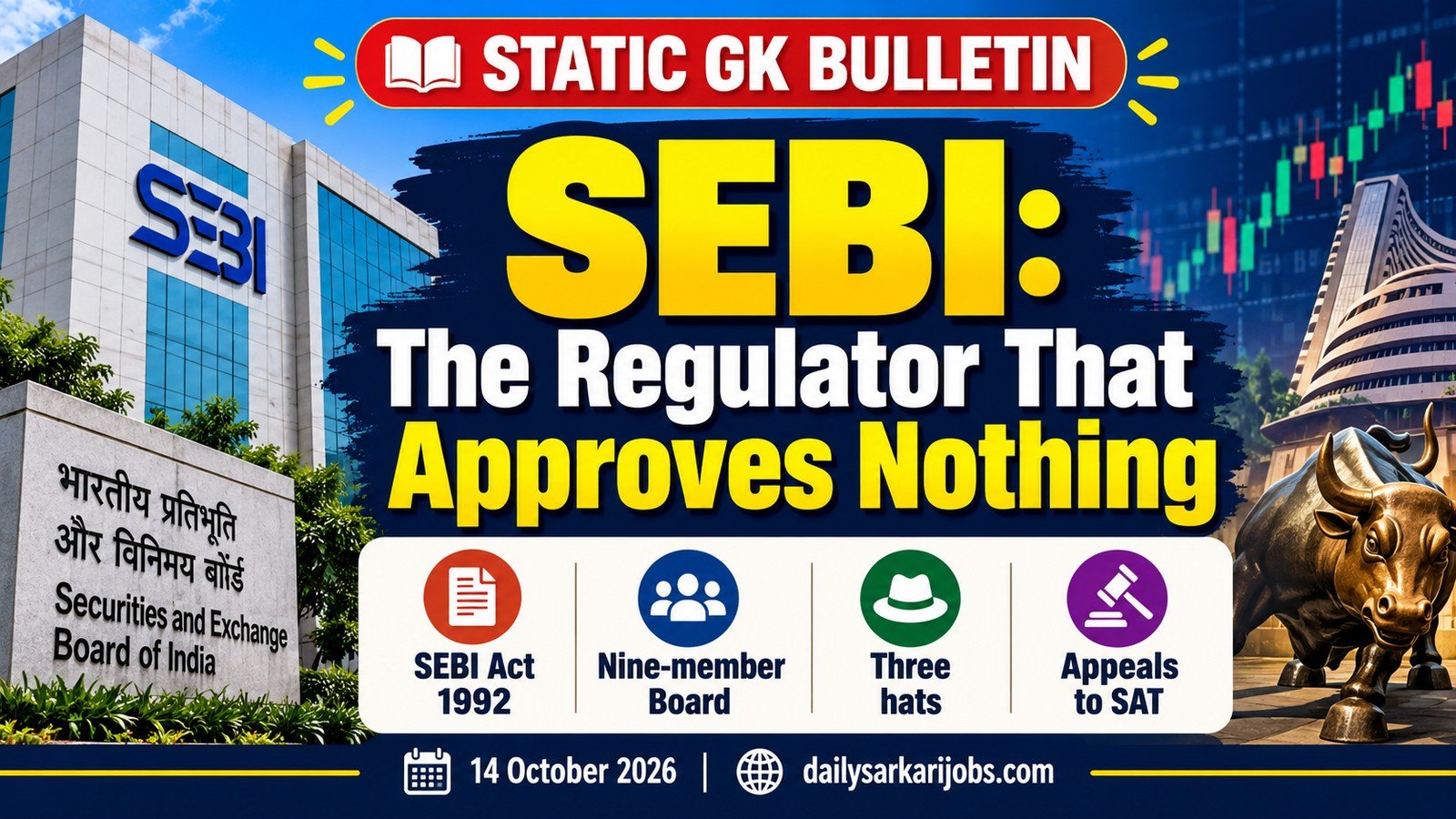
Every offer document for a public issue in India carries a disclaimer, printed in bold capitals, saying that SEBI has not cleared or approved the issue and takes no responsibility for the financial soundness of the project. People read that line and assume it is lawyers covering themselves. It is not. It is the most accurate single sentence ever written about what SEBI does.
This is the first capsule in our new series on markets and institutions, explained in plain language for SSC, RRB NTPC, banking exams, State PSC and UPSC Prelims.
⚡ QUICK FACTS
Set up as a non-statutory body
12 April 1988, by a Government resolution
Given statutory powers
The SEBI Act, 1992, in force from 30 January 1992
Headquarters
Mumbai
The three jobs in its preamble
Protect investors, develop the market, regulate it
Board strength
Nine — Chairman, 2 from the Centre, 1 from the RBI, 5 appointed
Appeals against SEBI go to
The Securities Appellate Tribunal, then the Supreme Court
The regime
Disclosure-based, not merit-based
The Hinge: Disclosure, Not Merit
There are two ways a regulator can protect people who buy shares.
A merit-based regime
A disclosure-based regime
What the regulator asks
Is this a good investment?
Has everything a buyer needs to know been told?
What approval means
The regulator vouches for the company
The regulator vouches for nothing
Who bears the risk
Partly the regulator
Entirely the investor
India
—
This one
SEBI’s own guidance spells it out. A prospectus must state that submission of the offer document to SEBI should not be construed to mean that it has been cleared or approved, and that SEBI does not take responsibility for the financial soundness of the scheme or for the correctness of the statements made in it. Elsewhere the securities themselves are described as not recommended or approved by SEBI.
So the question SEBI actually asks of a company raising money from the public is not “is this worth buying?” but “have you told them everything?” A company with terrible finances may list, provided it has disclosed that its finances are terrible. Hiding it is the offence; having it is not.
That explains the headline every few years asking why SEBI “allowed” a bad IPO. It allowed it because allowing is not endorsing, and a regulator that endorsed investments would be making the investment decision for a crore of people it has never met. The design hands the judgement to the buyer and the honesty obligation to the seller — and almost every SEBI rule you will ever read is an attempt to enforce the second half of that bargain.
Where SEBI Came From
Date
What happened
12 April 1988
SEBI set up by a Government resolution — an advisory body with no legal powers
30 January 1992
The SEBI Act, 1992 comes into force and makes it a statutory regulator
Before that
The securities market was administered under the Securities Contracts (Regulation) Act, 1956
The four-year gap between 1988 and 1992 is worth one line of memory, because it is the difference between a body that can advise and a body that can act. A statutory regulator draws its powers from an Act of Parliament and can make binding rules; a body created by a Government resolution can only recommend. The same distinction separates a constitutional body from a statutory one, and examiners use it constantly.
The Board, and the Three Hats
Section 4 of the SEBI Act fixes the Board at nine:
One Chairman, appointed by the Central Government
Two members from officials of the Ministry of Finance and the ministry dealing with company law, nominated by the Central Government
One member nominated by the Reserve Bank of India
Five members appointed by the Central Government, of whom at least three must be whole-time
The Reserve Bank seat is the detail to notice. Banks and markets are regulated separately in India, but money moves between them constantly, so the two regulators are wired together by statute rather than by goodwill — and India runs a separate regulator for each kind of financial promise. The banking regulator and the market regulator are not meant to discover each other’s decisions in the newspaper.
SEBI wears three hats at once, which is unusual and is the reason an appeal route had to be built.
Hat
What it means
Where in the Act
Quasi-legislative
It writes binding regulations
Rule-making powers
Quasi-executive
It investigates, inspects, searches and enforces
Section 11 — functions, including inspections and inquiries
Quasi-judicial
It passes orders and penalties
Section 11B — power to issue directions, including disgorgement
A body that writes the rule, investigates the breach and judges the case is a constitutional oddity, which is exactly why section 15T gives anyone aggrieved by a SEBI order the right to appeal to the Securities Appellate Tribunal, ordinarily within 45 days. From the Tribunal the appeal goes to the Supreme Court. Whenever one body holds all three powers, look for the external appeal — it is where the check was put.
Disgorgement is worth knowing by name. It is not a fine. It is an order to give up what was wrongly gained, or the loss wrongly avoided — the law taking back the profit rather than punishing on top of it.
The Market SEBI Regulates
Primary market
Secondary market
What happens
New securities are issued and money reaches the company
Existing securities change hands between investors
Typical event
An IPO — Initial Public Offering
Everyday trading on a stock exchange
Who gets the money
The company
The selling investor
The second row of that table catches people out. When you buy a share on an exchange, the company whose name is on it receives nothing — the money goes to whoever sold it to you. A company raises money once, at issue; everything after that is investors trading among themselves.
The Institutions Around It
Institution
What it is
BSE
The oldest stock exchange in Asia, founded in 1875; its index is the Sensex, of 30 companies
NSE
Established in 1992 and built on screen-based trading from the start; its index is the Nifty 50
NSDL and CDSL
The two depositories, which hold shares in electronic form under the Depositories Act, 1996
Depository Participant
The agent — usually a bank or broker — through whom you open a demat account
SAT
The Securities Appellate Tribunal, which hears appeals against SEBI
Dematerialisation is the reform that did more for ordinary investors than any rule. A share used to be a piece of paper that could be forged, stolen, lost in the post or signed over by somebody who was not the owner. Holding shares as an electronic entry abolished an entire category of fraud by abolishing the object the fraud depended on — which is a better way to stop a crime than detecting it.
Who Is in the Market
Kind of investor
Who they are
Retail
Individuals, with a ceiling on application size in a public issue
Qualified Institutional Buyer (QIB)
Banks, insurers, mutual funds, pension funds — institutions presumed able to assess risk
Foreign Portfolio Investor (FPI)
Registered foreign investors buying shares and bonds
Anchor investor
An institution that commits before an issue opens, with a lock-in
The categories exist because disclosure means different things to different readers. A pension fund with a research team and a first-time buyer with a phone receive the same prospectus and are not equally equipped to read it, so the rules give the retail investor extra protection and the institution extra freedom. Foreign portfolio money, as the external-sector capsule showed, can also leave in a day, which is why its movements are watched so closely.
Why a Reader Should Care
The securities market is the only place where a stranger may lawfully ask the public for its savings. A bank taking your deposit is licensed, supervised and insured; a company selling you shares is none of those things. All that stands between a saver and a plausible story is the obligation to tell the truth in writing.
So SEBI’s real product is not safety. It is information, and the credibility of information. That is why its penalties fall hardest on concealment — insider trading, misleading disclosure, failure to report — rather than on losing money. The Monetary Policy Committee protects the value of your rupee and the tax system decides who gets it; SEBI protects only your right to know what you are buying, and then stands back.
Practice Questions
Q1. SEBI was given statutory status by (a) A Government resolution of 1988 (b) The SEBI Act, 1992 (c) The Securities Contracts (Regulation) Act, 1956 (d) The Depositories Act, 1996 Answer: (b) The SEBI Act, 1992 The first option created the body in April 1988 as an advisory one with no legal powers, and the four-year gap between the two is the difference between advising and acting.
Q2. Appeals against an order of SEBI lie to (a) The High Court (b) The National Company Law Tribunal (c) The Securities Appellate Tribunal (d) The Reserve Bank of India Answer: (c) The Securities Appellate Tribunal The appeal must ordinarily be filed within 45 days, and from there the matter can go to the Supreme Court; the route exists because the regulator holds rule-making, investigative and judicial powers together.
Q3. Under the SEBI Act, how many members does the Board have, including the Chairman? (a) Seven (b) Nine (c) Eleven (d) Twelve Answer: (b) Nine The count is one Chairman, two nominated by the Central Government, one nominated by the Reserve Bank and five appointed, of whom at least three must be whole-time.
Q4. India’s securities market follows (a) A merit-based regime, in which SEBI approves the quality of an issue (b) A disclosure-based regime, in which SEBI requires full disclosure but does not approve the issue (c) A regime in which SEBI guarantees the listing price (d) A regime in which only profitable companies may list Answer: (b) A disclosure-based regime, in which SEBI requires full disclosure but does not approve the issue Every offer document must carry a disclaimer in bold capitals saying the regulator takes no responsibility for the financial soundness of the project.
Q5. In which market does the company whose shares are traded actually receive the money? (a) The secondary market (b) The primary market (c) Both markets (d) Neither market Answer: (b) The primary market Once a security has been issued, later trades move money between investors only, which is why a rising share price does not by itself put a rupee into the company.