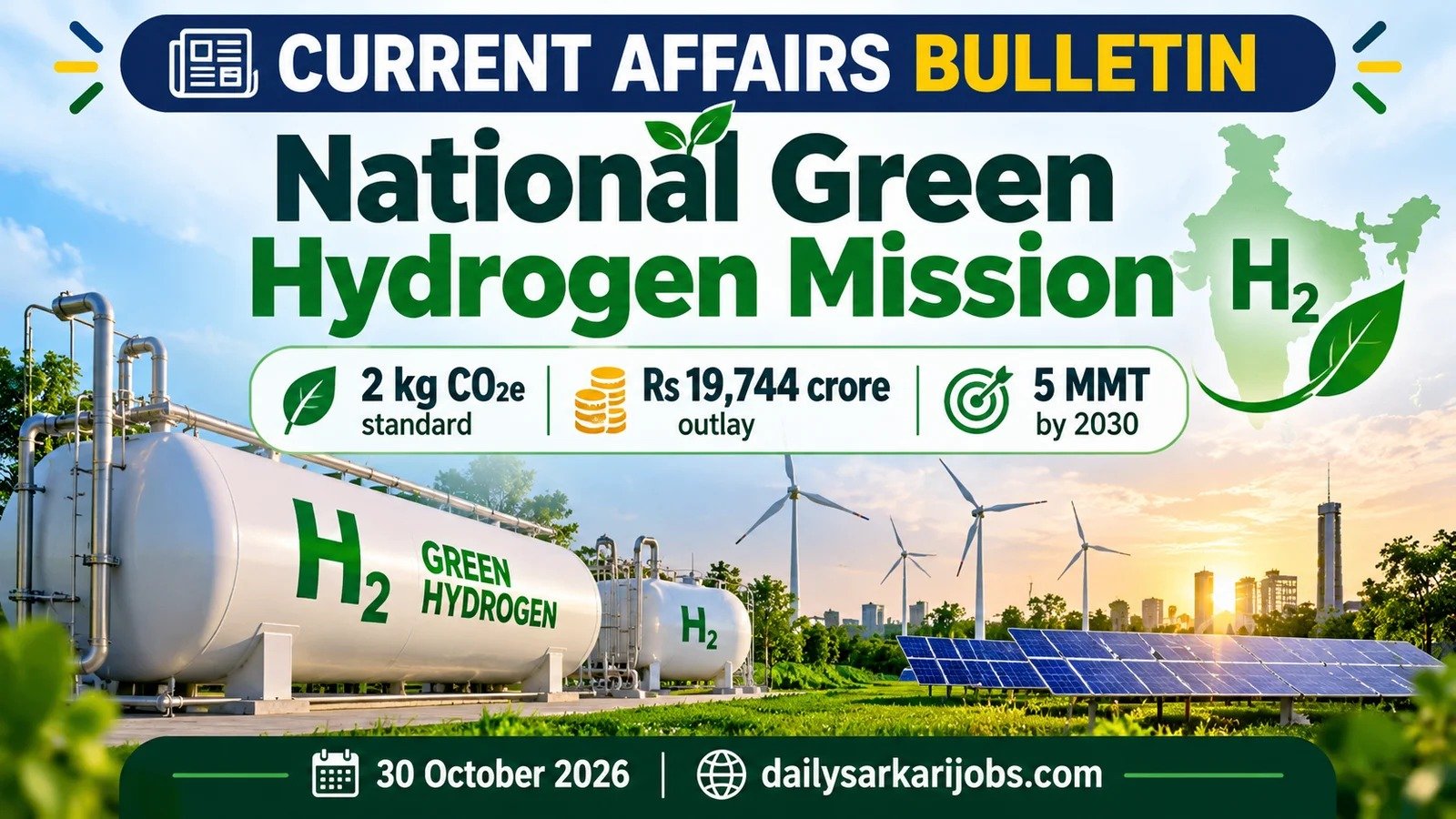
India is now a global leader in green hydrogen, the Ministry of New and Renewable Energy said on 29 October 2026, as the Emerging Science, Technology and Innovation Conclave (ESTIC-2026) closed in New Delhi.
Green hydrogen turns up constantly in current affairs and almost never gets explained properly. The topic has one genuinely clever idea inside it, and once you have that idea the scheme names, the numbers and the colour words all fall into place.
⚡ QUICK FACTS
Mission launched
January 2023
Mission outlay
₹19,744 crore, to 2029-30
2030 production target
5 million metric tonnes (MMT) a year
Green Hydrogen Standard
Notified August 2023
The green limit
Not more than 2 kg CO₂ equivalent per kg of hydrogen
Nodal ministry
New and Renewable Energy (MNRE)
The Hinge: India Defined ‘Green’ as a Number, Not a Technology
Start with the obvious question. Hydrogen is a colourless gas. So what do green, grey and blue actually mean?
They describe how the hydrogen was made, not what it is:
Colour
How it is made
Carbon result
Grey
From natural gas or coal, the ordinary industrial way
Carbon dioxide released into the air
Blue
The same fossil route, but the carbon dioxide is captured and stored
Much less released
Green
Water split into hydrogen and oxygen using renewable electricity — electrolysis
Essentially none from the process
Now the clever part. When India notified its Green Hydrogen Standard in August 2023, it did not define green by the method. It defined it by a number. Hydrogen counts as green if the emissions are not more than 2 kg of carbon dioxide equivalent per kilogram of hydrogen, measured well-to-gate and averaged over twelve months.
That single design choice does a lot of work. It means the rule is technology-neutral: electrolysis powered by solar or wind obviously qualifies, and so does hydrogen made by converting biomass such as agricultural waste, as long as it stays under the same line. Define the outcome you want and let anyone reach it however they can — rather than naming one approved machine and freezing the technology in place.
Jargon, defined once.Well-to-gate means the count starts at the energy source and stops at the factory gate, so the emissions of making the electricity are included, not just the emissions inside the plant. CO₂ equivalent is a common unit that converts every greenhouse gas into the amount of carbon dioxide that would warm the planet as much.
And the standard explains why a certification system had to follow. If green is a number, somebody has to measure it. The Green Hydrogen Certification Scheme of India was launched in April 2025, with the Bureau of Energy Efficiency as the nodal authority that accredits the agencies doing the checking, and its compliance portal went live in June 2026.
The National Green Hydrogen Mission in One Place
Approved by the Cabinet in January 2023 with an outlay of ₹19,744 crore up to 2029-30. The money splits like this:
Component
Outlay
SIGHT — Strategic Interventions for Green Hydrogen Transition
₹17,490 crore
Pilot projects
₹1,466 crore
Research and development
₹400 crore
Other Mission components
₹388 crore
SIGHT is almost the whole Mission — about 89% of it — and it pays incentives for two things: producing green hydrogen, and manufacturing the electrolysers that split the water. Note what the Government chose to subsidise: not the fuel’s users, but its makers and their machines.
The 2030 Targets, Which Are Asked as a Set
5 MMT — five million metric tonnes — of green hydrogen production capacity a year.
About 125 GW of new renewable capacity dedicated to making it.
More than ₹8 lakh crore of investment.
More than 6 lakh jobs.
Nearly 50 MMT of greenhouse gas emissions avoided each year.
More than ₹1 lakh crore cut from the fossil fuel import bill.
Memory hook for the two big tonnage figures:5 MMT of hydrogen made, about 50 MMT of emissions avoided — ten times as much. And the import-bill saving is the line that connects this to the economy section, which our capsule on the external sector and the balance of payments sets out.
Where It Has Actually Reached
Targets are promises. These are the figures on the ground, and the gap between them is itself worth noticing:
Measure
Figure
Green hydrogen production capacity awarded incentives
8,62,000 tonnes a year (about 0.86 MMT)
Capacity actually commissioned, as of February 2026
About 8,000 tonnes a year
Electrolyser manufacturing capacity awarded
3,000 MW a year, to 15 companies
Read those first two rows together. Awarded capacity is roughly a hundred times what has been commissioned so far. That is not a scandal — industrial plants take years to build — but it is the honest picture, and an exam question asking what has been “achieved” is testing whether you know the difference between sanctioned and running.
Four More Facts Worth Carrying
Three ports were recognised as Green Hydrogen Hubs in October 2025: Deendayal Port (Gujarat), V. O. Chidambaranar Port (Tamil Nadu) and Paradip Port (Odisha). All three are ports, because the plan is to export.
India’s first indigenous hydrogen train was inaugurated on 17 July 2026, on the Jind–Sonipat section.
Plants commissioned by 31 December 2030 are exempt from inter-state transmission charges for 25 years — a quiet but large subsidy, because renewable power usually has to travel a long way to reach an electrolyser.
The derivatives matter as much as the gas: green ammonia and green methanol are easier to ship, which is how hydrogen is actually exported. With export demand, the Government estimates national production could reach 10 MMT a year.
Why Hydrogen at All
A fair question, since India is already building solar and wind. The answer is that electricity cannot do everything. Some industries need very high heat or a chemical feedstock rather than a current: fertilisers, oil refining, steel, heavy road transport and shipping. These are the sectors the Mission names, and they are sometimes called hard to abate — hard to clean up.
So green hydrogen is not a competitor to solar power. It is a way of carrying solar power into places a wire cannot go. The same logic runs through the E100 flex-fuel notification, where a liquid fuel does the job an electric motor cannot yet do, and through the India-Japan Joint Crediting Mechanism, which is about who gets counted for the emissions avoided.
Why a Reader Should Care
Green hydrogen sits in the overlap of environment, energy, economy and science and technology, which is why it recurs. The reliably asked facts are the launch year, the outlay, the 2030 production target, the 2 kg standard and the SIGHT acronym. Everything else is colour.
It also belongs to a family of missions worth knowing together — the Semiconductor Mission in our capsule on SEMICON India and the Semiconductor Mission is built the same way: a named mission, a large outlay, incentives to manufacturers, and a target year.
Today’s Static GK capsule goes back rather a long way — to the Mauryan Empire and the king who wrote on rock. The two share an odd similarity: both are stories about a state deciding to publish a standard and then having to prove it was being followed.
What Is Not Settled
Two honest points. The gap between awarded and commissioned capacity is large and the Mission’s 2030 target depends on closing it, so treat 5 MMT as a target and 8,000 tonnes as the achievement, and never swap them. And the figures move: the awarded, commissioned and electrolyser numbers are dated snapshots, so quote them with their month.
Practice Questions
Q1. Under India’s Green Hydrogen Standard, hydrogen qualifies as green if emissions do not exceed (a) 2 kg CO₂ equivalent per kg of hydrogen (b) 5 kg CO₂ equivalent per kg of hydrogen (c) 1 tonne CO₂ equivalent per tonne of hydrogen (d) Zero emissions of any kind Answer: (a) 2 kg CO₂ equivalent per kg of hydrogen It is measured well-to-gate and averaged over twelve months, which is what makes the rule technology-neutral rather than method-specific.
Q2. The National Green Hydrogen Mission was approved with an outlay of (a) ₹8 lakh crore (b) ₹17,490 crore (c) ₹19,744 crore (d) ₹1 lakh crore Answer: (c) ₹19,744 crore The second option is the SIGHT component alone, which is about 89% of the total, and the first is the expected private investment by 2030.
Q3. SIGHT, the Mission’s largest component, provides incentives for (a) Buying hydrogen vehicles (b) Building hydrogen pipelines (c) Producing green hydrogen and manufacturing electrolysers (d) Importing green ammonia Answer: (c) Producing green hydrogen and manufacturing electrolysers The Government chose to subsidise the makers and their machines rather than the users of the fuel.
Q4. The National Green Hydrogen Mission targets annual production capacity by 2030 of (a) 1 MMT (b) 5 MMT (c) 10 MMT (d) 50 MMT Answer: (b) 5 MMT The third figure is what production could reach if export demand materialises, and the fourth is the greenhouse gas emissions avoided each year, so all three appear together.
Q5. Which three ports were recognised as Green Hydrogen Hubs? (a) Mumbai, Chennai and Kolkata (b) Kandla, Cochin and Visakhapatnam (c) Mundra, Haldia and Ennore (d) Deendayal, V. O. Chidambaranar and Paradip Answer: (d) Deendayal, V. O. Chidambaranar and Paradip All three are ports rather than inland sites, because the hubs are meant to serve export as well as domestic use.
30-Second Revision
Green is a number, not a method. India’s Green Hydrogen Standard (August 2023) sets a ceiling of 2 kg CO₂e per kg of hydrogen, well-to-gate, averaged over twelve months — so electrolysis and biomass routes can both qualify. Certification: GHCI, April 2025, with BEE as nodal authority.
National Green Hydrogen Mission: launched January 2023, outlay ₹19,744 crore, of which SIGHT takes ₹17,490 crore. 2030 targets: 5 MMT a year, about 125 GW of renewables, over ₹8 lakh crore invested, 6 lakh jobs, about 50 MMT of emissions avoided.
On the ground:8,62,000 tonnes a year awarded, only about 8,000 tonnes commissioned (February 2026), 3,000 MW of electrolyser capacity to 15 firms. Hubs: Deendayal, V. O. Chidambaranar, Paradip. First hydrogen train: 17 July 2026, Jind–Sonipat.
Sources
Press Information Bureau / Ministry of New and Renewable Energy, release of 29 October 2026 on India’s position in green hydrogen, issued around the close of ESTIC-2026 — the Mission’s dates and outlay, the Green Hydrogen Standard, the certification scheme and portal, the awarded and commissioned capacity figures, the hydrogen train and the transmission-charge exemption.
Press Information Bureau feature, Unlocking India’s Green Hydrogen Production Potential — the component-wise outlay, the 2030 targets, the three Green Hydrogen Hubs and the definition of green hydrogen including the biomass route.
The grey and blue hydrogen descriptions are standard energy terminology rather than press-release definitions.