
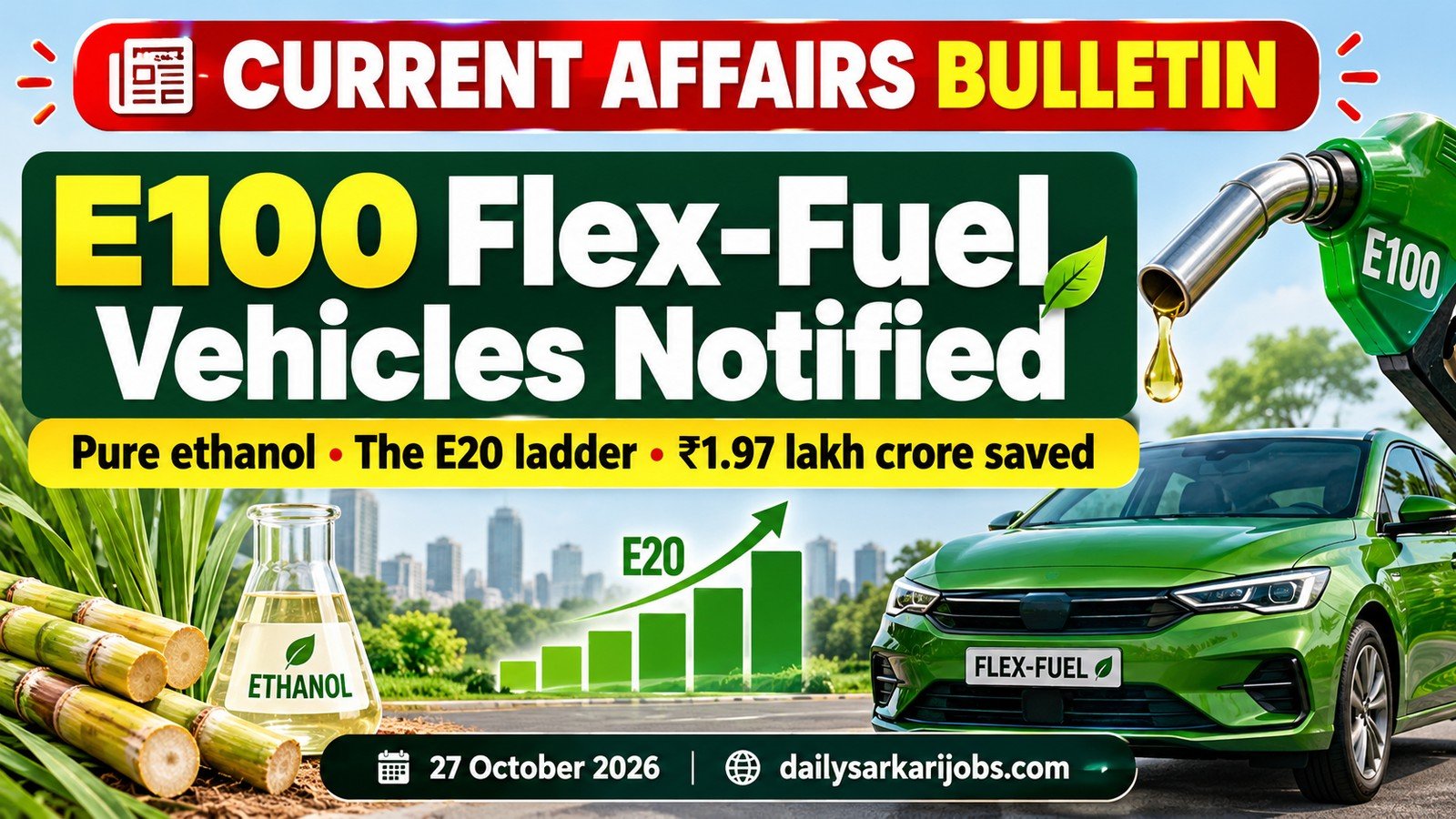
On 23 October 2026 the Ministry of Road Transport and Highways notified an amendment to the Central Motor Vehicles Rules, 1989 that adds E100 — fuel that is 100% ethanol — alongside E85 in the rules governing emission standards, fuel specifications and testing. In plain terms, India now has a legal route for vehicles that run on pure ethanol and no petrol at all.
This is a small notification with a large idea behind it, and the idea is the part worth learning. India has already hit its 20% ethanol blending target. The question this notification answers is: what comes after E20?
The Hinge: Blending Hits a Ceiling That Only the Engine Can Lift
Follow the logic and the whole topic becomes one chain rather than a pile of percentages.
Ethanol is mixed into ordinary petrol. A normal petrol engine tolerates a small share of ethanol without any change, because ethanol attacks some rubber and metal parts and carries less energy per litre than petrol. So blending can rise — 5%, 10%, 20% — only as far as the existing fleet can take it. Past that point the limit is no longer the fuel. It is the engine.
That is why the next step could not be another blending target. It had to be a different kind of vehicle: a flex-fuel vehicle, built from the start with materials and sensors that cope with any ethanol share from zero to one hundred per cent. You cannot legislate a fuel into existence without legislating the engine that burns it — and that is exactly what this notification does.
The trap follows immediately. E100 is not a fuel any car can use. A petrol car, and even a car certified for E20, cannot run on it — the fuel’s density is different and it corrodes parts not chosen for it. E100 is for manufacturer-built flex-fuel vehicles only. An option saying E100 will be available at every pump for every car is wrong.
What the Notification Actually Does
- Rule 115 of the Central Motor Vehicles Rules, 1989 now covers E100 alongside E85 in emission standards, fuel specifications and testing protocols.
- Several sub-rules that previously read E85 now read E85 or E100.
- The tables were reworked to cover E10 and E20 petrol blends and to standardise B100 biodiesel parameters.
- A documentation annexure for E100 vehicles was re-lettered, and one gross-vehicle-weight limit in the testing table rose from 3,000 kg to 3,500 kg.
- The draft had been published on 27 April 2026 with the usual thirty days for public objections before the final notification.
Jargon, defined once. A G.S.R. number — General Statutory Rules — is how a piece of subordinate legislation is numbered in the Gazette of India. Subordinate legislation means rules made by a ministry under powers that an Act of Parliament already gave it; no fresh Bill is needed. That is why a change this large can arrive as a notification rather than as a law.
The Ethanol Blended Petrol Programme, in One Table
The news only makes sense against the programme behind it. These figures are from the Government’s own FAQ on the Ethanol Blended Petrol (EBP) Programme:
| Year | What happened |
|---|---|
| 2001 | Pilot ethanol blending begins |
| 2004 | The programme is formally announced |
| 2006 | E5 — 5% blending — rolled out in several States |
| January 2013 | Policy framework notified for 5% blending in 10 States and UTs; blending stayed near 1.5% until 2014 |
| May 2018 | National Policy on Biofuels widens the feedstock base |
| June 2021 | NITI Aayog releases the ethanol roadmap |
| June 2022 | The E10 target is met — five months early |
| 2025-26 | E20 reached |
And the blending percentage year by year, which is the sequence most often asked:
| Ethanol Supply Year | Blending achieved |
|---|---|
| 2020-21 | About 8.1% |
| 2021-22 | 10.0% |
| 2022-23 | 12.1% |
| 2023-24 | 14.6% |
| 2024-25 | 19.2% |
| 2025-26 (November to June) | 20% |
What It Has Saved, and Who It Has Paid
Since Ethanol Supply Year 2014-15, the Government’s figures are:
- Over ₹1.97 lakh crore in foreign exchange saved.
- About 316 lakh metric tonnes of crude oil substituted.
- About 952 lakh metric tonnes of carbon dioxide emissions avoided.
- Over ₹1.66 lakh crore paid directly to farmers.
That last line is the one candidates under-use. Ethanol policy is farm policy wearing an energy hat. The money leaves the oil import bill and lands with sugarcane and maize growers instead, which is why the programme sits with three ministries at once — Petroleum, Road Transport, and Food and Public Distribution. Our capsule on the external sector and the balance of payments explains why an import bill of this size matters to the rupee, and the capsule on Soils and Crops of India covers the crops at the other end.
Where the Ethanol Comes From
Originally, sugarcane alone. The National Policy on Biofuels, 2018 widened the base because sugarcane could not supply enough, and maize and surplus grain were brought in. Maize-based ethanol is procured at about ₹71.86 per litre before GST, transport and storage.
National ethanol production capacity is now close to 2,000 crore litres, and oil marketing companies have floated tenders of more than 11 billion litres a year to hold the 20% mandate.
Here is the uncomfortable arithmetic, and it is worth carrying into the exam hall. Both feedstocks are rain-fed or irrigation-dependent crops, and the 2026 southwest monsoon ended at about 87% of its long period average — the weakest since 2015 — with the South Peninsula, sugarcane country, at about 76%. A policy that pushes toward more ethanol depends on a crop base that depends on the monsoon. Today’s Static GK capsule takes that machine apart: the Indian monsoon, from onset criteria to El Niño.
Why a Reader Should Care
Ethanol blending is one of the most reliably examined policy topics in General Awareness, because it sits across energy, environment, agriculture and the external sector at once. The questions take three shapes: a percentage and its year, a definition (what E20, E85, E100 or a flex-fuel vehicle is), and a policy name and its year (National Policy on Biofuels, 2018).
The useful habit is to hold the chain rather than the numbers: blending raises the ethanol share until the fleet cannot take more; flex-fuel vehicles lift that ceiling; the ethanol has to be grown; what is grown depends on rain. Each link is a different section of the syllabus, and the chain is what lets one fact fetch the next. Related reading: the India-Japan Joint Crediting Mechanism on how avoided emissions are counted, and PM-KISAN on direct payments to the same farmers.
What Is Not Yet Known
Three honest gaps. No launch dates or models have been announced for E100 vehicles; manufacturers now have a legal route, not a product. No E100 retail network exists yet, and the notification does not create one. And the price of E100 to the consumer has not been set — ethanol carries less energy per litre than petrol, so a lower price per litre does not automatically mean a lower cost per kilometre. Watch for the retail rollout before assuming any of this.
Practice Questions
Q1. The October 2026 amendment to the Central Motor Vehicles Rules, 1989 added which fuel alongside E85?
(a) E20 (b) B100 (c) E100 (d) CNG
Answer: (c) E100 It is fuel made of 100% bio-ethanol. B100 biodiesel parameters were standardised in the same amendment but were not the new addition.
Q2. E100 can be used in
(a) Any petrol vehicle (b) Vehicles certified for E20 (c) Manufacturer-built flex-fuel vehicles only (d) Diesel vehicles after a retrofit
Answer: (c) Manufacturer-built flex-fuel vehicles only Fuel density and corrosion of components are the reasons an ordinary petrol engine cannot take it, however much ethanol is available.
Q3. India’s 20% ethanol blending (E20) was reached in
(a) 2021-22 (b) 2023-24 (c) 2024-25 (d) 2025-26
Answer: (d) 2025-26 The year-by-year sequence runs 8.1%, 10.0%, 12.1%, 14.6%, 19.2% and then 20%, which is worth learning as a ladder rather than as separate numbers.
Q4. Which policy widened the feedstock base for ethanol beyond sugarcane?
(a) National Policy on Biofuels, 2018 (b) National Auto Policy, 2018 (c) Ethanol Blended Petrol Programme, 2004 (d) National Policy on Biofuels, 2009
Answer: (a) National Policy on Biofuels, 2018 Maize and surplus grain were brought in because sugarcane alone could not supply enough. A 2009 biofuels policy existed, which is what makes the fourth option tempting.
Q5. Since Ethanol Supply Year 2014-15, the foreign exchange saved through ethanol blending is stated by the Government as
(a) Over ₹50,000 crore (b) Over ₹1.97 lakh crore (c) Over ₹5 lakh crore (d) Over ₹1.66 lakh crore
Answer: (b) Over ₹1.97 lakh crore The last option is a real figure from the same source but refers to the amount paid directly to farmers, which is the classic swap in this question.
30-Second Revision
- 23 October 2026: G.S.R. 911(E) amends the Central Motor Vehicles Rules, 1989 to add E100 (100% ethanol) alongside E85 — usable only in manufacturer-built flex-fuel vehicles, never in a petrol or E20 car.
- The ladder: 8.1% (2020-21) → 10.0% → 12.1% → 14.6% → 19.2% → 20% (E20) in 2025-26. E10 was met in June 2022, five months early. National Policy on Biofuels, 2018 added maize and surplus grain to sugarcane.
- Since 2014-15: over ₹1.97 lakh crore of foreign exchange saved, about 316 lakh tonnes of crude substituted, about 952 lakh tonnes of CO₂ avoided and over ₹1.66 lakh crore paid to farmers.
Sources
- Press Information Bureau, Ethanol Blended Petrol Programme — Frequently Asked Questions (10 July 2026) — the programme timeline, the year-by-year blending figures, feedstocks, the procurement price and the savings, emissions and farmer-payment figures.
- Ministry of Road Transport and Highways, notification G.S.R. 911(E) dated 23 October 2026 amending the Central Motor Vehicles Rules, 1989. PIB carried only the headline; the rule-level detail here follows press reporting of the gazette notification and should be checked against the Gazette text.
- India Meteorological Department, as reported, for the 2026 southwest monsoon season figure of about 87% of the long period average.