Ancient history questions usually ask you to remember dynasties, dates and battles. The Mauryan Empire is the one chapter where that is the wrong instinct. Almost everything the exam asks about the Mauryas comes from a single unusual fact: one of its kings had his own words carved into rock, and those rocks are still there.
The Hinge: The First Indian King Who Speaks for Himself
For every earlier period of Indian history, we hear about rulers from somebody else — a later text, a foreign traveller, a court poet writing generations afterwards. Ashoka is the first ruler of India who addresses us directly, in his own lifetime, in his own voice. His orders were cut into rock faces and polished stone pillars across the subcontinent, and they survive.
That single fact explains the whole shape of this chapter. It is why exams ask you about edicts rather than battles, about Dhamma rather than conquests, about which pillar stands where. The Mauryas are the best-documented ancient Indian dynasty not because they were the largest, but because they left a written record that nobody could rewrite.
It is also the exact opposite of the problem in our capsule on the Indus Valley Civilisation. There the script has never been read, so we know the drains and not a single ruler’s name. Here one king wrote on stone, so we know his regrets. Writing, not greatness, decides what history remembers.
Jargon, Defined Once
- Edict — an official order issued by a ruler. Ashoka’s edicts are these orders carved into rock surfaces and stone pillars, not books written about him.
- Dhamma — the Prakrit form of the Sanskrit dharma. In Ashoka’s inscriptions it means a code of moral conduct, not the religion of Buddhism.
- Brahmi and Kharosthi — the two ancient Indian scripts used for the edicts. Brahmi runs left to right and was used nearly everywhere; Kharosthi runs right to left and appears in the north-west.
- Mahamatra — a high officer. Dhamma Mahamatras were officers appointed specifically to spread and supervise Dhamma.
The Three Rulers You Must Know
| Ruler | Period (approx.) | What the exam asks |
|---|---|---|
| Chandragupta Maurya | c. 322–298 BCE | Founded the empire by overthrowing the Nandas of Magadha with Chanakya (Kautilya); treaty with Seleucus Nicator (c. 305 BCE); turned to Jainism late in life |
| Bindusara | c. 298–273 BCE | Called Amitraghata (slayer of foes) in Greek accounts; extended the empire southward; received the ambassador Deimachus |
| Ashoka | c. 268–232 BCE | The Kalinga War; the edicts; Dhamma; the Third Buddhist Council; the Sarnath lion capital |
The empire outlived Ashoka by only about fifty years. The last Mauryan ruler, Brihadratha, was killed by his own commander Pushyamitra Shunga in 185 BCE, who founded the Shunga dynasty in his place.
Two Foreigners and One Minister: Where the Evidence Comes From
Besides the edicts, three sources carry almost all the detail that questions are set from. Knowing which fact comes from which source is itself a favourite question.
| Source | Who wrote it | What it gives us |
|---|---|---|
| Arthashastra | Kautilya, also called Chanakya and Vishnugupta — Chandragupta’s minister | A manual of statecraft: administration, taxation, spies, law. Describes how a state should work |
| Indica | Megasthenes, Seleucus’s ambassador at Chandragupta’s court | An outsider’s description of Pataliputra, the army and a seven-fold division of society. Survives only in quotations by later Greek writers |
| The edicts | Ashoka himself | The king’s own orders and reflections — the only source where a Mauryan ruler speaks in the first person |
Hold the difference between the first two. The Arthashastra is prescriptive — what ought to be done. The Indica is descriptive — what a visitor claims he saw. Neither is a record of what actually happened, which is precisely why the edicts matter so much.
The Edicts: Categories, Scripts and Languages
Ashoka’s inscriptions are grouped by what they are carved on and how long they are. This grouping is standard and askable.
| Category | Count | Worth remembering |
|---|---|---|
| Major Rock Edicts | 14 | The main series, repeated at sites across the empire. Edict XIII describes the Kalinga War and remorse |
| Minor Rock Edicts | Many sites | Shorter texts. A few — Maski, Gujarra, Nittur, Udegolam — actually name the king as Asoka |
| Major Pillar Edicts | 7 | On polished sandstone pillars, chiefly in the Ganga plain |
| Minor Pillar Edicts | A handful | Includes the Rummindei (Lumbini) and Nigali Sagar pillars, and the Schism Edict |
In almost every inscription Ashoka does not use his personal name. He calls himself Devanampiya (Beloved of the Gods) and Piyadasi (of pleasing appearance). That is why the Maski edict mattered so much: it was the find that proved Devanampiya Piyadasi and Ashoka were the same man.
On language and script, the pattern follows geography rather than importance:
| Where | Script used | Language |
|---|---|---|
| Most of the empire | Brahmi | Prakrit |
| The north-west (Shahbazgarhi, Mansehra) | Kharosthi | Prakrit |
| Afghanistan (Kandahar) | Greek and Aramaic | Greek and Aramaic — a bilingual inscription |
The edicts were unreadable for centuries until James Prinsep deciphered Brahmi in 1837. Everything we know about Ashoka from his own words is less than two hundred years old as knowledge.
Kalinga and Dhamma
The Kalinga War, fought around 261 BCE in Ashoka’s eighth regnal year, is the turning point of the chapter. Major Rock Edict XIII records the scale of the suffering and the king’s remorse, and announces his turn from conquest by war to conquest by Dhamma.
One detail separates the careful candidate from the rest. Edict XIII, which contains the remorse, was not carved in Kalinga itself. The edicts placed in the conquered territory carry different text. The apology was published everywhere except to the people it was about.
Dhamma is not Buddhism. This is the single most commonly misread point in the chapter. Ashoka was personally a Buddhist, but the Dhamma of the edicts is a civic code meant for everyone in a multi-religious empire:
- Non-violence towards living beings, and restraint in killing animals.
- Respect for parents, elders, teachers and Brahmanas and Shramanas alike.
- Kind treatment of servants, slaves and the poor.
- Tolerance of all sects — honouring one’s own sect while not disparaging another. Edict XII is explicit about this.
- Dhamma Mahamatras, a new class of officers created to spread this code.
The religious work sits beside it rather than inside it. Ashoka convened the Third Buddhist Council at Pataliputra around 250 BCE under Moggaliputta Tissa, and sent missions abroad — most famously Mahendra and Sanghamitra to Sri Lanka. For the doctrinal background see our capsule on Buddhism and Jainism.
Administration in One Pass
The empire was run from Pataliputra, at the meeting of the Son and the Ganga, with provinces under royal princes called Kumaras. Four provincial capitals are standard in the syllabus:
- Taxila — the northern province (Uttarapatha).
- Ujjain — the western province (Avantirashtra).
- Suvarnagiri — the southern province (Dakshinapatha).
- Tosali — Kalinga, after its conquest.
Below them worked Rajukas (revenue and justice in the districts), Pradeshikas and Yuktas. The Samahartta was the chief collector of revenue and the Sannidhata the treasurer. Land revenue, the main source of income, was commonly about one-sixth of produce.
One inscription proves the machinery worked. The much later Junagadh rock inscription of Rudradaman records that the Sudarshana lake in Saurashtra had been built by Chandragupta’s governor Pushyagupta and fitted with conduits under Ashoka. A second-century repair notice is our evidence for a fourth-century BCE dam.
Mauryan Art: The Polish and the Capital
Mauryan sculpture is identified by one physical quality: a high mirror-like polish on sandstone, so distinctive that it is simply called the Mauryan polish. The famous pieces are the Didarganj Yakshi from near Patna, the pillar capitals, and the rock-cut Barabar caves near Gaya.
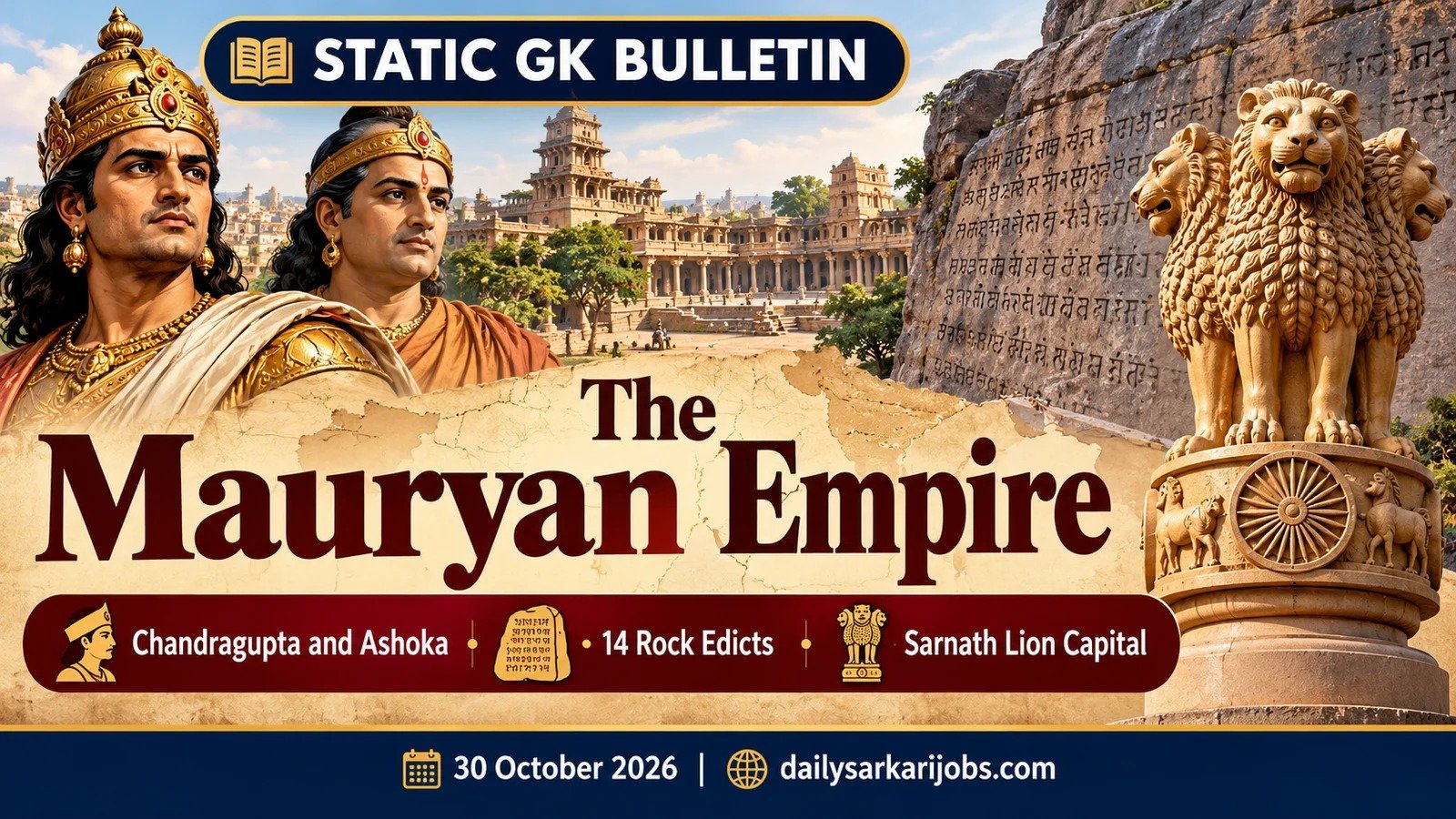
The best-known object in the chapter needs its details kept straight. The Lion Capital of Sarnath has four lions back to back on an abacus carrying four animals — lion, elephant, horse and bull — separated by wheels, above an inverted lotus. It was adopted as the State Emblem of India on 26 January 1950.
- In the State Emblem only three lions are visible, the fourth being hidden behind. The emblem is a two-dimensional view of a four-sided object.
- The Dharma Chakra below the lions is the wheel that appears on the national flag.
- The motto Satyameva Jayate, from the Mundaka Upanishad, was added below the emblem — it is not part of the ancient capital.
- The original capital stands in the Sarnath Museum, not in Delhi.
Sanchi and the other great stupa sites began in this period too; several are now on the UNESCO World Heritage list, which is where ancient history and current affairs meet most often in question papers.
Why a Reader Should Care
Ancient history is a fixed, finite and heavily repeated part of General Awareness in SSC, Railways, State PCS and the UPSC Prelims. The Mauryan chapter is the densest scoring block inside it, because the edicts give examiners clean, unambiguous facts — a number, a script, a place, a title.
It also pays twice over. The Sarnath capital, the Dharma Chakra and Satyameva Jayate are national-symbols questions, and the Ashokan idea of a ruler accountable in writing reappears in the constitutional and freedom-movement sections — see our capsule on the Indian National Movement.
Today’s Current Affairs capsule is on green hydrogen and the National Green Hydrogen Mission, and it shares this post’s idea more closely than it looks. India made green hydrogen governable by publishing a written standard anybody can check — exactly what Ashoka did when he put his orders on rock instead of leaving them to memory.
Practice Questions
Q1. The Mauryan Empire was founded by Chandragupta Maurya after overthrowing which dynasty?
(a) The Shungas (b) The Nandas (c) The Haryankas (d) The Shishunagas
Answer: (b) The Nandas The Shungas came after the Mauryas rather than before them, which is why the first option is the common trap here.
Q2. Megasthenes, who wrote the Indica, came to the Mauryan court as the ambassador of
(a) Antiochus I (b) Alexander (c) Seleucus Nicator (d) Ptolemy II
Answer: (c) Seleucus Nicator He was sent after the treaty of about 305 BCE. The first option sent Deimachus instead, to Bindusara’s court.
Q3. The Kalinga War and Ashoka’s remorse over it are described in
(a) Major Rock Edict XIII (b) Major Pillar Edict VII (c) The Rummindei Pillar Edict (d) Major Rock Edict XII
Answer: (a) Major Rock Edict XIII The last option is the edict on tolerance between sects, and these two numbers are the pair most often swapped.
Q4. In his inscriptions Ashoka usually refers to himself by which titles?
(a) Chakravartin and Samrat (b) Maharajadhiraja and Parameshvara (c) Devanampiya and Piyadasi (d) Amitraghata and Priyadarshi
Answer: (c) Devanampiya and Piyadasi His personal name appears at only a few sites such as Maski, which is exactly why that find settled his identity.
Q5. The Lion Capital of Sarnath was adopted as the State Emblem of India on
(a) 15 August 1947 (b) 26 November 1949 (c) 26 January 1950 (d) 24 January 1950
Answer: (c) 26 January 1950 It was adopted on the day the Constitution came into force, and the original capital is kept in the Sarnath Museum.
30-Second Revision
- The hinge: Ashoka is the first Indian ruler who speaks in his own words, because his orders were carved on rock and pillars. That is why the exam asks about edicts, not battles — and why we know Mauryan kings but no Harappan one.
- Rulers: Chandragupta (c. 322 BCE, with Chanakya, treaty with Seleucus Nicator, later a Jaina) → Bindusara (Amitraghata) → Ashoka (c. 268–232 BCE). Capital Pataliputra; last ruler Brihadratha, killed by Pushyamitra Shunga in 185 BCE.
- Edicts: 14 Major Rock Edicts, 7 Major Pillar Edicts, plus minor ones. Brahmi nearly everywhere, Kharosthi in the north-west, Greek and Aramaic at Kandahar; language mostly Prakrit. Deciphered by James Prinsep in 1837. Kalinga War c. 261 BCE, Edict XIII.
- Sources and art: Arthashastra (Kautilya, prescriptive), Indica (Megasthenes, descriptive), the edicts (Ashoka himself). Provinces at Taxila, Ujjain, Suvarnagiri, Tosali. Lion Capital of Sarnath = State Emblem, 26 January 1950, three lions visible, motto Satyameva Jayate added from the Mundaka Upanishad.
Sources
- Ashoka’s Major Rock Edicts, Pillar Edicts and Minor Rock Edicts, in the standard published readings — the categories and their counts, the titles Devanampiya and Piyadasi, the Kalinga passage in Edict XIII, the tolerance passage in Edict XII and the naming of Asoka at Maski and Gujarra.
- Kautilya’s Arthashastra and the surviving fragments of Megasthenes’ Indica — the administrative offices, the revenue share and the description of Pataliputra.
- The Junagadh rock inscription of Rudradaman — Pushyagupta’s construction of the Sudarshana lake and the conduits added under Ashoka.
- Ministry of Home Affairs and the State Emblem of India (Prohibition of Improper Use) Act, 2005 — the adoption of the Sarnath capital as the State Emblem on 26 January 1950 and the form of the emblem.
- Dynastic dates are given as approximations because published chronologies differ by a few years; the rest is standard ancient-history syllabus material rather than press-release fact.