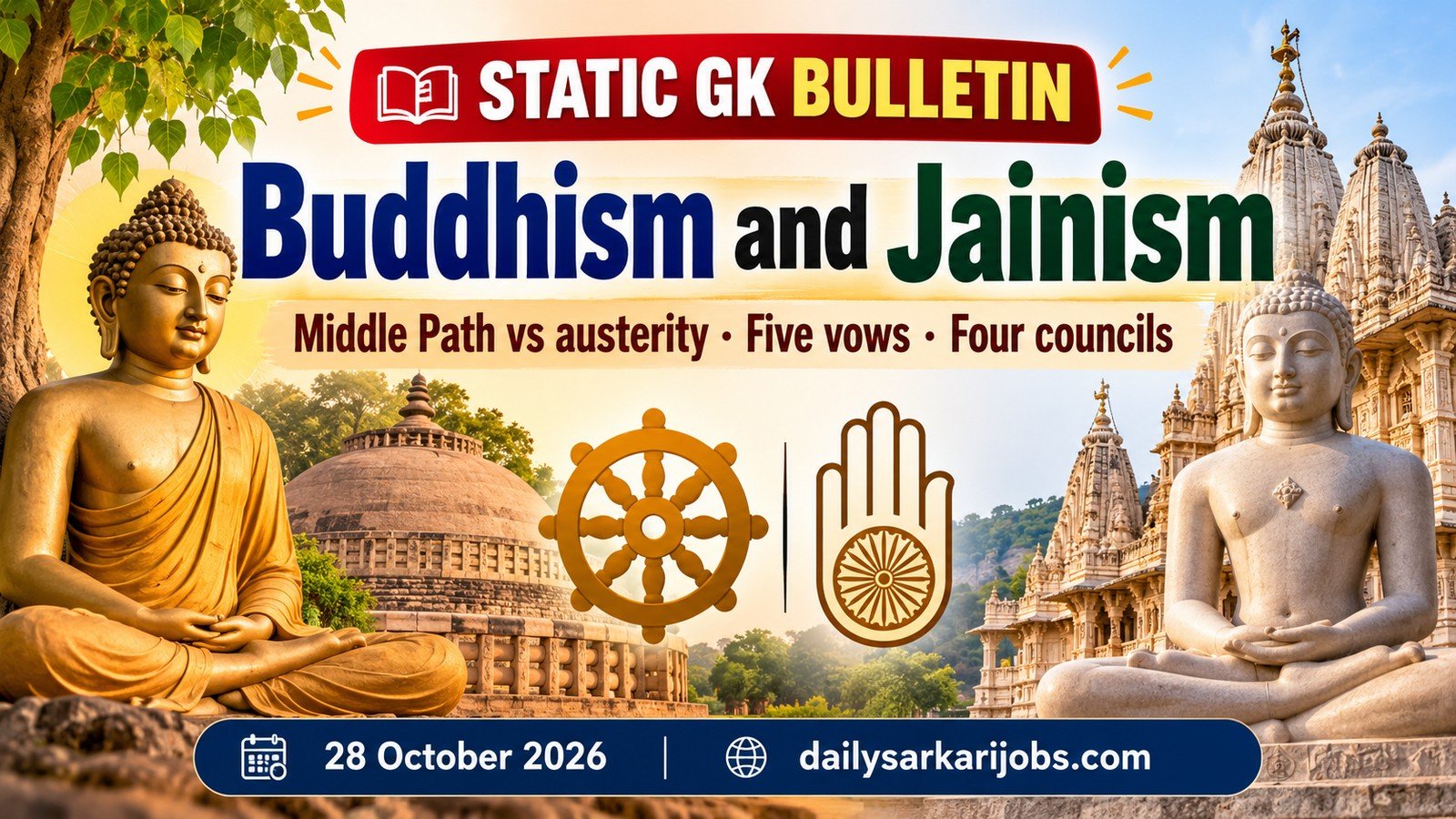
Buddhism and Jainism are almost never examined separately. The question is nearly always a comparison — which one said this, which one did that, which one went where — because the two arose in the same century, in the same region, among the same kind of people, and then diverged. Learn the divergence and the facts arrange themselves.
The Hinge: the Middle Path Against the Extreme One
Both traditions started from the same question: how does suffering end? Both answered that it ends by discipline rather than by sacrifice to the gods. Then they split on how much discipline.
The Buddha tried severe fasting, nearly died of it, and rejected it. His answer was the Middle Path — avoid both indulgence and self-torture. Mahavira went the other way and made extreme austerity the road itself: prolonged fasting, enduring discomfort, eventually abandoning clothing.
That one difference predicts almost everything else, and this is the device worth carrying into the hall:
| Because of the Middle Path, Buddhism… | Because of extreme austerity, Jainism… |
|---|---|
| was practicable for ordinary householders and merchants | demanded far more, so its full rigour stayed with monks |
| spread far beyond India — Sri Lanka, Central Asia, China, Tibet, South-East Asia | remained almost entirely Indian |
| was flexible enough to change as it travelled, producing new schools | held its discipline tightly and changed far less |
| largely faded in the land of its birth | survives in India to this day |
A tradition that asks less travels further; a tradition that asks more lasts longer where it began. That is not a slogan — it is the pattern the facts actually make, and it turns a memory exercise into a reasoning one.
The Two Founders, Side by Side
| Gautama Buddha | Vardhamana Mahavira | |
|---|---|---|
| Clan and status | Shakya clan, a Kshatriya prince | Jnatrika clan, a Kshatriya prince |
| Birthplace | Lumbini, in present-day Nepal | Kundagrama, near Vaishali in Bihar |
| Parents | Suddhodana and Maya | Siddhartha and Trishala |
| Enlightenment at | Bodh Gaya, under the Bodhi tree | Jrimbhikagrama, on the bank of the Rijupalika river |
| Term for it | Nirvana / Bodhi | Kevala Jnana |
| First sermon at | Sarnath | — |
| Died at | Kushinagar | Pavapuri |
Both were Kshatriya princes who left wealth behind, and that is not a coincidence worth skipping. Vedic religion of the time placed ritual, and the Brahmins who performed it, above everything. The strongest objection came from the class that stood second in that order and first in every other.
Buddhism: What Is Actually Asked
- Four Noble Truths — there is suffering; it has a cause; it can end; there is a path to ending it.
- The Noble Eightfold Path is that fourth truth, and the Middle Path is its character.
- The Tripitaka — three baskets — is the canon, written in Pali: Vinaya (monastic rules), Sutta (discourses) and Abhidhamma (philosophy).
- The sangha, the monastic order, was founded at Sarnath with the first disciples.
- Sects: Hinayana (also Theravada, the older and stricter form), Mahayana (which treats the Buddha as divine and reveres Bodhisattvas), and Vajrayana (the tantric form, associated with Tibet).
The four Buddhist Councils are a standing favourite, and the pattern is king plus place plus outcome:
| Council | Place | Royal patron | What came of it |
|---|---|---|---|
| First | Rajagriha | Ajatashatru | The teachings were compiled |
| Second | Vaishali | Kalashoka | The first major split over monastic rules |
| Third | Pataliputra | Ashoka | The canon was settled; missionaries were sent abroad |
| Fourth | Kashmir | Kanishka | The division into Hinayana and Mahayana hardened |
Two patrons carry most of the questions — Ashoka at the third and Kanishka at the fourth. If you remember only two rows, remember those.
Jainism: What Is Actually Asked
Start with the fact candidates get wrong most often: Mahavira did not found Jainism. He was the 24th and last Tirthankara — the last in a line of teachers. The first was Rishabhanatha, also called Adinatha, whose symbol is the bull; the 23rd was Parshvanatha.
That matters because of the vows. Parshvanatha taught four vows. Mahavira added the fifth.
| Vow | Meaning | Taught by |
|---|---|---|
| Ahimsa | Non-injury to any living being | Parshvanatha |
| Satya | Truthfulness | Parshvanatha |
| Asteya | Not taking what is not given | Parshvanatha |
| Aparigraha | Non-possession | Parshvanatha |
| Brahmacharya | Chastity | Added by Mahavira |
- Triratna — the three jewels: Right faith, right knowledge, right conduct. All three together, not one of them.
- Anekantavada — reality has many aspects, so no single view captures it fully. Syadvada is the method that follows: every statement is true only from a particular standpoint.
- Sects: Digambara (“sky-clad”, monks go unclad) and Svetambara (“white-clad”). The split is traditionally dated to a famine that scattered the community.
- Councils: the first at Pataliputra under Sthulabhadra, the second at Vallabhi under Devardhi Kshamasramana, where the canon was written down.
- The canon is the Agamas, in Prakrit (Ardhamagadhi).
Language is the cleanest contrast of all. Buddhist canon in Pali, Jain canon in Prakrit, Vedic literature in Sanskrit. Both new traditions deliberately used the language people already spoke — which is, in itself, the argument they were making.
The Traps, Named
- Mahavira founded Jainism. He did not; he was the 24th Tirthankara.
- Five vows were always five. Four came from Parshvanatha; Brahmacharya is Mahavira’s addition.
- The Buddha’s first sermon was at Bodh Gaya. Enlightenment was at Bodh Gaya; the first sermon was at Sarnath.
- Lumbini is in India. It is in Nepal. Bodh Gaya, Sarnath and Kushinagar are in India.
- Theravada and Mahayana split at the Second Council. The Second Council split the order over monastic rules; the Hinayana-Mahayana division hardened at the Fourth, under Kanishka.
Where You Can Still Stand: the Sites
The Buddha named four principal places of pilgrimage, and three of them are in India. Two now carry UNESCO World Heritage status:
- Bodh Gaya, Bihar — the Mahabodhi Temple Complex, where he attained enlightenment.
- Sarnath, Uttar Pradesh — inscribed on the World Heritage List on 25 July 2026 at the 48th session in Busan, as India’s 45th World Heritage property. The Ashokan lion capital found there became India’s National Emblem, and its site museum, set up in 1904, holds it.
- Kushinagar, Uttar Pradesh — where he died.
- Lumbini, Nepal — where he was born.
The lion capital is the single most useful object in this chapter, because it ties three syllabus areas together at once: Buddhism, the Mauryas, and the national symbols. Our capsule on India’s UNESCO World Heritage Sites explains how inscription works and why the count keeps moving.
A Note on the Dates
You will see the Buddha’s dates given as 563–483 BCE and Mahavira’s as 540–468 BCE. These are traditional dates, and they are genuinely disputed — a large body of modern scholarship places the Buddha roughly a century later. Learn the traditional figures, because that is what the papers use, but know they are a convention rather than a settled fact. The same caution applies to the century given for the sects and the councils.
Why a Reader Should Care
This is one of the highest-yield chapters in ancient history, and it is tested at every level — SSC CGL and CHSL, Railways, Banking general awareness, State PCS and the UPSC prelims. It also sits next to the Mauryas, the Mauryan art chapter and the national symbols, so the effort compounds.
Revise it the way this capsule is built: one hinge (middle path against extreme path), two founder columns, one vow table, one council table and the five named traps. For the rest of the history track, see our capsules on the Indus Valley Civilisation and the Indian National Movement, and on Classical Dances, Folk Dances and Festivals for the culture section beside it.
Today’s Current Affairs capsule has an unexpected connection to this one. At CBD COP-17 in Yerevan, India spoke of “living in harmony with nature” — which is also the Convention’s own 2050 vision. Non-injury to every living thing was doctrine here two and a half thousand years before it became policy anywhere.
Practice Questions
Q1. Mahavira is best described as
(a) The founder of Jainism (b) The 23rd Tirthankara (c) The 24th Tirthankara (d) The first Tirthankara
Answer: (c) The 24th Tirthankara The 23rd was Parshvanatha and the first was Rishabhanatha, whose symbol is the bull. Calling him the founder is the commonest error in this chapter.
Q2. Which vow was added by Mahavira to the four taught by Parshvanatha?
(a) Ahimsa (b) Brahmacharya (c) Aparigraha (d) Satya
Answer: (b) Brahmacharya The other three, along with Asteya, were already part of Parshvanatha’s teaching.
Q3. The Buddha delivered his first sermon at
(a) Bodh Gaya (b) Lumbini (c) Sarnath (d) Kushinagar
Answer: (c) Sarnath Enlightenment was at the first option, birth at the second and death at the fourth, which is why all four appear together so often.
Q4. The Fourth Buddhist Council, held in Kashmir, is associated with which ruler?
(a) Ashoka (b) Ajatashatru (c) Kalashoka (d) Kanishka
Answer: (d) Kanishka Ashoka patronised the Third Council at Pataliputra. The Hinayana and Mahayana division hardened at the Fourth.
Q5. The Jain doctrine that reality has many aspects, so no single viewpoint captures it fully, is called
(a) Anekantavada (b) Syadvada (c) Triratna (d) Kevala Jnana
Answer: (a) Anekantavada The second option is the method of expression that follows from it, qualifying every statement as true from a particular standpoint.
30-Second Revision
- The hinge: the Buddha rejected extreme austerity for the Middle Path; Mahavira embraced it. So Buddhism travelled and faded at home; Jainism stayed Indian and survived. Both founders were Kshatriya princes of the 6th century BCE.
- Places: Buddha — born Lumbini (Nepal), enlightened Bodh Gaya, first sermon Sarnath, died Kushinagar. Mahavira — born near Vaishali, Kevala Jnana at Jrimbhikagrama, died Pavapuri.
- Mahavira is the 24th Tirthankara, not the founder; he added Brahmacharya to Parshvanatha’s four vows. Canon: Tripitaka in Pali, Agamas in Prakrit. Councils: Ashoka at the third, Kanishka at the fourth.
Sources
- Press Information Bureau / Archaeological Survey of India, Ancient Buddhist Site of Sarnath inscribed in the UNESCO World Heritage List — the inscription on 25 July 2026 at the 48th session in Busan as India’s 45th property, the first sermon as the Turning of the Wheel of the Law, the founding of the sangha, the Ashokan lion capital that became the National Emblem, and the 1904 site museum.
- Archaeological Survey of India, Mahabodhi Temple Complex at Bodh Gaya — the place of enlightenment and its World Heritage status.
- The lives, doctrines, canons, sects and councils are standard textbook history rather than press-release facts, and the traditional dates are given as traditional because they are disputed in modern scholarship.