Today’s Current Affairs explainer covered three Indian sites added to UNESCO’s Tentative List and made the point that a Tentative List entry is not a World Heritage Site. This capsule is the list those three are queuing to join.
Explained in plain language for SSC, RRB NTPC, banking exams, State PSC and UPSC Prelims.
⚡ QUICK FACTS
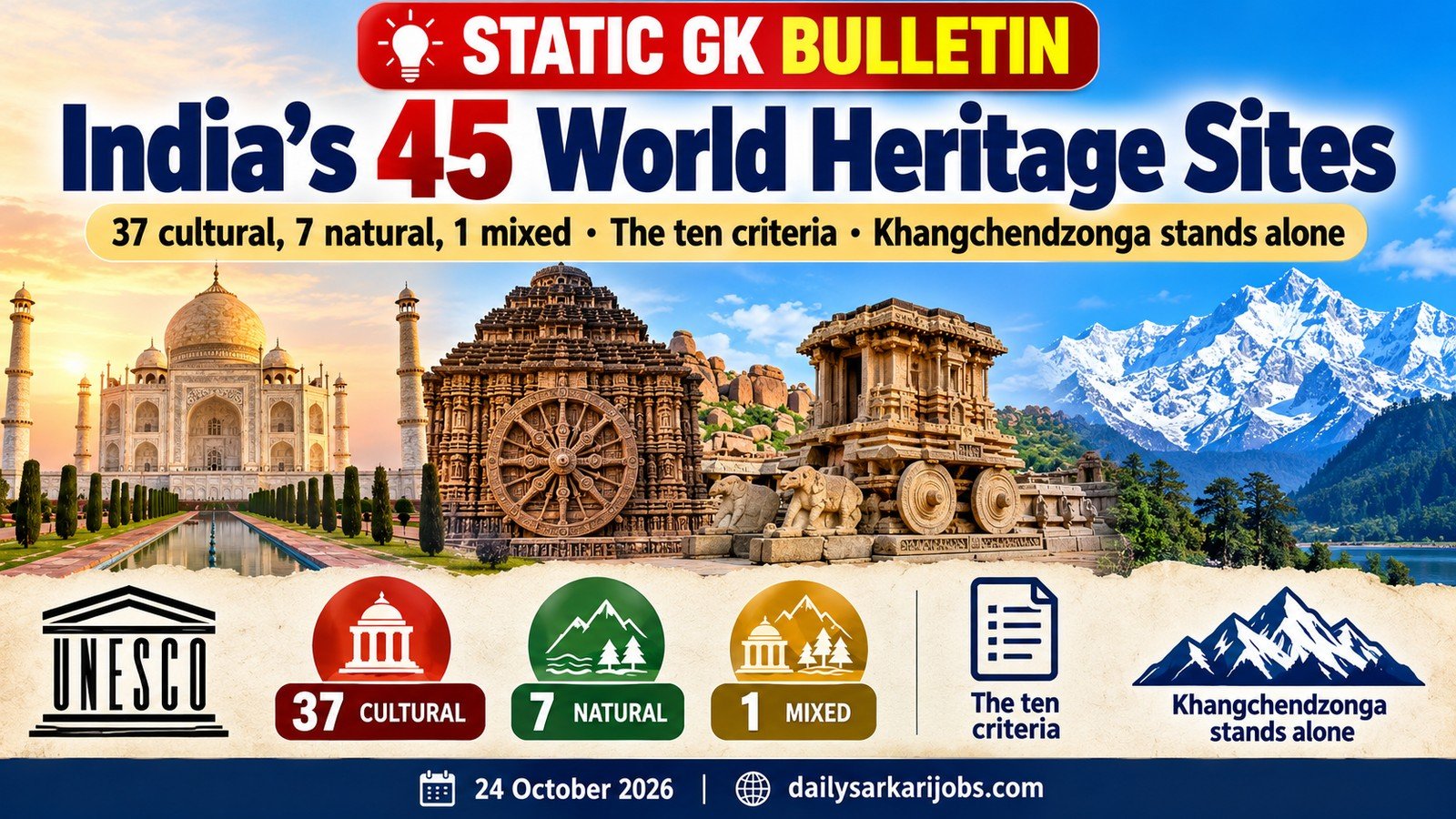
India’s World Heritage Sites
45
The split
37 cultural, 7 natural, 1 mixed
The only mixed site
Khangchendzonga National Park, Sikkim, 2016
India’s first four
Agra Fort, Ajanta, Ellora and the Taj Mahal, all 1983
The newest
Ancient Buddhist Site of Sarnath, July 2026
The Convention
Adopted by UNESCO in 1972
India joined
14 November 1977
Who decides
The World Heritage Committee, 21 States Parties
The Hinge: Count to Ten, Not to Forty-Five
Almost everybody tries to memorise forty-five names. Almost nobody learns the ten criteria, and the criteria are where the marks are.
A site is inscribed only if it meets at least one of ten criteria.Criteria i to vi are cultural — human creative genius, an exchange of human values, a tradition or civilisation, a type of building or landscape, a traditional settlement, and association with events or beliefs of universal significance. Criteria vii to x are natural — exceptional natural beauty, major stages of Earth’s history, ongoing ecological processes, and the most important habitats for biodiversity.
Now the definition falls straight out. A cultural site meets only cultural criteria. A natural site meets only natural ones. A mixed site meets at least one of each — which is why India has exactly one, and why it is the answer to a question that gets asked every year.
India’s Forty-Five, Sorted the Easy Way
Kind
How many
What to remember
Cultural
37
Monuments, cities, caves and railways — the large majority
Natural
7
A short list, and worth learning by name
Mixed
1
Khangchendzonga National Park, Sikkim, inscribed 2016
The seven natural sites are the cheapest marks in the whole chapter, because there are only seven of them.
Natural site
Where
Year
Kaziranga National Park
Assam
1985
Manas Wildlife Sanctuary
Assam
1985
Keoladeo National Park
Rajasthan
1985
Sundarbans National Park
West Bengal
1987
Nanda Devi and Valley of Flowers
Uttarakhand
1988
Western Ghats
Six States
2012
Great Himalayan National Park
Himachal Pradesh
2014
Notice that three of the seven were inscribed in the same year, 1985, and two of those three are in Assam.The national parks capsule covers what each of them protects — and the useful observation is that a World Heritage listing does not replace Indian law; it sits on top of it. Kaziranga is a national park under the Wild Life (Protection) Act and a World Heritage Site under an international convention at the same time.
The Four That Started It, and the One That Just Arrived
India’s first inscriptions came in 1983, and there were four of them: the Taj Mahal, Agra Fort, the Ajanta Caves and the Ellora Caves. Two monuments of the Mughal period and two cave complexes of a much older one — a neat summary of what the country chose to put forward first.
The newest is the Ancient Buddhist Site of Sarnath, in Varanasi, inscribed at the 48th session of the World Heritage Committee at Busan, Republic of Korea, in July 2026. The property takes in the Chaukhandi Stupa and the archaeological remains of Sarnath including the Dhamek and Dharmarajika stupas — the landscape known as the Deer Park, where the Buddha is held to have given his first sermon.
How the Machinery Works
The Convention Concerning the Protection of the World Cultural and Natural Heritage was adopted by UNESCO in 1972. India accepted it on 14 November 1977.
A country first places a site on its own Tentative List; only then may it be nominated.
Decisions are taken by the World Heritage Committee, made up of 21 States Parties elected by the General Assembly of the Convention.
The Committee meets once a year; the 2026 session was the 48th, at Busan.
The test a site must pass is Outstanding Universal Value.
A site that is threatened can be put on the List of World Heritage in Danger, and in the last resort deleted from the World Heritage List altogether.
That last point is the one people find surprising, and it is examinable.Inscription is not permanent.The capsule on international organisations places UNESCO itself — and this is the clearest example on the site of an international body whose only real instrument is a list it can also take you off.
What the Words Mean
Term
In plain words
Tentative List
A country’s own list of places it intends to nominate later
Inscription
Being formally added to the World Heritage List
Outstanding Universal Value
Significance so great that it matters to all humanity, not just one country
States Parties
Countries that have accepted the Convention
Mixed site
One that meets at least one cultural and one natural criterion
In Danger list
A warning list for sites whose value is threatened
Why a Reader Should Care
Because this chapter is pure recall and the questions repeat. The total, the split, the only mixed site, the first four of 1983, the seven natural sites and the year India joined the Convention are asked in SSC, State PSC, banking and UPSC papers year after year. The capsule on dances and festivals is the living half of the same syllabus, and the one on the National Akademis is the institutional half.
And because the count moves. A new session every year means a new number, and India went from 44 to 45 in July 2026. Any figure learnt for this topic needs a date attached to it — which is the single most useful habit a Static GK reader can build.
One caution worth printing.UNESCO’s own country page for India was still showing 44 when this was written, while UNESCO’s own news article on the Sarnath inscription says 45. This capsule uses 45, and a reader should recheck the number after every annual session rather than trusting any single page.
Practice Questions
Q1. How many World Heritage Sites does India have? (a) 38 (b) 42 (c) 45 (d) 50 Answer: (c) 45 The figure rose by one in July 2026 when the Ancient Buddhist Site of Sarnath was inscribed, so the number needs a date attached whenever it is quoted.
Q2. Which is India’s only mixed World Heritage Site? (a) Khangchendzonga National Park (b) Western Ghats (c) Sundarbans National Park (d) Great Himalayan National Park Answer: (a) Khangchendzonga National Park A mixed site must satisfy at least one cultural criterion and one natural criterion, and every other option is natural only.
Q3. India accepted the World Heritage Convention in (a) 1972 (b) 1975 (c) 1977 (d) 1983 Answer: (c) 1977 The first option is the year the Convention itself was adopted and the last is the year India’s first four sites were inscribed, so all three dates are worth separating.
Q4. Which of the following was NOT among India’s first World Heritage Sites inscribed in 1983? (a) Taj Mahal (b) Agra Fort (c) Ajanta Caves (d) Kaziranga National Park Answer: (d) Kaziranga National Park That site was inscribed two years later, in 1985, along with two others.
Q5. Decisions on inscribing a site on the World Heritage List are taken by (a) The UNESCO General Conference (b) The UN General Assembly (c) The International Court of Justice (d) The World Heritage Committee Answer: (d) The World Heritage Committee It is made up of twenty-one States Parties and meets once a year, the 2026 session being the forty-eighth.