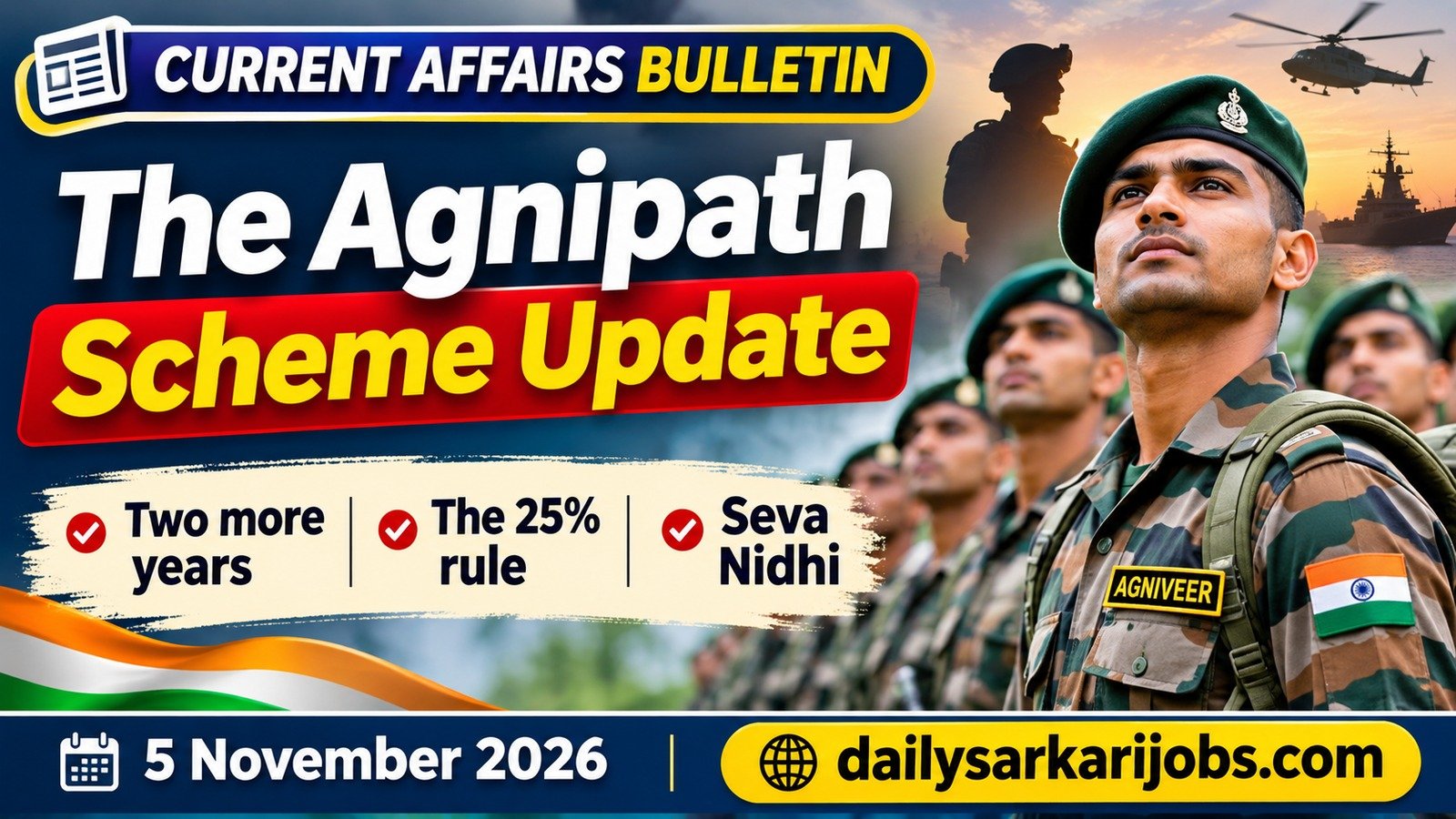
On 4 November 2026 the Union Cabinet approved the biggest change to the Agnipath scheme since it began. Agniveers who finish their four years will now be offered two more, and at the end of those two years they can be taken into the armed forces as regular soldiers if they are willing and meet the selection criteria. To see why this matters so much, you have to know which number the scheme actually turned on.
The Number That Defined Agnipath Was Never Four
Everybody remembers Agnipath as the four-year scheme. The four years were never the controversial part. Short service in the armed forces already existed. What made Agnipath genuinely new was a different number: 75.
Under the original design, at the end of four years only up to 25 per cent of each batch would be kept on as regular soldiers, and the other 75 per cent would leave with a lump sum and a certificate. That planned exit was the heart of the scheme and the heart of the objection to it. The 4 November decision leaves the four years untouched and dissolves the 75.
Read the change that way and everything else falls into place. Agnipath was built as a filter that most people passed through and out of. It has been turned into a longer road that most people can stay on. Defence Minister Rajnath Singh called the extra two years a “Second Tour of Duty”.
Jargon, Defined Once
- Agnipath is the scheme; Agniveer is the rank a soldier recruited under it holds. The scheme has a name and the soldier has a name, and questions swap them deliberately.
- Seva Nidhi is the one-time lump sum paid when an Agniveer leaves. It is not a pension. A pension is paid every month for life; this is paid once and then it is over.
- Agniveer Corpus Fund is the pot the Seva Nidhi comes out of. 30 per cent of the monthly package goes into it and the Government puts in the same amount again.
- CDS is the Chief of Defence Staff, the senior-most military officer and the Government’s single-point military adviser. The post was created in 2019.
What Changed on 4 November 2026
| Point | Before | After |
|---|---|---|
| Tenure | 4 years, then out | 4 years, plus an offer of 2 more |
| The 25 per cent | Kept on as regular soldiers on merit | Unchanged — still kept at the 4-year mark |
| The other 75 per cent | Left the forces | Offered the 2-year engagement, then regular enrolment if willing and selected |
| Pay in the extra years | Did not exist | Higher pay and a larger Seva Nidhi package |
| Seniority | Not an issue | The 25 per cent stay senior to those absorbed later |
Two cautions on this table. First, the two years are an offer, not an automatic promotion — enrolment at the end still depends on willingness and on meeting the criteria. Second, the 25 per cent rule has not been scrapped; it continues exactly as before. A question that says the 25 per cent provision was abolished is wrong.
The Original Scheme, in the Government’s Own Figures
These are the figures from the Cabinet decision of 14 June 2022, and they are what questions on the scheme are built from.
| Year | Monthly package | In hand (70%) | To the Corpus Fund (30%) |
|---|---|---|---|
| First | ₹30,000 | ₹21,000 | ₹9,000 |
| Second | ₹33,000 | ₹23,100 | ₹9,900 |
| Third | ₹36,500 | ₹25,580 | ₹10,950 |
| Fourth | ₹40,000 | ₹28,000 | ₹12,000 |
- The Government matches the Agniveer’s contribution rupee for rupee, so each side builds about ₹5.02 lakh over four years.
- The Seva Nidhi paid on exit is about ₹11.71 lakh including interest, and it is exempt from income tax.
- There is a non-contributory life insurance cover of ₹48 lakh for the period of engagement.
- There is no gratuity and no pension. This is the single most asked fact about the scheme, and the new two-year engagement does not change it for anyone who still leaves.
- The age range is 17½ to 21 years, and up to 25 per cent of a batch may be enrolled in the regular cadre.
Why the Decision Came Now
The first batch of Agniveers is finishing. Recruitment began in 2022, so the earliest recruits reach the end of their four years at the close of 2026. Around 18,300 Agniveers were due to walk out by 31 December, and the decision came a little over three weeks before that date. This is a deadline being answered, not a reform arriving out of the blue.
Over three lakh soldiers recruited under Agnipath are serving today, across the Army, the Navy and the Air Force. The CDS said plainly that the scheme is not being discontinued. He also noted that the special provisions various ministries and state governments had announced for exiting Agniveers — reserved quotas in police and central forces, for instance — would no longer be needed in the same way, because far fewer people will now be exiting.
Exam Alert: Four Traps Hiding in This Story
- “Six-year scheme” is wrong. The tenure is four years plus an offer of two. Nobody is recruited for six years at the outset, and the CDS gave no commitment that future batches will follow the same model.
- The 25 per cent is intact. It was not raised, lowered or removed. What changed is what happens to the rest.
- Seva Nidhi is not a pension and is not taxed. Two separate facts, both asked, often in the same question.
- The online Common Entrance Exam is not part of this decision. The Army moved to a written test before the physical rally back in 2023. Some coverage has mixed the two together; they are years apart.
Did You Know: The Scheme Was Meant to Make the Army Younger, Not Smaller
The stated purpose of Agnipath was to bring the average age of the armed forces down by about four to five years. That is the logic the whole design hangs on: a force that takes in a large number of young people and lets most of them go stays permanently young, because the intake keeps refreshing it.
The 4 November decision works against that arithmetic, and it is worth seeing why. If most Agniveers now stay for six years and then become regular soldiers, the force ages more like it did before. The Government’s answer is that a soldier with six years of training behind him is worth more than a slightly lower average age — which is a judgement about modern warfare, not about numbers.
Why a Reader Should Care
Defence recruitment is one of the most reliably asked Current Affairs areas there is, and Agnipath is the single biggest change to how India recruits soldiers in decades. A decision of this size, three weeks before the first batch was due to leave, will be asked about.
It connects straight to our capsule on the Central Armed Police Forces, because the CAPFs were where many exiting Agniveers were expected to go next, and that expectation has just been reduced. For the command structure behind the announcement, see HQ Integrated Defence Staff, and for the equipment side of the same budget, our explainer on the next-generation corvettes.
Today’s Static GK capsule is on India’s physiography, and the pairing is not an accident. The soldiers being discussed here are posted along the lines that capsule describes — the Himalayan frontier, the long coastline, the island chains. One capsule is about who defends the country and the other is about the shape of the thing being defended.
Practice Questions
Q1. The Union Cabinet decision of 4 November 2026 on the Agnipath scheme offers Agniveers
(a) A pension after four years (b) An additional two-year engagement period (c) An increase in the retained share from 25 to 50 per cent (d) A reduction in tenure to three years
Answer: (b) An additional two-year engagement period At the end of those two years they may be enrolled as regular soldiers, subject to willingness and selection criteria.
Q2. Under the Agnipath scheme, what share of the monthly package goes into the Agniveer Corpus Fund?
(a) 10 per cent (b) 20 per cent (c) 30 per cent (d) 50 per cent
Answer: (c) 30 per cent The Government contributes an equal amount, so an Agniveer takes home 70 per cent of the package each month.
Q3. The Seva Nidhi package paid to an Agniveer on exit is
(a) About ₹5.02 lakh and taxable (b) About ₹11.71 lakh and exempt from income tax (c) A monthly pension from the fifth year (d) About ₹48 lakh and taxable
Answer: (b) About ₹11.71 lakh and exempt from income tax The ₹48 lakh figure is the non-contributory life insurance cover, which is a different thing entirely.
Q4. The Agnipath scheme was approved by the Union Cabinet on
(a) 14 June 2022 (b) 15 August 2021 (c) 1 April 2023 (d) 26 January 2022
Answer: (a) 14 June 2022 The age range set at the time was 17½ to 21 years, and up to 25 per cent of each batch could be taken into the regular cadre.
Q5. Which statement about the 4 November 2026 decision is correct?
(a) The 25 per cent retention provision has been abolished (b) The Agnipath scheme has been discontinued (c) All Agniveers are now recruited for six years at the outset (d) The 25 per cent retained at four years keep their seniority over those absorbed later
Answer: (d) The 25 per cent retained at four years keep their seniority over those absorbed later The CDS confirmed the scheme continues, the 25 per cent rule is unchanged, and the extra two years are an offer rather than the recruitment term.
30-Second Revision
- The hinge: Agnipath’s defining number was never four, it was 75 — the share that had to leave. 4 November 2026 keeps the four years and dissolves the 75.
- The change: 4 years + an offer of 2 more, then regular enrolment if willing and selected. Higher pay and a larger Seva Nidhi in the extra years. The 25 per cent rule is unchanged and stays senior.
- The money: ₹30,000 rising to ₹40,000 a month, 30 per cent to the Corpus Fund matched by the Government, Seva Nidhi about ₹11.71 lakh, tax-free, ₹48 lakh insurance, no gratuity and no pension.
- The context: scheme approved 14 June 2022, age 17½ to 21, over 3 lakh serving, and about 18,300 were due to exit by 31 December 2026.
What Is Not Settled
Three honest notes. First, at the time of writing the formal Government order and the detailed PIB text had not yet been published; the account above follows the announcement made by the CDS and the Information and Broadcasting Minister on 4 November 2026 and the agency reports of it. Check the official release for the exact wording before quoting it as a rule.
Second, the pay and Seva Nidhi figures for the extra two years have not been announced — they are described as higher and enhanced, with no numbers yet. Third, the CDS did not commit to the four-plus-two model continuing for future batches, saying only that the provision exists as of now. So treat “six years” as what today’s Agniveers are being offered, not as the new permanent shape of the scheme.
Sources
- Press Information Bureau, Cabinet release on the Agnipath scheme, 14 June 2022 — the pay table, the 30 per cent Corpus Fund contribution and Government match, the Seva Nidhi of about ₹11.71 lakh and its tax exemption, the ₹48 lakh non-contributory insurance cover, the absence of gratuity and pension, the age range and the 25 per cent regular-cadre provision.
- PTI and agency reports of the announcement by the Chief of Defence Staff and the Minister of Information and Broadcasting, 4 November 2026 — the two-year engagement, the pathway to regular enrolment, the seniority position of the 25 per cent, the figure of over three lakh serving Agniveers and the roughly 18,300 due to exit by 31 December 2026, and the Defence Minister’s description of the extra period as a Second Tour of Duty.
- The online Common Entrance Exam introduced ahead of the physical rally is a 2023 change to Army recruitment and is noted here only because some coverage has attached it to the 4 November decision.