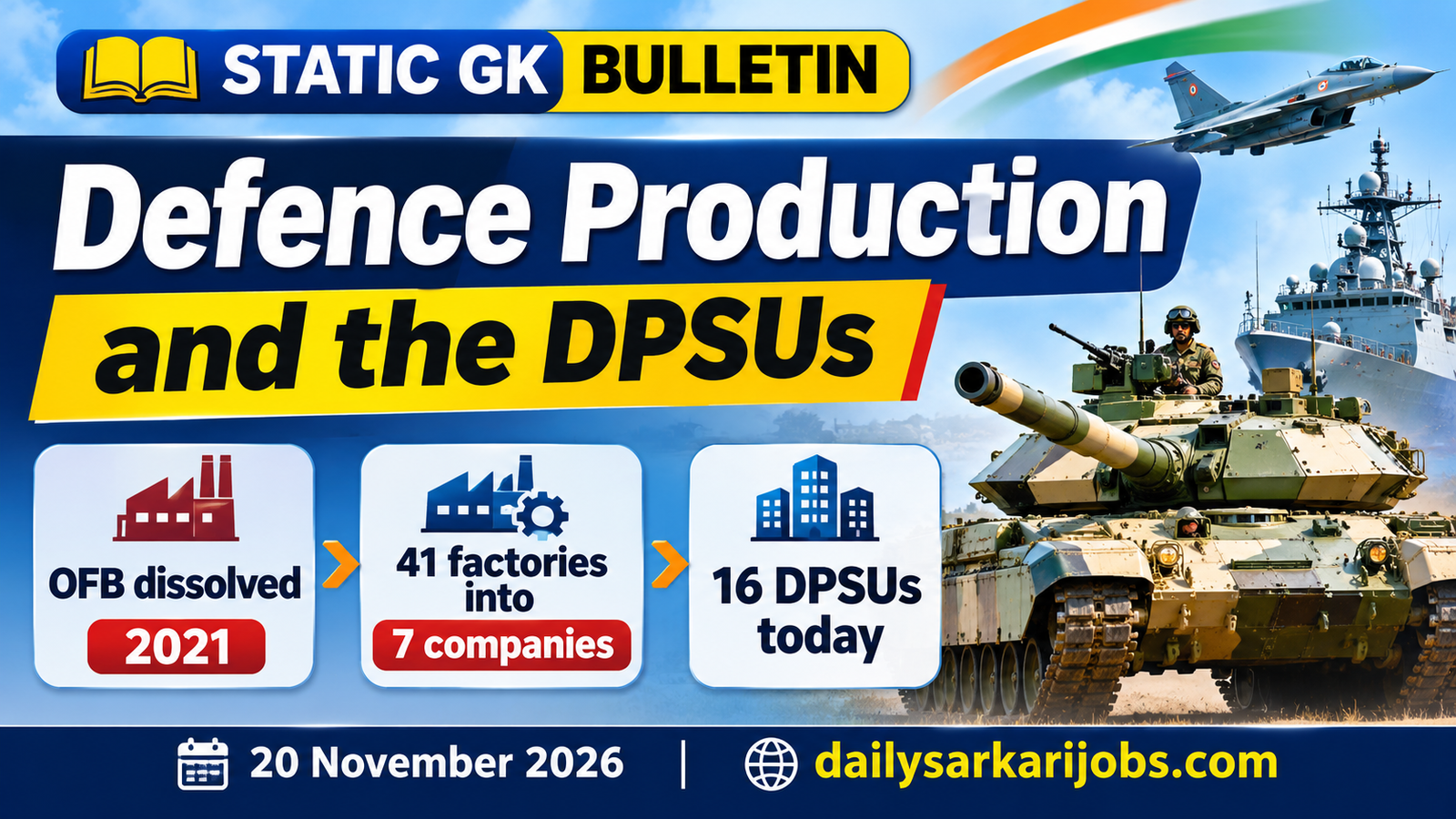
For forty-two years, the government of India ran factories. On 1 October 2021, it stopped, and started owning companies instead. That single sentence is the hinge of this entire topic. The Ordnance Factory Board, a government department that directly operated 41 ordnance factories, was dissolved, and those factories were handed to seven new defence public sector undertakings. Once you hold that shift in your head, everything else in India’s defence manufacturing story — the indigenisation lists, the two corridors, the export numbers, the private sector share — stops being a pile of facts and becomes one argument.
⚡ QUICK FACTS
OFB dissolved
1 October 2021
Factories transferred
41, into 7 new DPSUs
Total DPSUs today
16
Production FY 2025-26
Rs 1.78 lakh crore
Before and after: what actually changed
A department spends a budget allotted to it and reports up a government chain. A company has a balance sheet, must cover its own costs, can borrow, can bid for orders and can be held to a profit figure. Converting the OFB was not a renaming exercise; it changed who carries the risk.
Feature
Before 1 Oct 2021
After 1 Oct 2021
Form
OFB, a government department
7 corporate DPSUs
Headquarters
Ayudh Bhawan, Kolkata
Each company separately
Set up
2 April 1979
Dissolved 1 October 2021
Units
41 ordnance factories
Same 41, split across 7 firms
Money
Government budget head
Company accounts and orders
Coordination
OFB itself
Directorate of Ordnance (C and S)
DPSU stands for Defence Public Sector Undertaking — a company owned by the government under the Ministry of Defence. The successor coordinating body, the Directorate of Ordnance (Coordination and Services), sits under the Department of Defence Production and also manages the Indian Ordnance Factories Service cadre.
The seven new DPSUs created in 2021
These names turn up constantly in recruitment notices, so they are worth knowing cold.
Company
Short form
Broad area
Munitions India Limited
MIL
Ammunition and explosives
Armoured Vehicles Nigam Limited
AVNL
Tanks and armoured vehicles
Advanced Weapons and Equipment India Ltd
AWE India
Weapons and equipment
Troop Comforts Limited
TCL
Clothing and troop comfort items
Yantra India Limited
YIL
Components and general stores
India Optel Limited
IOL
Optical and electronic sights
Gliders India Limited
GIL
Parachutes and aerial delivery
The nine older DPSUs
The seven new companies joined nine that already existed, taking the total to 16 DPSUs — the number the Defence Minister uses at the annual performance review.
These are the figures most likely to be asked, and the trend matters as much as the level.
Measure
Figure
Defence production, FY 2025-26
Rs 1.78 lakh crore, an all-time high
Growth over FY 2024-25
15.6 per cent, from Rs 1.54 lakh crore
Growth over FY 2020-21
110 per cent, from Rs 84,643 crore
Against FY 2013-14
Almost four times Rs 43,746 crore
Public sector share
About 76 per cent
Private sector share
24 per cent, about Rs 42,000 crore
Defence exports, FY 2025-26
Rs 38,424 crore, a record
Targets for 2029
Rs 3 lakh crore output, Rs 50,000 crore exports
Read the private sector line carefully: it rose from 22 per cent in FY 2024-25 to 24 per cent. The public sector still does three-quarters of the work. Any statement claiming the private sector now dominates defence manufacturing is wrong, and that is a favourite statement-based trap.
The four levers government uses
Having companies is not the same as having orders. Four instruments push work towards Indian firms.
1. Positive Indigenisation Lists (PILs). A PIL is a list of items that, after a stated deadline, may only be bought from Indian suppliers. It is an import embargo with a calendar attached. The first five lists together notified 5,012 items. The sixth list, notified in August 2026, added 405 items — 389 for DPSUs and 16 for the Indian Coast Guard — with an estimated business potential of Rs 3,070 crore.
2. The SRIJAN portal. Launched by the Department of Defence Production in August 2020, SRIJAN is a shop window: the armed forces and DPSUs post items they currently import, and Indian firms offer to make them. By June 2026 it had carried more than 33,000 items offered for indigenisation, with more than 15,700 items indigenised over five years, worth about Rs 9,000 crore of import substitution.
3. iDEX.Innovations for Defence Excellence, launched in April 2018, funds start-ups and small firms to solve specific military problems. Grants run up to Rs 1.5 crore, and the ADITI sub-scheme goes up to Rs 25 crore for deep-technology work. By February 2025 it had opened 549 problem statements and signed 430 contracts.
4. Rules on money and buying. Foreign direct investment in defence was liberalised in September 2020: up to 74 per cent through the automatic route, above that through the government route. The Defence Acquisition Procedure 2020 ranks purchase categories, and the top priority is Buy Indian-IDDM, short for Indigenously Designed, Developed and Manufactured. Over 700 industrial licences have gone to 436 companies, and India now exports defence items to more than 100 countries. For the controls on what may leave the country, see the NSTCC and SCOMET export controls.
The two defence industrial corridors
Announced in the Union Budget for 2018-19, the corridors are not single sites but clusters of nodes, each meant to pull suppliers around an anchor plant.
Count them: six nodes in Uttar Pradesh, five in Tamil Nadu, eleven in all. Exams ask for the count and for one node that is not on the list, so learn the names rather than the idea.
1 October 2021 is the date the OFB was dissolved. The OFB itself was set up on 2 April 1979 with headquarters at Ayudh Bhawan, Kolkata.
41 factories became 7 DPSUs; the total number of DPSUs is 16, not 7.
Learn the seven new names and what each makes. MIL is ammunition, AVNL is armoured vehicles, GIL is parachutes — the pairings are the question.
Rs 1.78 lakh crore production and Rs 38,424 crore exports in FY 2025-26; targets for 2029 are Rs 3 lakh crore and Rs 50,000 crore.
Private sector share is 24 per cent. The public sector still does about 76 per cent.
FDI: 74 per cent automatic, above that by government route, liberalised in September 2020.
Corridors: six UP nodes, five Tamil Nadu nodes. SRIJAN launched August 2020; iDEX launched April 2018.
The top DAP-2020 purchase category is Buy Indian-IDDM.
Did You Know?
Some of the factories are far older than the board that ran them. Several of the 41 units trace back to British-era arsenals, while the Ordnance Factory Board that coordinated them was created only in 1979 and lasted 42 years.
A PIL is a deadline, not a ban. Each listed item carries a date after which imports stop, which gives Indian suppliers a known runway to prepare.
The sixth indigenisation list included the Coast Guard. Sixteen of its 405 items were for the Indian Coast Guard rather than a DPSU.
Troop Comforts Limited makes the unglamorous half of soldiering — clothing, tents and bedding. An army runs on those as surely as on ammunition.
30-Second Quick Revision
The hinge: OFB dissolved 1 October 2021; 41 factories became 7 DPSUs; total DPSUs now 16.
New seven: MIL, AVNL, AWE India, TCL, YIL, IOL, GIL.
Money: Rs 1.78 lakh crore output and Rs 38,424 crore exports in FY 2025-26; private share 24 per cent.
Levers: Positive Indigenisation Lists (6th list, 405 items, August 2026), SRIJAN (2020), iDEX (2018), FDI 74 per cent automatic.
Corridors: Uttar Pradesh six nodes, Tamil Nadu five nodes.
Targets: Rs 3 lakh crore production and Rs 50,000 crore exports by 2029.
Test Your Knowledge
Q1. The Ordnance Factory Board was dissolved with effect from which date? (a) 1 April 2021 (b) 1 October 2021 (c) 2 April 1979 (d) 1 January 2022 Answer: (b) 1 October 2021 Its 41 factories were transferred to seven newly created defence public sector undertakings.
Q2. How many DPSUs does the Ministry of Defence have after the 2021 reorganisation? (a) 7 (b) 9 (c) 16 (d) 21 Answer: (c) 16 The seven new companies joined nine existing ones, and the Defence Minister’s annual performance review covers all sixteen.
Q3. Which of these new DPSUs makes ammunition and explosives? (a) Troop Comforts Limited (b) India Optel Limited (c) Gliders India Limited (d) Munitions India Limited Answer: (d) Munitions India Limited Troop Comforts makes clothing, India Optel makes sights and Gliders India makes parachutes.
Q4. The sixth Positive Indigenisation List, notified in August 2026, covered how many items? (a) 101 (b) 405 (c) 928 (d) 5,012 Answer: (b) 405 Of these, 389 were for DPSUs and 16 for the Indian Coast Guard; the first five lists together had 5,012 items.
Q5. How many nodes does the Uttar Pradesh Defence Industrial Corridor have? (a) Four (b) Five (c) Six (d) Eight Answer: (c) Six Aligarh, Agra, Jhansi, Kanpur, Chitrakoot and Lucknow; Tamil Nadu’s corridor has five nodes.
Want the full ten-question set as a PDF? Head to our Test Your Knowledge page.
Verified on 20 November 2026 against Press Information Bureau releases on defence production for FY 2025-26 and on the sixth Positive Indigenisation List, the Department of Defence Production’s note on defence manufacturing, and Ministry of Defence releases on the two defence industrial corridors.