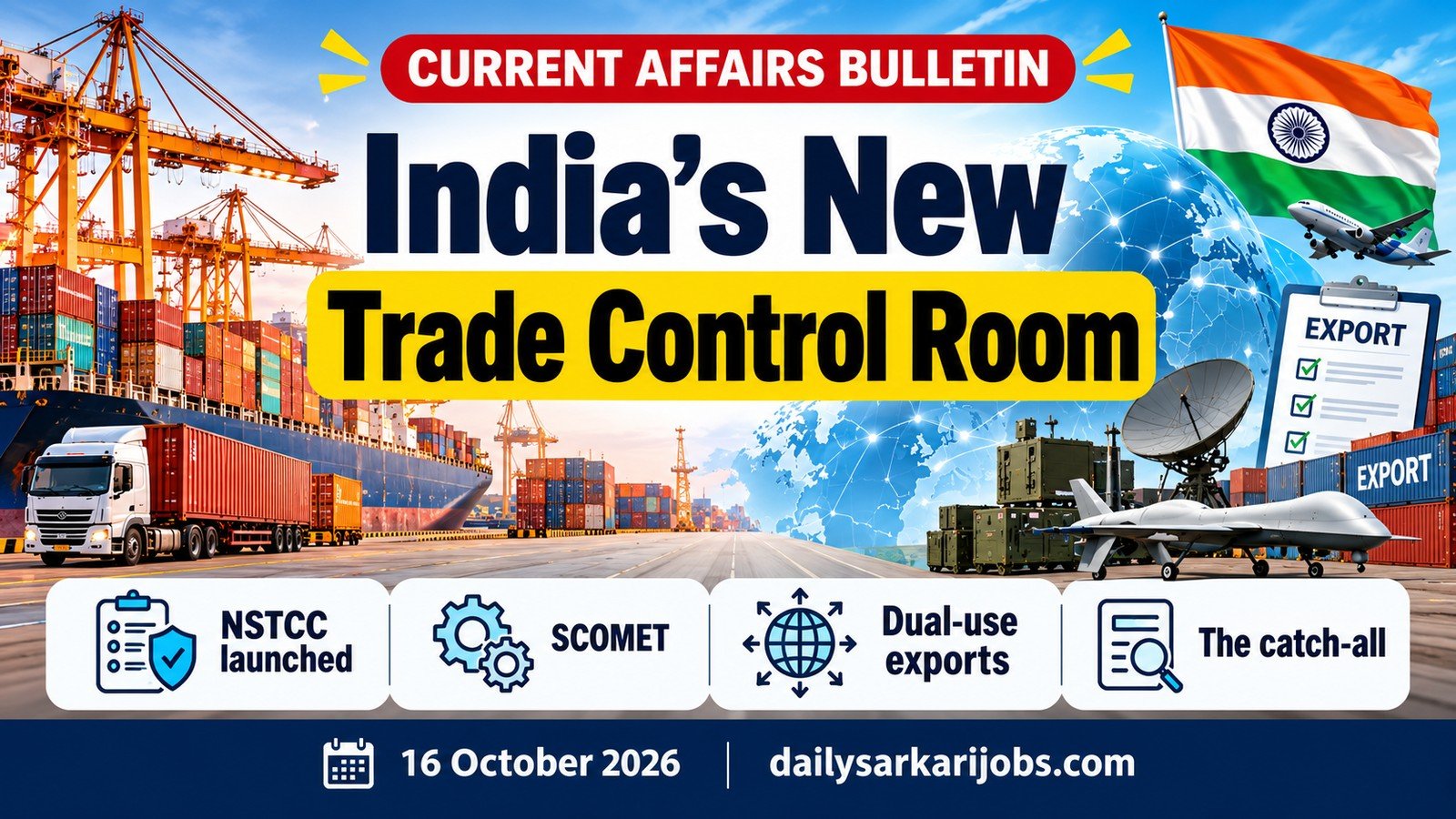
On 15 October 2026 the Union Minister of Commerce and Industry launched the National Strategic Trade Command Centre at Vanijya Bhawan in New Delhi. It is a control room for India’s trade paperwork — a set of dashboards that show, on one screen, how every export scheme and every licence application is actually moving.
The most interesting thing that happened at the launch was not the launch. Reviewing the dashboard for SCOMET, India’s export-control list, the Minister asked for the Inter-Ministerial Committee to meet regularly — weekly if necessary — to clear a backlog of pending applications. Within minutes of being switched on, the control centre’s first visible output was a queue.
The Hinge: a Dashboard’s First Finding Is Usually a Queue
Nothing about a dashboard is interesting in itself. A government can put any number on a screen. What makes this one worth a reader’s time is what happened the moment somebody senior looked at it.
The SCOMET dashboard did not reveal a trade trend or a market opportunity. It revealed that applications were waiting. That is almost always what a new dashboard finds first, because a delay is the one thing an organisation can carry for years without anybody having to own it. A queue is invisible until somebody counts it.
This is the third time in a week that the same idea has turned up on this site, and it is worth naming. PM GatiShakti is a map whose value is that an objection raised on a map costs nothing while the same objection after construction costs a project. The parliamentary report on the National Testing Agency made the point from the other side: an institution that does not measure an outcome cannot be held to it. Measurement is not a management fashion. It is the thing that converts a private inconvenience into a public fact.
What SCOMET Actually Is
SCOMET is India’s national export control list. The letters stand for Special Chemicals, Organisms, Materials, Equipment and Technologies, and the list covers goods, software and technology that are dual-use — ordinary in one pair of hands and dangerous in another.
That phrase is the whole subject. A chemical used to make dye can also be a step towards a nerve agent. A high-precision bearing belongs in a wind turbine and in a centrifuge. Nothing about the object makes it controlled. What makes it controlled is where it is going and what it might become.
| Category | What it covers |
|---|---|
| 0 | Nuclear materials, nuclear-related other materials, equipment and technology |
| 1 | Toxic chemical agents and other chemicals |
| 2 | Micro-organisms and toxins |
| 3 | Materials, materials processing equipment and related technologies |
| 4 | Nuclear-related other equipment and technology, not controlled under Category 0 |
| 5 | Aerospace systems and equipment, including production and test equipment |
| 6 | Munitions List |
| 7 | Reserved — the category exists but has nothing in it |
| 8 | Special materials, electronics, computers, telecommunications, information security, sensors and lasers, navigation, marine and propulsion |
Category 7 is the detail worth remembering, because an empty box is a deliberate thing. The number is held open so that the Indian list keeps the same shape as the international lists it is harmonised with. A gap in a numbered list is usually a promise to somebody else that the numbering will not drift.
Who Signs the Licence Tells You What the Risk Is
An exporter cannot simply ship a SCOMET item. It needs an authorisation — and three different parts of the Government issue them, depending on what is being exported.
| Who authorises | For which categories |
|---|---|
| DGFT (Headquarters) | Categories 1 to 5 and 8 — and it issues, amends and revalidates SCOMET authorisations centrally |
| Department of Atomic Energy | Category 0, the nuclear category |
| Department of Defence Production, Ministry of Defence | Category 6, the Munitions List, with specified exceptions |
Read that table as a map of anxiety rather than a map of paperwork. The trade ministry handles the trade. Anything nuclear goes to the atomic energy department and anything on the munitions list goes to the defence ministry, because for those two the question is not whether the export is good business. The identity of the signing authority tells you which risk the system is actually worried about — a habit worth carrying into any approval process.
The Catch-All: the List Is Not the Law
Here is the provision that surprises people, and the one examiners like. An item that is not on the SCOMET list can still be stopped.
Under the catch-all provision, if the DGFT informs an exporter in writing, or if the exporter knows or has reason to believe that an item may be used in or diverted towards weapons of mass destruction, their delivery systems, or a military end use — including by terrorists or non-State actors — the export may be refused, or allowed only under licence.
So the list is a convenience, not the boundary. The real rule is about end use, and it places a duty on the exporter to think about the buyer rather than merely to check a schedule. Whenever a law says “knows or has reason to believe”, it has stopped regulating objects and started regulating judgement.
The legal backbone sits in two places: the Weapons of Mass Destruction and their Delivery Systems (Prohibition of Unlawful Activities) Act, 2005, which covers export, transfer, re-transfer, transit, trans-shipment and brokering; and Chapter IVA of the Foreign Trade (Development and Regulation) Act, 1992, into which those provisions were written by the 2010 amendment.
Three Standing Permissions, and Why They Exist
Applying separately for every shipment would be unworkable for a company that moves the same controlled item between its own offices every week. So the rules create general authorisations — standing permissions with reporting attached.
| Authorisation | What it covers | Validity |
|---|---|---|
| GAICT | Global Authorisation for Intra-Company Transfers — Category 8 items, including software and technology, moved within one company under a master service agreement | 3 years |
| GAEC | General Authorisation for export of chemicals and related equipment, excluding software and technology | 5 years |
| GAER | General Authorisation for Export after Repair in India — imported items returned to the same overseas entity after repair | Quarterly reporting |
Notice what is being traded in each case. The exporter gets speed; the Government gets a reporting obligation instead of a prior check. That is the same bargain the trade facilitation side of the new command centre is making — approve faster, watch more closely afterwards.
Why India Keeps an Export Control List at All
A country that wants to buy advanced technology has to prove it will not leak. India’s export controls are the price of admission to the arrangements that decide who may receive sensitive goods, and they are harmonised with the control lists those arrangements publish.
The most recent of those accessions is a date worth knowing: India became the 43rd participant in the Australia Group on 19 January 2018, having committed to bring its export control system into alignment with the Group’s guidelines and common control lists, with the reporting and information-exchange obligations that go with them.
This is why an export control list is a trade story and not only a security story. The site has covered what India gives and gets in the ASEAN agreement review and in the India-EFTA agreement; export controls are the same negotiation conducted in reverse. In a trade agreement a country opens its market to get access to another. In an export control regime a country closes part of its market to get access to another’s technology.
What the Words Mean
| Term | In plain words |
|---|---|
| Dual-use item | Something with an ordinary civilian use that could also serve a weapons programme |
| SCOMET | India’s national list of controlled goods, software and technology |
| Catch-all | The power to control an item that is not on the list, because of what it may be used for |
| Authorisation | The export licence for a controlled item |
| IEC | Importer Exporter Code — the identity number every Indian exporter needs |
| Advance Authorisation | Permission to import inputs duty-free provided the output is exported |
| EPCG | Export Promotion Capital Goods — duty concession on machinery against an export obligation |
| Certificate of Origin | The document saying where a good was made, which decides whether a trade agreement’s lower duty applies |
Why a Reader Should Care
Most government launches are announcements. This one is an instrument, and the difference shows up in what it can embarrass. The Integrated Transport and Logistics Authority, approved earlier this month, was built on the same conviction — that the problem was never money or intention but the absence of one place where the whole picture is visible.
And the honest caution belongs in the same paragraph. The official release gives no outlay, no staffing, no timeline for the later phases, and no figure for the backlog the Minister referred to. A dashboard that shows a queue has not shortened it. The test of this control centre is not what it displays in October 2026 but whether anybody can point, a year from now, to an application that moved faster because of it.
Practice Questions
Q1. SCOMET stands for
(a) Strategic Commodities, Materials, Equipment and Technologies (b) Special Chemicals, Organisms, Materials, Equipment and Technologies (c) Secure Commercial Materials and Export Technologies (d) Special Commodities for Military Export and Trade
Answer: (b) Special Chemicals, Organisms, Materials, Equipment and Technologies It is India’s national export control list, and it covers software and technology as well as physical goods.
Q2. In the SCOMET list, Category 7 is
(a) The Munitions List (b) Nuclear materials (c) Reserved, with nothing listed in it (d) Toxic chemical agents
Answer: (c) Reserved, with nothing listed in it The number is held open so that the Indian list keeps the same shape as the international control lists it is harmonised with; the Munitions List is Category 6.
Q3. Export authorisations for SCOMET Category 0 items are issued by
(a) The Directorate General of Foreign Trade (b) The Ministry of External Affairs (c) The Department of Atomic Energy (d) The Ministry of Home Affairs
Answer: (c) The Department of Atomic Energy Category 0 is the nuclear category, and the Munitions List goes to the Department of Defence Production, while the trade ministry handles the rest.
Q4. Under the catch-all provision in India’s export controls
(a) Only items on the SCOMET list can ever be controlled (b) An item not on the SCOMET list can still be controlled because of its likely end use (c) All exports to non-member countries are banned (d) Software and technology are outside the control system
Answer: (b) An item not on the SCOMET list can still be controlled because of its likely end use The test is whether the exporter knows or has reason to believe the item may be diverted to a weapons programme or a military end use, which means the duty is to think about the buyer and not merely to check a schedule.
Q5. India became a participant in the Australia Group on
(a) 19 January 2018 (b) 27 June 2016 (c) 7 December 2017 (d) 1 October 2021
Answer: (a) 19 January 2018 It joined as the 43rd participant, having undertaken to align its export control system with the Group’s guidelines and common control lists.