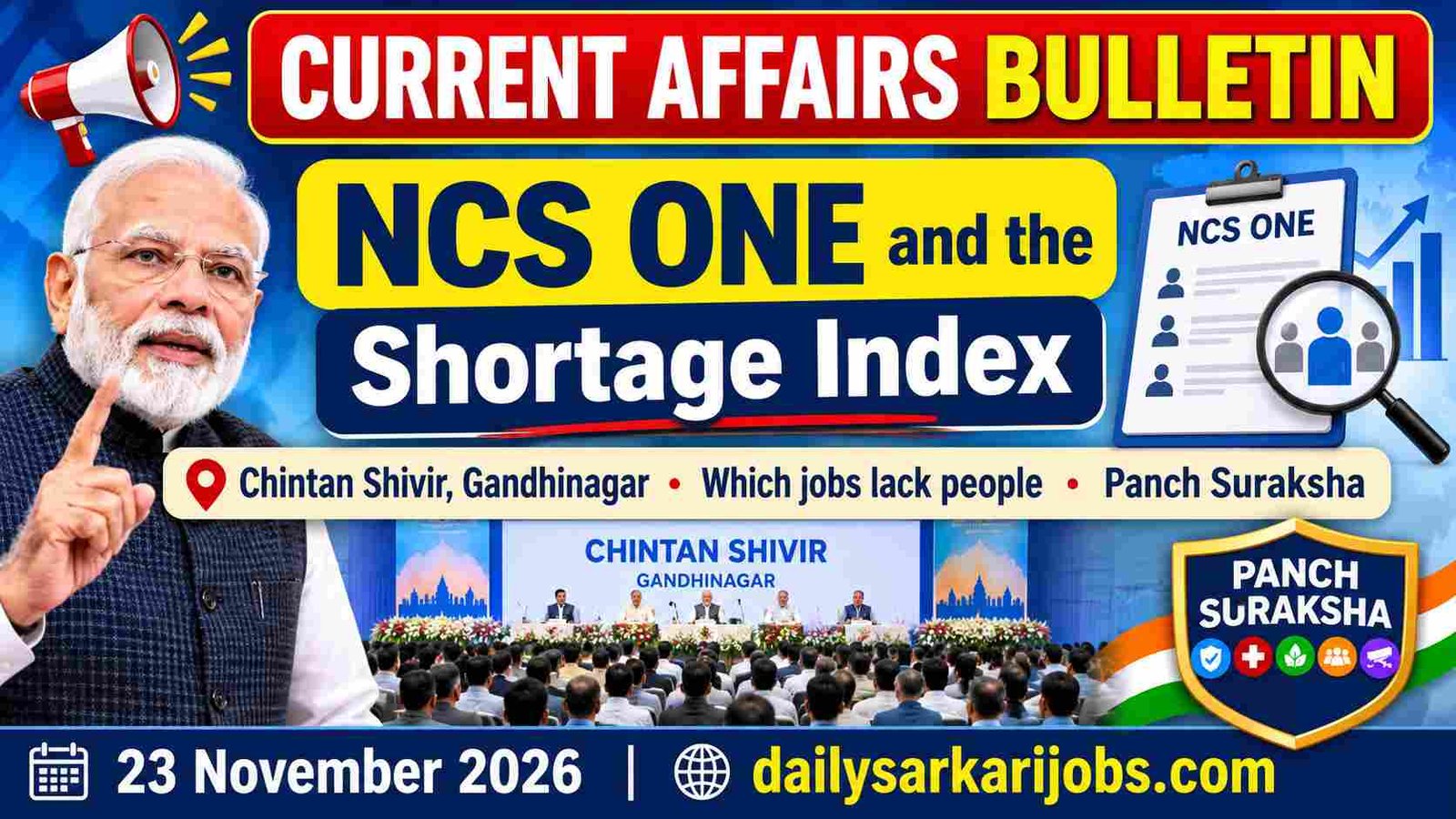
For as long as India has kept employment statistics, it has measured one thing: how many people cannot find work. On 22 November 2026, at the Chintan Shivir in Gandhinagar, the Labour Ministry launched a tool that measures the opposite — which work cannot find people. That is the Occupational Shortage Index, and the distinction is the whole point. Unemployment and shortage are not opposites that cancel out; a country can suffer both at the same time, and India does. The cures are different too: unemployment needs more jobs, while shortage needs people pointed towards different training. You cannot fix the second problem by solving the first.
⚡ QUICK FACTS
Event
Chintan Shivir, 21-22 November 2026
Venue
Gandhinagar, Gujarat
Ministry
Labour and Employment
Launched by
Dr Mansukh Mandaviya
What was launched
The Chintan Shivir was a two-day meeting of the Labour and Employment Ministers of the states and union territories, held on 21 and 22 November 2026 in Gandhinagar, Gujarat. Chintan Shivir means a reflection camp — a working retreat where ministers and officials think through a subject together rather than simply announce decisions.
Item
Detail
NCS ONE portal
National Career Service Open Network for Employment
Addendum to the National Classification of Occupations, 2015
Publication two
Compilation of Existing and Emerging Green Occupations
The launches were made by Dr Mansukh Mandaviya, Union Minister of Labour and Employment, who also holds Youth Affairs and Sports. Sushri Shobha Karandlaje, Minister of State for Labour and Employment and for MSME, also took part. The knowledge partners were the V. V. Giri National Labour Institute at Noida and Gujarat National Law University at Gandhinagar.
The Occupational Shortage Index
The Ministry describes it as a data-driven tool to assess labour market demand and supply gaps. In plain terms, it looks at each occupation and asks whether the country has enough trained people for the work that exists.
Why that matters is best seen through an example. Suppose a state has thousands of unemployed graduates and, at the same time, factories that cannot find welders. Both facts are true at once. An unemployment figure captures only the first. It tells a young person that jobs are scarce, but not which jobs are going begging. A shortage index answers the second question, and that answer is far more useful to somebody deciding what to train in.
The Ministry lists four uses for the index.
Jobseekers can make career choices with evidence instead of guesswork.
Employers can identify shortages and plan recruitment.
Training institutions can align skilling with what industry actually needs.
Policymakers can target employment and skilling action where the gap is widest.
One honest caveat worth knowing, because a careful question could turn on it: the Ministry has not published the index’s methodology, data sources or update frequency. What has been announced is the tool and its purpose, not the arithmetic behind it. For how a different official index is actually constructed, see our capsule on how CPI and WPI inflation are measured.
NCS ONE, and what the NCS already was
The National Career Service is the government’s employment portal, where jobseekers register and employers post vacancies. The problem it has always faced is that it was one portal among many: states run their own employment portals, private job sites run theirs, and campuses run placement systems of their own. A vacancy on one is invisible to the others.
NCS ONE — National Career Service Open Network for Employment — is the attempt to join them up. The Ministry says it links jobseeker apps, employer apps, state employment portals, private job platforms and campuses. The word that matters is network: it is not another portal competing with the rest, it is a layer meant to connect them. It also carries a Voice Bot and a Chat Bot so that a user can ask questions by speaking or typing rather than navigating menus.
Career Lounges
Eight NCS Career Lounges were launched virtually, and 200 are planned. They extend the existing Model Career Centres and are aimed mainly at Tier-II and Tier-III cities, sitting inside employment exchanges, universities and other educational institutions.
The eight cities
State
Jaipur
Rajasthan
Ludhiana
Punjab
Bhubaneswar
Odisha
Kanpur
Uttar Pradesh
Bengaluru
Karnataka
Varanasi
Uttar Pradesh
Hyderabad
Telangana
Guwahati
Assam
The lounges are to offer career guidance, assessments, mentoring, internships, apprenticeships and placement support — and notably also international employment and language preparation, which is why one of the Shivir’s sessions was on career lounges for international labour mobility. The skilling side of this picture is covered in our explainer on PM SETU and ITI upgradation.
e-Shram and the five protections
e-Shram is the national database of unorganised workers — the labourers, vendors, domestic workers and others who have no formal employer and therefore fall outside the usual payroll records. The new Livelihood Profile Module tracks a worker’s livelihood information alongside five social security protections, grouped as Panch Suraksha.
Panch Suraksha
Protection
One
Food security
Two
Health protection
Three
Life insurance
Four
Accident and disability protection
Five
Pension security
Learn those five as a set; a question asking which of the following is not among the Panch Suraksha is the obvious form. For the retirement-savings side of social security, see our explainer on the EPFO wage ceiling.
One year of the Labour Codes
The Shivir also marked one year since the Labour Codes came into effect on 21 November 2025. Much of the two days went on ground-level implementation, with plenary sessions on EPFO and ESIC reforms, social security for unorganised workers and labour statistics, and breakaway sessions on MSME engagement, grievance redressal, the National Classification of Occupations and a District Employment Profile framework.
The National Classification of Occupations is the official list that gives every occupation in India a code, so that employment data from different sources can be compared. Its last full edition was NCO-2015, and the addendum released at the Shivir updates it. The second publication, on green occupations, maps the jobs emerging from the shift to clean energy — the same transition described in our explainers on the National Green Hydrogen Mission and grid-scale energy storage.
Exam Alert
NCS ONE = National Career Service Open Network for Employment. Expect the full form to be asked.
The Occupational Shortage Index measures demand and supply gaps by occupation — not the unemployment rate.
Chintan Shivir: 21 to 22 November 2026, Gandhinagar, Gujarat, Ministry of Labour and Employment.
Panch Suraksha: food security, health protection, life insurance, accident and disability protection, pension security — carried by the e-Shram Livelihood Profile Module.
Eight Career Lounges launched, 200 planned, extending Model Career Centres into Tier-II and Tier-III cities.
The Labour Codes came into force on 21 November 2025.
Two publications: the NCO-2015 addendum and the green occupations compilation.
Knowledge partners: V. V. Giri National Labour Institute, Noida, and Gujarat National Law University, Gandhinagar.
Did You Know?
Unemployment and shortage can rise together. People without jobs and jobs without people are separate failures, and an economy can have plenty of both at once. That is precisely why a second index was needed.
The V. V. Giri National Labour Institute is named after a President of India. V. V. Giri, India’s fourth President, was a trade unionist before he entered office.
The Career Lounges teach languages. Because they prepare workers for jobs abroad, language training sits alongside interview practice — employment policy quietly becoming foreign policy.
Green jobs now have their own catalogue. The compilation released at the Shivir lists occupations that barely existed a decade ago.
30-Second Quick Revision
What and when: Chintan Shivir of state Labour Ministers, 21-22 November 2026, Gandhinagar.
The headline tool: the Occupational Shortage Index, measuring which occupations lack people.
The platform: NCS ONE, linking state portals, private job sites, campuses and apps.
The social security piece: e-Shram Livelihood Profile Module carrying Panch Suraksha.
The reach: eight Career Lounges live, 200 planned, extending Model Career Centres.
The anniversary: one year of the Labour Codes, in force since 21 November 2025.
Test Your Knowledge
Q1. The Occupational Shortage Index, launched in November 2026, measures (a) The national unemployment rate (b) Demand and supply gaps across occupations (c) Inflation in wages (d) The number of registered trade unions Answer: (b) Demand and supply gaps across occupations It is meant to tell a jobseeker which occupations lack trained people, which an unemployment figure cannot do.
Q2. NCS ONE stands for (a) National Career Service Online Network for Employers (b) National Classification of Skills Open Network (c) National Career Service Open Network for Employment (d) National Centre for Skills and Occupational Needs Answer: (c) National Career Service Open Network for Employment It links jobseeker apps, employer apps, state employment portals, private job platforms and campuses.
Q3. The Chintan Shivir of Labour and Employment Ministers in November 2026 was held at (a) New Delhi (b) Lucknow (c) Bhopal (d) Gandhinagar Answer: (d) Gandhinagar It ran over two days, 21 and 22 November 2026, in Gujarat.
Q4. Which of the following is NOT one of the five Panch Suraksha protections? (a) Housing security (b) Food security (c) Life insurance (d) Pension security Answer: (a) Housing security The five are food security, health protection, life insurance, accident and disability protection, and pension security.
Q5. The Labour Codes came into effect on (a) 1 April 2025 (b) 21 November 2025 (c) 1 January 2026 (d) 21 November 2026 Answer: (b) 21 November 2025 The Gandhinagar Chintan Shivir marked their first anniversary.
Want the full ten-question set as a PDF? Head to our Test Your Knowledge page.
Verified on 23 November 2026 against the Press Information Bureau release of 22 November 2026 on the conclusion of the two-day Chintan Shivir of Labour, Employment and Industry Ministers of States and Union Territories at Gandhinagar.