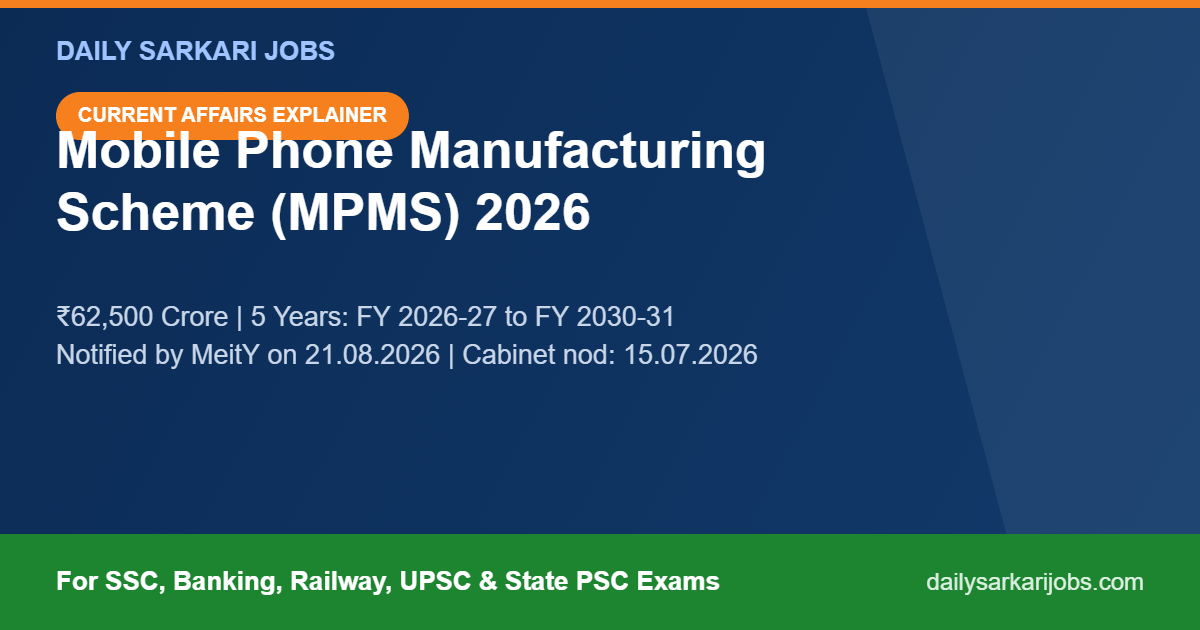
On 21 August 2026, the Ministry of Electronics and IT (MeitY) notified a new Mobile Phone Manufacturing Scheme (MPMS) worth ₹62,500 crore. The Union Cabinet had approved it earlier, on 15 July 2026. In easy words: for the next five years, the government will pay companies a small percentage of their sales as a reward for making mobile phones in India — and it will pay extra to anyone who makes the parts here, or who builds a phone brand that India actually owns.
⚡ QUICK FACTS
📱 Scheme
Mobile Phone Manufacturing Scheme (MPMS), MeitY
💰 Outlay
₹62,500 crore
🗓️ Tenure
5 years: FY 2026-27 to FY 2030-31
🏭 Target
₹39 lakh crore production, ~60,000 direct jobs
What Actually Happened
India’s old PLI scheme for large-scale electronics manufacturing — the one that brought iPhone assembly to Tamil Nadu and Karnataka — had run its course. MPMS is what comes after it. Two dates matter for your exam, and students mix them up every year:
15 July 2026 — the Union Cabinet approved the scheme.
21 August 2026 — MeitY notified it, which is when the rules became official.
The scheme will be run through a Project Management Agency, with an inter-ministerial empowered committee chaired by the Secretary, MeitY, taking the final calls.
The Scheme in One Line
Think of it as cashback on sales. If a company sells phones made in its Indian factory, the government returns a fixed percentage of those sales to it — between 2.25% and 5%. The catch is that the percentage is not the same for everybody. It depends on who you are and how much of the phone you actually make in India. That single idea is the whole scheme.
Who Gets How Much
MPMS splits applicants into two groups, called Target Segments.
Point
Target Segment 1 (TS1)
Target Segment 2 (TS2)
Who it is for
Big phone makers and contract manufacturers (EMS companies) registered in India
Indian mobile phone brands
Minimum turnover (FY 2025-26)
₹10,000 crore
₹1,000 crore
Base incentive
2.25% to 5% of eligible sales, stepping down over the years
5% flat
Extra for Indian design & R&D
Not available
Additional 3%
Extra for local components
Up to 1.5%
Up to 1.5%
Special condition
Incremental sales thresholds to be met each year
Indian-held IP and trademark, over 51% Indian shareholding, Indian management control, in-house R&D; one-year gestation period allowed
For TS1 the rate is highest in the early years and falls later — the government’s way of saying “the help is temporary, stand on your own feet.” As reported at the time of notification:
Financial Year
Lower slab
Higher slab
FY 2026-27 and FY 2027-28
2.75%
5%
FY 2028-29 and FY 2029-30
2.5%
4.5%
FY 2030-31
2.25%
4%
The Component Bonus — The Real New Idea
This is the part that separates MPMS from the old PLI. On top of the base incentive, a company can earn up to 1.5% extra for buying key parts from Indian suppliers — but only if it does this for at least 25% of the phones it sells in a year. Each part carries its own small reward:
Component made in India
Extra incentive
Enclosure (the body/frame)
0.5%
Display module
0.3%
Camera module
0.3%
Battery / cell
0.2%
USB cable and connectors
0.2%
Maximum total
1.5%
Why India Needed a New Scheme
Here is the honest picture, and it is the most useful thing to remember from this news. India is today the second largest mobile phone manufacturing country in the world. Production grew from about ₹18,000 crore in 2014-15 to ₹5.45 lakh crore in FY 2024-25 — roughly 28 times. Exports grew from about ₹1,500 crore to ₹2 lakh crore in the same period, roughly 127 times. In calendar year 2025, smartphones became India’s single largest export item, worth about ₹2.62 lakh crore (around $30 billion), ahead of diesel and cut diamonds.
Impressive — but there is a gap hiding inside those numbers. India’s domestic value addition in electronics is still only about 18-20%. In simple language: out of every ₹100 phone made here, only ₹18-20 of the value is actually created in India. The display comes from one country, the chip from another, the camera from a third. India mostly does the final assembly, which is the least valuable step in the chain.
MPMS is an attempt to fix exactly that. The 1.5% component bonus pushes companies to make parts here instead of importing them. The 3% design bonus pushes for something India still does not have — a phone brand that is Indian-owned, from the trademark to the intellectual property. Union Minister Ashwini Vaishnaw put the goal plainly: “Design, intellectual property and brand must be Indian-owned.” The government says it is in talks with three Indian players and expects a product in the market within about 18 months.
The Part Most News Reports Skip
A good current-affairs answer knows the limits of a scheme, not just its headline. Three points worth carrying into an interview or a descriptive paper:
The previous target was missed. A 2022 MeitY vision document aimed for about $126 billion of mobile production by FY 2025-26. The actual figure was closer to $70 billion, with roughly $29 billion of exports. Industry now expects the original ambition to arrive around 2030-31 — about five years late.
Exports are concentrated. A very large share of India’s smartphone exports comes from a single company’s supply chain. A production base that depends on one buyer is efficient, but it is not resilient.
Incentives cannot create demand. Domestic phone sales have been slow, and rising memory-chip prices are expected to keep pressure on the market. A subsidy on sales only helps if the sales happen.
None of this makes MPMS a bad scheme. It simply explains why the design changed: the old scheme rewarded volume, the new one rewards depth — parts, design and ownership. That shift, from “Assembled in India” to “Made and owned in India,” is the one-line insight to remember.
Key Terms for Your Exam
Term
What It Means
MPMS
Mobile Phone Manufacturing Scheme, 2026 — MeitY’s ₹62,500 crore, five-year incentive scheme for phones made in India.
PLI
Production Linked Incentive — a reward paid as a percentage of extra production or sales, not as an upfront grant. MPMS is a PLI-type scheme.
EMS company
Electronics Manufacturing Services — a contract manufacturer that builds products for other brands (for example, Dixon Technologies).
Domestic Value Addition (DVA)
The share of a product’s value actually created inside the country. India’s electronics DVA is about 18-20%.
ECMS
Electronics Components Manufacturing Scheme — a separate scheme for parts, whose Budget 2026 allocation was raised to ₹40,000 crore. Do not confuse it with MPMS.
Technological sovereignty
A country’s ability to design, own and control the technology it uses, instead of only assembling someone else’s.
Probable Exam Angles
Q1. The Mobile Phone Manufacturing Scheme (MPMS) notified in August 2026 has an outlay of: (a) ₹40,000 crore (b) ₹62,500 crore (c) ₹22,919 crore (d) ₹39 lakh crore Answer: (b) ₹62,500 crore. ₹39 lakh crore is the expected production during the scheme, and ₹40,000 crore is the ECMS allocation — classic distractors.
Q2. Under MPMS, the additional incentive for Indian design and R&D available to Indian brands is: (a) 1.5% (b) 2.25% (c) 3% (d) 5% Answer: (c) 3%. The 1.5% is the component-sourcing bonus, and 5% is the base rate for Target Segment 2.
Q3 (descriptive). “India assembles phones but does not yet make them.” Examine this statement in the light of the Mobile Phone Manufacturing Scheme, 2026. Frame your answer around three points: the scale India has achieved (second largest producer, smartphones as the top export item), the weakness that remains (18-20% domestic value addition, imported displays, chips and cameras), and how MPMS responds to it (component bonus, Indian-brand segment, ownership conditions).
Common Mistakes to Avoid
Do not confuse the two dates. Cabinet approval was 15 July 2026; the MeitY notification was 21 August 2026.
Do not confuse outlay with target. ₹62,500 crore is what the government will spend; ₹39 lakh crore is the production it hopes to see.
Do not mix the turnover thresholds. ₹10,000 crore is for TS1 (large manufacturers), ₹1,000 crore for TS2 (Indian brands).
The 3% bonus is not for everyone. It belongs only to Indian brands under TS2, and only for Indian design and R&D.
MPMS is not ECMS. One is for finished phones, the other for electronic components.
Do not write that MPMS “replaces Make in India.” It is one scheme under that broader policy, not a substitute for it.
Sources: Press Information Bureau releases on the Cabinet approval and notification of the Mobile Phone Manufacturing Scheme; MeitY data on electronics production, exports and domestic value addition; and contemporary reporting in Business Standard on the incentive slabs and production targets. Figures are as reported on the date of publication — always cross-check the latest official notification before quoting them in an exam.




1 thought on “Mobile Phone Manufacturing Scheme (MPMS) 2026 Explained in Simple Words – ₹62,500 Crore Scheme, Incentives and Exam Facts”
Comments are closed.