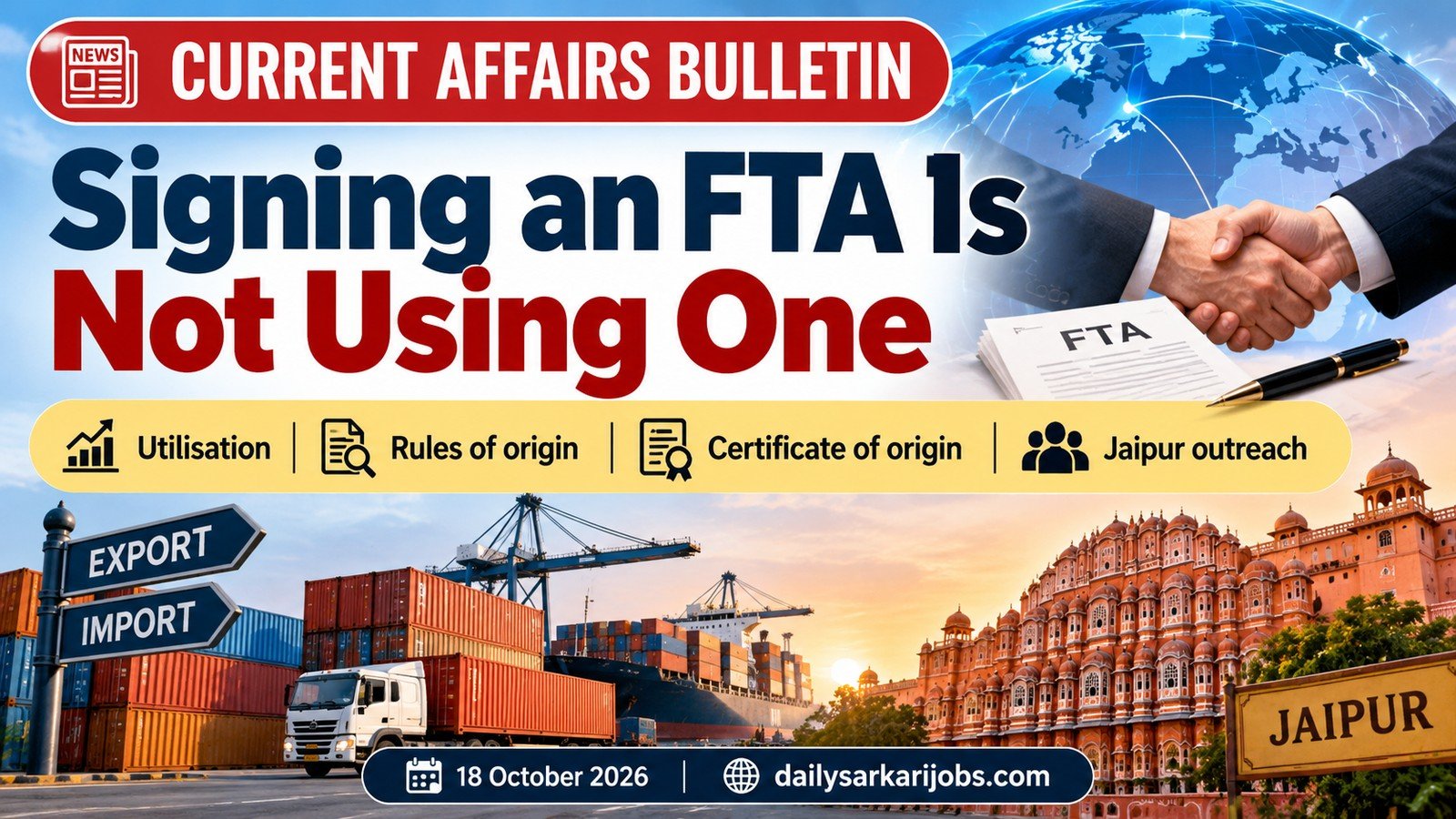
India has spent four years signing trade agreements. On 17 October 2026 the Department of Commerce held a programme in Jaipur to explain to exporters how to use them. The event was called Leveraging FTAs, and the fact that it had to be held at all is the most useful thing about it.
A trade agreement is a door. Somebody still has to walk through it. An agreement lowers a duty; it does not file a single form, identify a single buyer or prove where a single consignment was made. All of that is left to an exporter who may not know the agreement exists.
⚡ QUICK FACTS
The event
Leveraging FTAs Outreach Programme, Jaipur, 17 October 2026
Held by
The Department of Commerce, Ministry of Commerce and Industry
Who was in the room
Exporters, the State Government, DGFT, the Jaipur SEZ and the GJEPC
Agreements discussed
India’s agreements with the UAE, Australia, the EFTA countries and the United Kingdom
Exports, April to September 2026-27
About USD 476.20 billion, against USD 418.31 billion a year earlier
Growth
About 13.84 per cent
Gems and jewellery
India ranks 8th globally with a 2.9 per cent share of a USD 1 trillion market
What was taught
Export-ready products, tariff preferences, rules of origin, certification, buyer linkages
The Hinge: Signing Is Not the Benefit, Using Is
Every trade agreement is reported on the day it is signed and almost never on the day somebody uses it. That is the wrong way round, because the concession is worthless until a particular firm ships a particular product to a particular country and claims it.
The word for this is utilisation, and it is the number that actually measures an agreement. A country can conclude a dozen agreements and move very little extra trade, because small exporters do not know which of their products is covered, cannot prove origin, or have no buyer on the other side. An outreach programme in Jaipur is the Government admitting that in public, which is more honest than most trade announcements.
This completes a thought the site has been building for a fortnight.The ASEAN agreement review showed that the chapter nobody can agree on is the one that keeps getting its own meeting. The India-EFTA agreement showed that the verb in the treaty decides what was really promised. This event adds the last step: even a settled, favourable, fully-in-force agreement delivers nothing until an exporter in Bhilwara fills in a form correctly.
The Certificate of Origin Is the Agreement
At a port, nobody reads the treaty. A customs officer in the importing country reads one document: proof of where the goods were made. Without it the lower duty does not apply, whatever the agreement says.
That is what rules of origin are for. They decide when a good counts as coming from India — because otherwise goods made elsewhere could be routed through India to borrow its tariff concession, and the partner country would be giving away access it never intended to give.
The exporter asks
The answer decides
Is my product on the list?
Whether any concession exists at all
Does it qualify as Indian?
Whether the concession can be claimed — this is rules of origin
Can I prove it?
Whether the certificate of origin will be accepted
Has the agreement started?
Whether the duty has actually changed yet — implementation varies by agreement
Three of those four questions are paperwork, and that is the point.The new trade command centre launched two days earlier put Certificate of Origin among its first dashboards, alongside the Importer Exporter Code and Advance Authorisation. A government that is measuring certificates of origin has worked out that the agreement is not the bottleneck.
The Numbers the Release Gave
Figure
Value
Merchandise and services exports, April to September 2026-27
About USD 476.20 billion
The same period of 2025-26
About USD 418.31 billion
Growth
About 13.84 per cent
What drove September’s merchandise growth
Electronic goods, petroleum products, organic and inorganic chemicals, engineering goods, and cotton yarn, fabrics, made-ups and handloom
Gems and jewellery
India 8th among global exporters, 2.9 per cent of a USD 1 trillion market
Read the second-last row rather than skipping it. The list of what grew is a list of things India makes in volume, not a list of things India has just started making — and the external sector capsule explained why that matters: a goods deficit paid for by services and remittances is a different economy from one paid for by a manufacturing surplus. Export growth of 13.84 per cent is a good number; what it is composed of is the more interesting question.
Why Jaipur, and Why Gems and Jewellery
The sector chosen for the detailed presentation tells you what the programme was really for. Gems and jewellery is dominated by small firms and artisans, exactly the exporters least likely to have a compliance department that reads trade agreements.
The opportunities named were lab-grown diamond jewellery, coloured gemstones, Kundan-Meenakari heritage jewellery, smart and wearable jewellery, recycled and ethically sourced gold jewellery, and pearl and cultured jewellery. Note how many of those are about how a thing is made rather than what it is — lab-grown, recycled, ethically sourced. In several export markets the story of a product is now part of the product.
The State material is worth one line for anybody writing about Rajasthan: the Rajasthan Export Promotion Policy 2024, a stated target of a USD 350 billion economy and ₹1.5 lakh crore of exports by 2029, and a longer goal of a USD 4.3 trillion State economy by 2047. These are policy targets, not forecasts, and should be quoted as such.
What the Words Mean
Term
In plain words
FTA
Free Trade Agreement — a treaty in which countries cut duties on each other’s goods
Tariff preference
The lower duty an agreement gives, compared with the normal rate
Rules of origin
The test of whether a good counts as made in the exporting country
Certificate of origin
The document proving it, without which the lower duty is refused
Utilisation
The share of eligible trade that actually claims the agreement’s benefit
Tariff line
One entry in the customs classification — the unit in which concessions are counted
EPC
Export Promotion Council — an industry body recognised to support exporters in one sector
Why a Reader Should Care
The useful habit from this story is to stop reading trade news at the signature.When this site covered the New Zealand agreement, the finding was in the exclusion list rather than the headline. The habit generalises: for any agreement, ask three questions — what is excluded, when does it actually start, and who has to do paperwork to claim it.
And there is an honest caution here too. The release reports an event, not an outcome. It gives no utilisation rate for any agreement, no count of exporters trained, and no figure for how much trade has moved because of outreach. Those are the numbers that would settle whether programmes like this work, and they were not published.
Practice Questions
Q1. Rules of origin in a trade agreement determine (a) The port through which goods must be shipped (b) Whether a good counts as made in the exporting country and so qualifies for the lower duty (c) The currency in which payment must be made (d) The quality standards a good must meet Answer: (b) Whether a good counts as made in the exporting country and so qualifies for the lower duty Without meeting them a consignment pays the normal duty however favourable the agreement is, and the rule exists so that goods made elsewhere cannot be routed through a member country to borrow its concession.
Q2. The utilisation rate of a free trade agreement measures (a) How many countries have signed it (b) How many tariff lines it covers (c) The share of eligible trade that actually claims its benefit (d) The number of years it has been in force Answer: (c) The share of eligible trade that actually claims its benefit An agreement can cover a great many products and still move very little extra trade, which is why outreach programmes for exporters exist at all.
Q3. At the Jaipur outreach programme, India’s share of the global gems and jewellery market was given as (a) 2.9 per cent (b) 8 per cent (c) 13.84 per cent (d) 29 per cent Answer: (a) 2.9 per cent India was placed 8th among global exporters, and one of the wrong options is that rank rather than the share.
Q4. India’s merchandise and services exports in April to September 2026-27 were reported as about (a) USD 418.31 billion (b) USD 350 billion (c) USD 476.20 billion (d) USD 1 trillion Answer: (c) USD 476.20 billion The comparable figure for the same months a year earlier is one of the wrong options, and the growth between the two was about 13.84 per cent.
Q5. Which of the following agreements was NOT among those discussed at the programme? (a) India and the UAE (b) India and Australia (c) India and the United States (d) India and the United Kingdom Answer: (c) India and the United States The fourth agreement covered was the one with the European Free Trade Association countries, which are not in the European Union.