
Two taxes can take exactly the same rupee out of your pocket and have completely different consequences for the country. One is shared with the States; the other is not. Nothing on your bill or your payslip tells you which is which — the difference is in the name the tax was given, and the name is chosen in Delhi.
This is the fifth capsule in our series on the economy, explained in plain language for SSC, RRB NTPC, banking exams, State PSC and UPSC Prelims.
The Hinge: Read Where the Money Goes, Not What the Tax Is Called
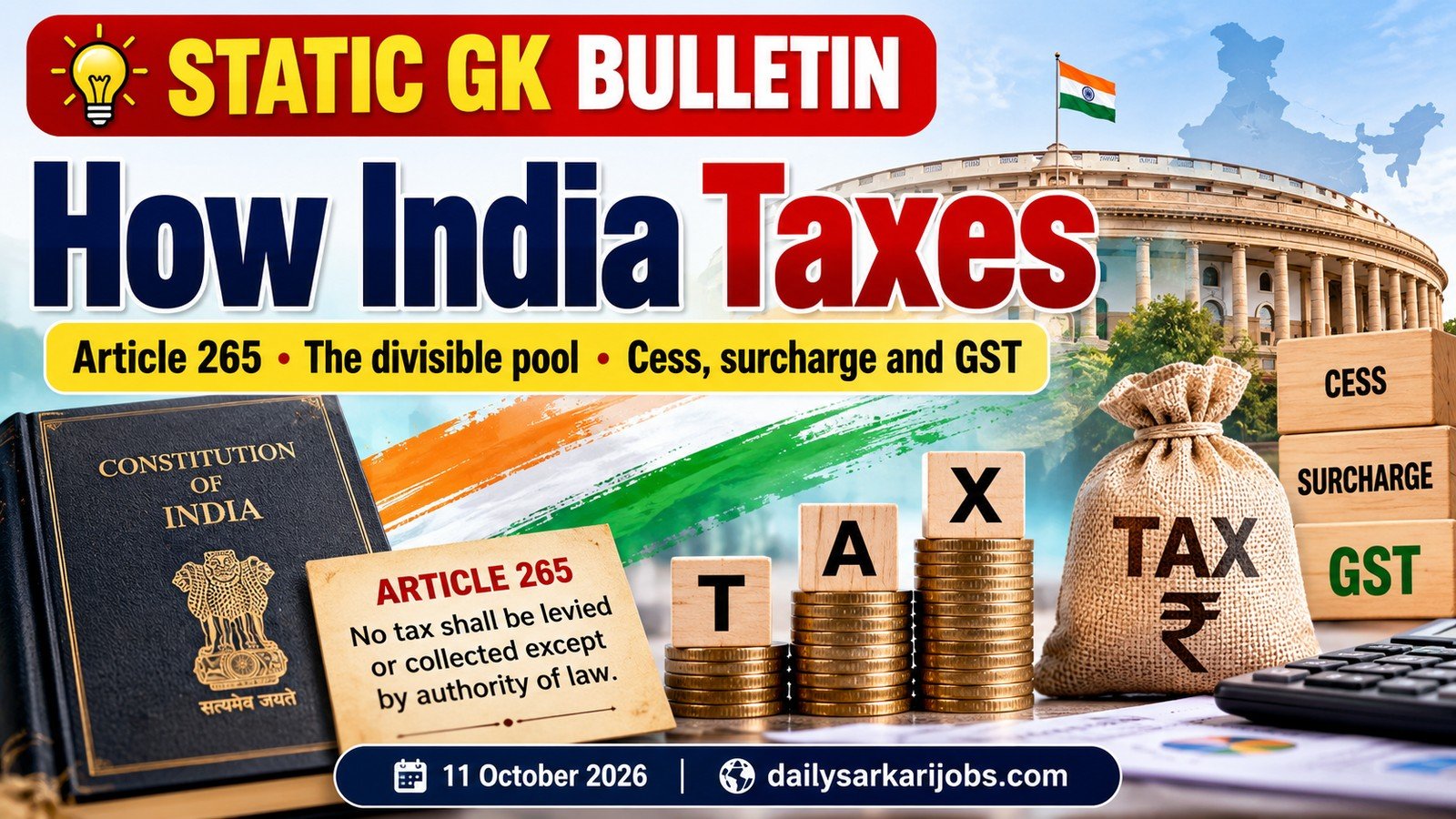
Start with the Constitution’s own words. Article 265: “No tax shall be levied or collected except by authority of law.”
Read the verbs. It says levied or collected — both, separately. A government cannot impose a tax without a law, and it cannot collect one either, even if the imposition was lawful. That is why a tax demand with no statute behind it fails in court however reasonable it sounds, and it is the shortest answer to any question beginning “can the government simply…”.
Now follow a rupee of central tax. Article 270 puts Union taxes into a shared pool — the divisible pool — of which a percentage goes to the States, the percentage being set by the President after considering what the Finance Commission recommends.
But Article 270 lists what does not go into that pool, and the list is the single most consequential sentence in Indian public finance:
- The duties and taxes mentioned in Articles 268 and 269, which are assigned to the States by a different route
- Surcharges on taxes and duties, under Article 271
- Any cess levied for specific purposes under any law made by Parliament
And Article 271 makes the consequence explicit for a surcharge: the whole of its proceeds forms part of the Consolidated Fund of India. The States get none of it.
So the lesson is a habit, not a fact. When a tax is announced, do not ask what it is on. Ask what it is called. A one-rupee rise in a basic duty is partly the States’ money; a one-rupee cess with the same effect on the same buyer is entirely the Union’s. The citizen cannot tell the difference and the State government certainly can.
Direct and Indirect: the Oldest Division
| Direct tax | Indirect tax | |
|---|---|---|
| Who bears it | The person it is charged on — it cannot be passed on | Someone further down the chain — it is built into the price |
| Examples | Income tax, corporation tax | GST, customs duty, excise on petroleum and liquor |
| Administered by | Central Board of Direct Taxes | Central Board of Indirect Taxes and Customs |
| Both sit under | The Department of Revenue, Ministry of Finance | The Department of Revenue, Ministry of Finance |
| Effect across incomes | Can be made progressive — higher incomes pay a higher rate | Tends to be regressive — the same tax on a packet of biscuits is a larger share of a small income |
The last row is the one worth understanding rather than memorising. A country that raises most of its revenue indirectly is taxing its poorer citizens relatively harder, whatever the rates look like. That is why the balance between the two is a political question and not a technical one, and why it appears in essay papers far more often than in arithmetic ones.
Who Is Allowed to Tax What
The answer is in the Seventh Schedule, which divides subjects between the Union List, the State List and the Concurrent List. Taxation is the one area where there is no concurrency: a tax belongs either to the Union or to a State, never to both, because two governments taxing the same thing under separate laws would be unworkable.
| Level | What it may tax |
|---|---|
| Union | Income other than agricultural income, corporation tax, customs duties, excise on a short list of goods, and its share of GST |
| States | Agricultural income, land revenue, stamp duty, taxes on electricity, excise on alcohol for human consumption, and their share of GST |
| Both, by a special provision | Goods and services tax, under Article 246A |
Agricultural income is a State subject, which is the answer to a question asked almost every year. The Union cannot tax it — not because of a policy choice that could be reversed by a Budget, but because the Constitution places it with the States.
GST required its own article because it broke the rule. Article 246A, inserted by the 101st Amendment, lets Parliament and every State legislature make laws on the same tax — with Parliament holding exclusive power over supplies in the course of inter-State trade. The GST Council exists to keep those parallel laws identical.
The Shape of GST in One Table
| Component | On what supply | Who collects it |
|---|---|---|
| CGST | Within one State | The Union |
| SGST or UTGST | Within one State or Union territory | That State or Union territory |
| IGST | Between States, and on imports | The Union, under Article 269A, then apportioned between Union and States |
Imports are treated as inter-State supply — that is written into Article 269A itself, and it is a favourite one-line question. Note also what GST does not cover: petroleum products, alcohol for human consumption and electricity remain outside it, taxed the old way, which is why fuel prices do not move when GST rates do. Recent Council meetings have changed the administration of GST considerably without touching that boundary.
Cess and Surcharge: the Two Words That Matter Most
| Cess | Surcharge | |
|---|---|---|
| What it is | A tax levied for a stated purpose | A tax on top of a tax |
| Constitutional basis | Article 270, which excludes it from the divisible pool | Article 271 |
| Shared with States? | No | No |
| Is the purpose binding? | It must be spent on the stated purpose, through a dedicated fund | There is no stated purpose — it is general revenue |
| Example in ordinary life | A health and education cess added to your income tax | An extra percentage charged on very high incomes |
A cess at least has to say what it is for; a surcharge does not even pretend. Both share the one feature that matters to a State government: the money stops at the Union. When States complain that their share of central taxes has fallen even though central tax collection has risen, this is the mechanism they are describing — the pool is a percentage of a shrinking base, not of everything collected. The Finance Commission can recommend a larger share of the pool; it cannot put a cess into the pool.
The Income Tax Act, 2025
From 1 April 2026 India’s income tax is governed by a new statute, the Income Tax Act, 2025, replacing the Income-tax Act of 1961 after more than six decades. The old Act had been amended through nearly 65 Finance Acts and amendment Bills, accumulating over 4,000 changes.
- “Tax year” replaces two older terms. The Act drops previous year and assessment year and uses a single tax year, the twelve months of the financial year beginning 1 April. This is the change most likely to be examined, because the old pair confused everybody.
- It is a rewrite, not a rate change. The Act restructures and simplifies the language; it is not in itself a new set of slabs.
- It was drafted by a departmental committee of the CBDT, which consulted industry and professional bodies and studied the way the United Kingdom and Australia had rewritten their own tax laws.
- Its passage is a small lesson in procedure. The original Income-tax Bill, 2025 was referred to a Parliamentary Select Committee; the Government then withdrew it and introduced a fresh Bill incorporating most of the committee’s recommendations, which both Houses passed in the monsoon session.
That last point is the useful one. Withdrawing a Bill and reintroducing an amended version is cleaner than carrying hundreds of amendments through the House, and it is a manoeuvre worth recognising when it happens again.
The Vocabulary of a Budget Speech
| Term | In plain words |
|---|---|
| Divisible pool | The part of central tax revenue that is shared with the States |
| Devolution | The act of transferring that share |
| Progressive tax | A higher rate on higher incomes |
| Regressive tax | A tax that takes a larger share of a smaller income |
| Tax buoyancy | How much tax revenue grows when the economy grows |
| Tax-to-GDP ratio | Total tax collected as a share of the economy — a measure of how much of the economy the state can reach |
| Direct tax | Borne by the person charged |
| Indirect tax | Passed on in the price |
Why a Reader Should Care
Taxation is where the Constitution stops being about rights and starts being about money, and the two are the same subject. A State that cannot raise revenue cannot do anything its own voters elected it to do, whatever powers the Seventh Schedule gives it on paper.
So the argument between the Union and the States is never really about rates. It is about labels — which rupee is called a duty and shared, and which is called a cess and kept. The Budget announces the rate and the newspapers report the rate; the word next to it decides who gets the money, and almost nobody reads it. The same lesson has already appeared in this series in a different form: the choice of a price index quietly sets the repo rate and the minimum wage. In public finance, the technical word is usually where the politics is hiding.
Practice Questions
Q1. Which article of the Constitution says that no tax shall be levied or collected except by authority of law?
(a) Article 110 (b) Article 265 (c) Article 280 (d) Article 300A
Answer: (b) Article 265 One wrong option defines a Money Bill, another sets up the Finance Commission and the third concerns the right to property, so none of them governs the power to tax itself.
Q2. Which of the following does NOT form part of the divisible pool shared with the States?
(a) Corporation tax (b) Customs duty (c) A cess levied for a specific purpose (d) The Union’s share of GST
Answer: (c) A cess levied for a specific purpose Article 270 excludes it by name, along with surcharges under Article 271, which is why a rise in this kind of levy leaves State governments no better off.
Q3. Agricultural income may be taxed by
(a) The Union only (b) The States only (c) Both the Union and the States (d) Neither
Answer: (b) The States only This is a Seventh Schedule allocation rather than a policy choice, so it cannot be changed by a Budget announcement.
Q4. Article 246A is a special provision dealing with
(a) The Finance Commission (b) Goods and services tax (c) Surcharges (d) Customs duties
Answer: (b) Goods and services tax It was inserted by the 101st Amendment and is unusual because it lets Parliament and the State legislatures make laws on the same tax, with inter-State supply reserved to Parliament.
Q5. The Income Tax Act, 2025 replaces which pair of terms with a single tax year?
(a) Financial year and calendar year (b) Accounting year and fiscal year (c) Previous year and assessment year (d) Base year and current year
Answer: (c) Previous year and assessment year The two terms it drops are the ones that forced every taxpayer to keep track of two different twelve-month periods for the same income.