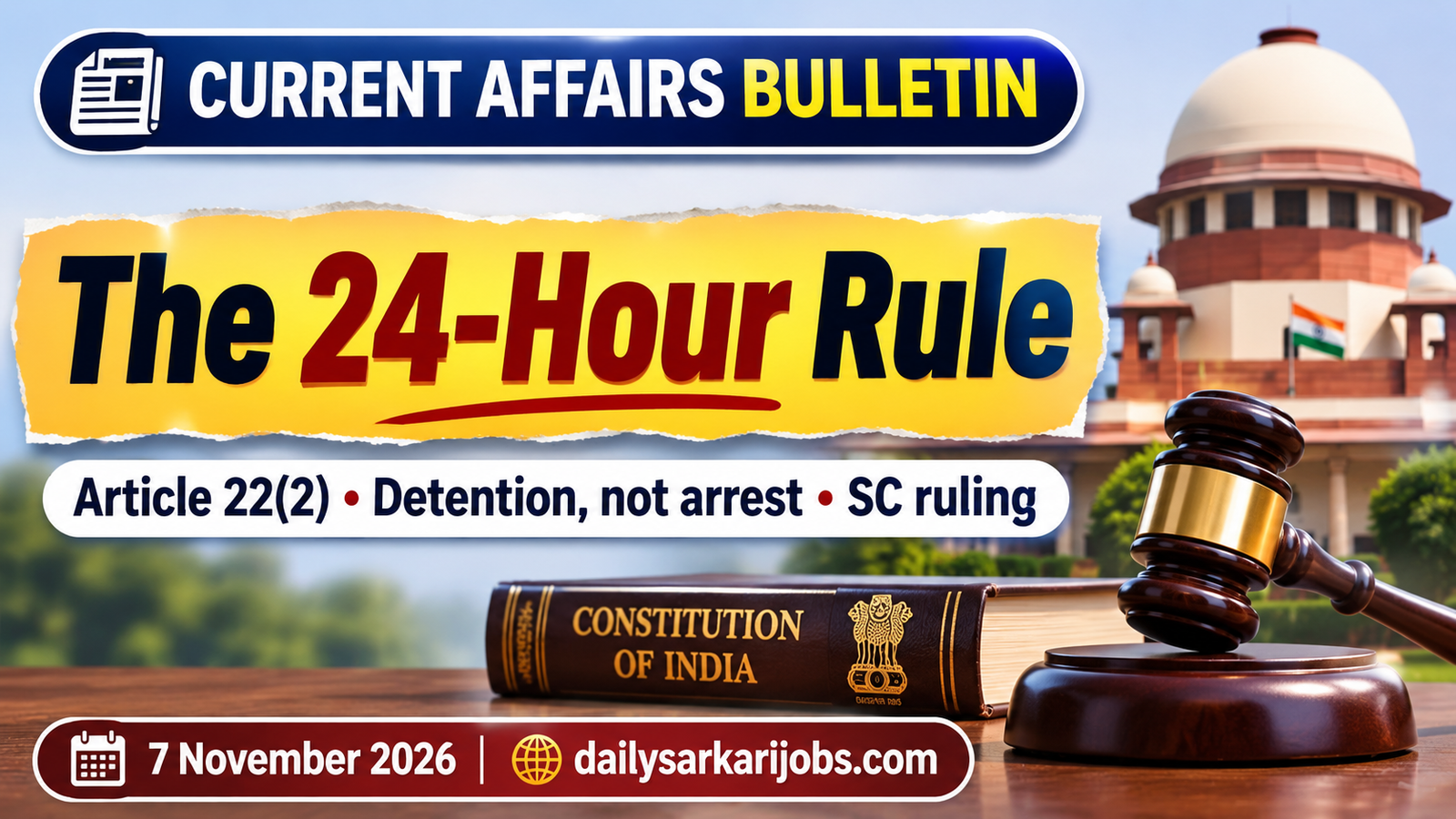
On 5 November 2026 the Supreme Court settled a question that had been answered differently by different High Courts: when exactly does the 24-hour clock in Article 22(2) start? The answer turns on a distinction the police had been drawing and the Court has now refused to accept.
The Clock Starts When Your Liberty Ends, Not When the Paperwork Does
The practice being challenged was this. Police would stop a person during a search, hold them for hours while the search and seizure were completed, and only then record a formal arrest. The 24-hour period was then counted from that formal arrest — so the hours already spent in custody simply did not count.
The Supreme Court held that this split between “detention” and “arrest” is artificial and constitutionally unsustainable. In the Court’s reasoning, the Constitution does not recognise a detention that is separate from arrest. If your liberty has been curtailed, you are in custody, whatever the file says.
So the 24 hours run from the moment liberty is curtailed, and if that period passes without production before a Magistrate, the person must be released immediately.
Jargon, Defined Once
- Article 22 is the fundamental right that protects a person who has been arrested. It is the safeguard that sits beside Article 21’s guarantee of life and personal liberty.
- Production before a Magistrate means physically bringing the person before a judicial officer, so that a judge rather than the police decides whether custody continues.
- Remand is the Magistrate’s order permitting further custody. Without it, custody must end.
- The BNSS is the Bharatiya Nagarik Suraksha Sanhita, the criminal procedure law that replaced the CrPC. Sections 56 and 58 deal with production and with keeping detention reasonable.
- The NDPS Act is the narcotics law, under which Section 37 sets unusually strict conditions for bail.
What Article 22 Actually Says
| Clause | What it guarantees |
|---|---|
| 22(1) | The right to be told the grounds of arrest, and to consult and be defended by a lawyer of choice |
| 22(2) | Production before a Magistrate within 24 hours, excluding travel time, and no longer custody without the Magistrate’s authority |
| 22(3) | Says 22(1) and 22(2) do not apply to enemy aliens or to preventive detention |
That third clause is the trap. The 24-hour rule protects a person arrested in the ordinary criminal process. It does not reach preventive detention, which runs on a separate and far weaker set of safeguards. Our capsule on the Fundamental Rights sets Article 22 in its place among the rest.
What the Court Decided
- The 24 hours begin when liberty is curtailed, not when an arrest is recorded.
- Time spent on inquiry, investigation or search and seizure cannot be excluded. The only permitted exclusion is the journey from the place of arrest to the Magistrate’s court — which is what the Article itself says.
- If the 24 hours pass without production, release is immediate.
- Even inside the 24 hours, detention must stay reasonable under Section 58 of the BNSS.
- The Magistrate must record the actual date and time of detention and check that the limit was met — and may refuse remand if the detention, though under 24 hours, was unreasonably long.
- The Court tied the reasoning to custodial violence, as the reason judicial oversight of custody has to be real rather than formal.
The Case Behind the Ruling
The appeal was Sujit Das v. Union of India, brought by four people whose bail the Tripura High Court had refused in a case under the NDPS Act involving a commercial quantity of yaba tablets.
| When | What happened |
|---|---|
| 29 September 2025, 2 pm | The four were detained during a search and seizure |
| 30 September 2025, 11 am | They were shown as formally arrested — 21 hours later |
| 5 November 2026 | The Supreme Court held Article 22(2) was violated and ordered their release |
The High Court had taken the view that the strict bail conditions of Section 37 of the NDPS Act had to be satisfied regardless, and had rejected the argument built on the arrest procedure. The Supreme Court’s answer was that a constitutional violation at the very start of custody is not cured by how serious the offence later turns out to be.
The Court also sorted out the conflicting High Court rulings. It disapproved decisions of the Orissa, Kerala and Madras High Courts that had allowed pre-arrest detention to be excluded from the 24 hours, and approved a 2025 Kerala High Court ruling holding that the period begins when liberty is effectively curtailed. That is what makes this a settling judgment rather than one more voice in the argument.
Exam Alert: Four Points to Mark
- Article 22(2), not 21. Article 21 protects life and personal liberty in general; the 24-hour rule is specifically 22(2).
- Only journey time is excluded. Not investigation, not search, not paperwork.
- Preventive detention is outside all of this, under Article 22(3). The most common wrong answer on this topic.
- The CrPC is gone. The provisions here are Sections 56 and 58 of the BNSS. Questions written before the new codes will say CrPC Section 57; the principle is the same but the citation has changed.
Did You Know: The Rule Is Older Than the Constitution
The idea that a person in custody must be produced before a judicial officer quickly is not an invention of 1950. It is the long-standing principle behind habeas corpus — literally, produce the body — which is also the first of the five writs the higher courts can issue.
What the Constitution did was turn a remedy into a deadline. Habeas corpus requires somebody to go to court and ask. Article 22(2) runs on its own, whether or not anyone complains — and the judgment of 5 November is about making sure the clock cannot be quietly restarted. Our capsule on the Supreme Court and the High Courts covers the writs in full, and the NHRC capsule covers custodial violence as a human rights question.
Why a Reader Should Care
Article 22 is a staple of every polity paper, and a Supreme Court judgment that changes how a famous number is counted is exactly the kind of development that turns into a question. It also carries the new BNSS citations, which examiners have been steadily switching to.
Today’s Static GK capsule is on India’s air quality system — the AQI, GRAP and NCAP, and the pair share a structure worth noticing. Both are rules where a number does the deciding. Twenty-four hours forces a release; an AQI reading forces a set of restrictions. In each case the design point is the same — the threshold acts on its own, so that nobody has to be persuaded to act.
Practice Questions
Q1. Under which provision must an arrested person be produced before a Magistrate within 24 hours?
(a) Article 20(3) (b) Article 21 (c) Article 22(2) (d) Article 19(1)(d)
Answer: (c) Article 22(2) The general guarantee of life and personal liberty sits in Article 21; this clause is the one that sets the specific deadline.
Q2. In its judgment of 5 November 2026, the Supreme Court held that the 24-hour period begins
(a) From the time liberty is curtailed (b) From the formal recording of arrest (c) From the completion of search and seizure (d) From the filing of the first information report
Answer: (a) From the time liberty is curtailed The Court called the split between detention and arrest artificial, and ordered the four appellants released.
Q3. Which period may lawfully be excluded while computing the 24 hours?
(a) Time spent on investigation (b) Time spent on search and seizure (c) Time needed to travel from the place of arrest to the court (d) Time spent recording the arrest memo
Answer: (c) Time needed to travel from the place of arrest to the court That exclusion appears in the text of the Article itself, and the Court held that no other exclusion is permitted.
Q4. The protection of the 24-hour rule does NOT extend to
(a) Persons arrested under the NDPS Act (b) Persons held under preventive detention (c) Persons arrested at night (d) Women and minors
Answer: (b) Persons held under preventive detention Article 22(3) places enemy aliens and preventive detention outside clauses (1) and (2) altogether.
Q5. The statutory provisions discussed alongside Article 22(2) in this judgment belong to
(a) The Indian Penal Code (b) The Code of Criminal Procedure, 1973 (c) The Indian Evidence Act (d) The Bharatiya Nagarik Suraksha Sanhita
Answer: (d) The Bharatiya Nagarik Suraksha Sanhita Sections 56 and 58 of that Sanhita deal with production before a Magistrate and with keeping the detention reasonable.
30-Second Revision
- The hinge: the clock starts when liberty ends, not when the paperwork does. The Constitution does not recognise a detention separate from arrest.
- The judgment: 5 November 2026, Justices Ujjal Bhuyan and Atul S. Chandurkar, in Sujit Das v. Union of India; the four appellants were released.
- The rule: Article 22(2) — production within 24 hours, only journey time excluded, release immediate if breached, and the Magistrate must record the actual time of detention.
- The limit of the rule: Article 22(3) keeps preventive detention and enemy aliens outside it.
- The statute: Sections 56 and 58 of the BNSS, which replaced the CrPC; the case arose under Section 37 of the NDPS Act.
What Is Not Settled
Two honest notes. First, “reasonable” detention inside the 24 hours is not defined by a number. The Court said a Magistrate may refuse remand where custody was unreasonably long even within the limit, but what counts as unreasonable will be worked out case by case.
Second, this account follows the reported judgment rather than a certified copy, so for the exact wording of the directions, read the text on the Supreme Court’s own site before quoting it as a rule.
Sources
- Reporting of the Supreme Court judgment of 5 November 2026 in Sujit Das v. Union of India — the bench, the holding that the 24-hour period under Article 22(2) runs from the curtailment of liberty, the limited exclusion for journey time, the directions to Magistrates to record the actual time of detention, the Section 58 BNSS reasonableness requirement, the order of release, and the High Court decisions approved and disapproved.
- The facts of the case — detention at 2 pm on 29 September 2025, formal arrest recorded at 11 am on 30 September 2025, and the Tripura High Court’s earlier refusal of bail under Section 37 of the NDPS Act.
- The text of Article 22 of the Constitution for clauses (1), (2) and (3).