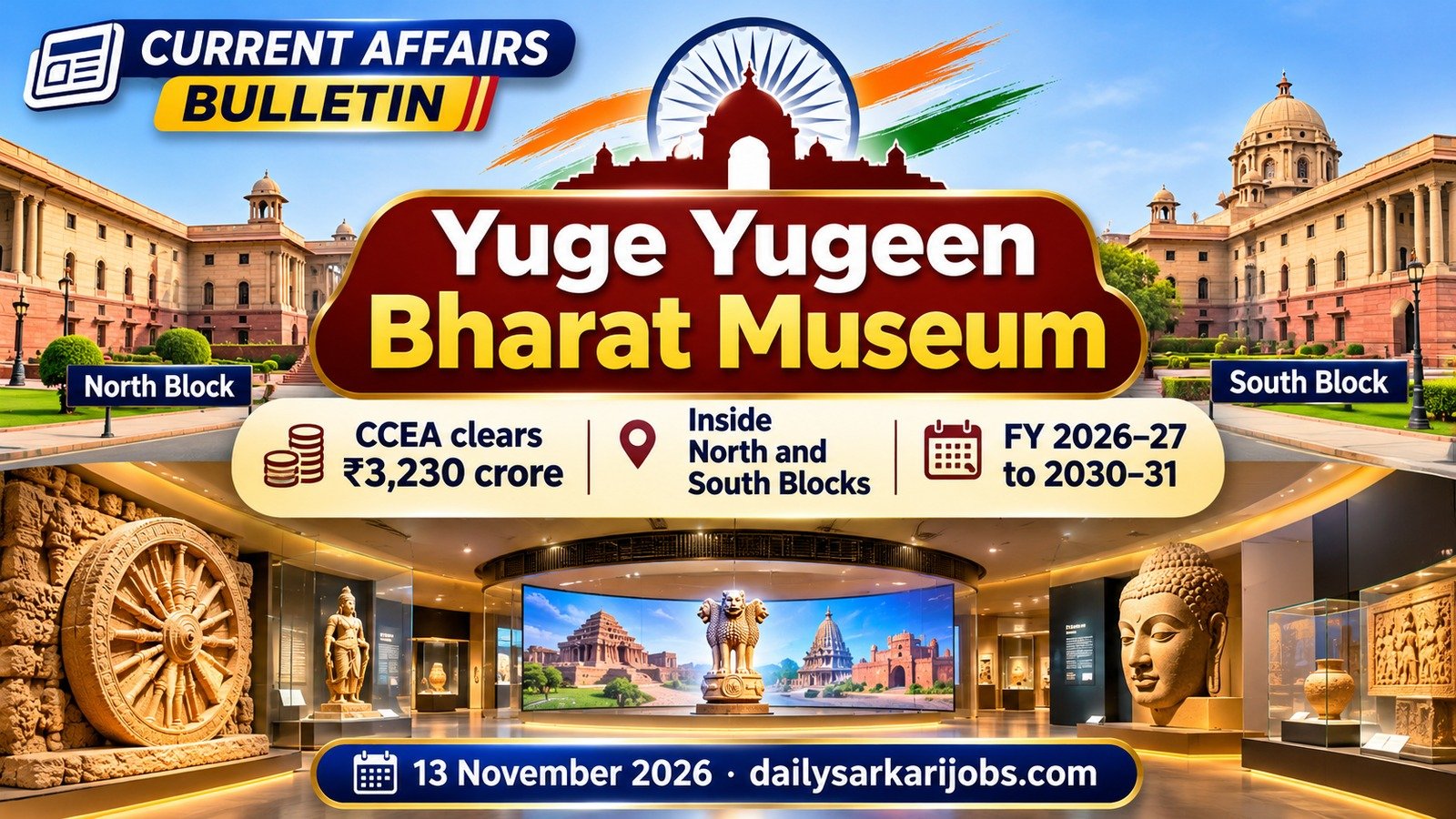
The Cabinet Committee on Economic Affairs approved the Yuge Yugeen Bharat Museum on 11 November 2026, at an estimated ₹3,230 crore. Most coverage leads with the money or with the claim about size. The genuinely striking thing is the address.
The Government Is Not Building a Museum. It Is Moving Out of Its Own Head Office.
The museum is going into the North and South Blocks. Those are not spare buildings. They are the Secretariat — the two wings that flank Rashtrapati Bhavan on Raisina Hill and have housed the most senior ministries of the Union government since they were completed in 1927.
| Block | Who has worked there |
|---|---|
| North Block | Ministry of Finance, Ministry of Home Affairs, the CBDT and the CBIC |
| South Block | The Prime Minister’s Office, the Ministry of Defence, the Ministry of External Affairs and the National Security Council |
Read that table again and the scale of the decision becomes clear. Every Union Budget of independent India was prepared in North Block. Every war has been run from South Block. These offices are being moved in phases to new buildings, and the rooms they leave behind become galleries.
That is the hinge: the exhibit and the building are the same object. A museum of Indian civilisation is being installed inside the seat of the government that colonised it and then inside the seat of the government that replaced it. The building is not a container for the history; it is a piece of it.
Jargon, Defined Once
- The CCEA is the Cabinet Committee on Economic Affairs, chaired by the Prime Minister. It clears projects and spending above a threshold, so a great many large approvals carry its name rather than the full Cabinet’s.
- The Secretariat Building is the formal name for the pair of blocks. North Block and South Block are halves of one design, not two separate buildings.
- Built-up area is the total floor space across all storeys, not the footprint on the ground.
- Tangible heritage is the things you can touch — objects, buildings. Intangible heritage is practice: music, craft, ritual. The museum is meant to hold both.
- Yuge Yugeen means age after age, or through the ages.
The Numbers Worth Carrying
- ₹3,230 crore, approved by the CCEA chaired by the Prime Minister.
- Phased from FY 2026–27 to FY 2030–31 — five financial years.
- About 1.78 lakh square metres of proposed built-up area.
- Nearly 1.8 million artefacts have been identified as possible exhibits, drawn from the National Museum, museums under the Ministry of Culture, ASI site museums, state museums and private collections.
- The first gallery, Adornment, is expected to open in North Block in the second half of 2027.
- It is expected to have the world’s largest museum display area when complete — note the careful wording: display area, not collection.
That last distinction is worth holding on to. A claim about floor space is not a claim about holdings. The Louvre and the British Museum are not being overtaken on what they own; the statement is about how much room there will be to show things in.
The Galleries Named So Far
- Architecture and Cityscapes
- Mathematics and Astronomy
- Languages and Scripts
- Faith and Spirituality
- Bharat Connects: Trade and Ideas
Notice what the list is organised by. Not dynasties, not centuries, not regions. The galleries are themes that run the whole length of Indian history, which is what the name of the museum is claiming — age after age, the same subjects reappearing.
The Buildings Themselves
- The Secretariat was designed by Herbert Baker, who worked alongside Edwin Lutyens on New Delhi. Lutyens designed Viceroy’s House, now Rashtrapati Bhavan; Baker designed the two blocks that flank it.
- The style is Indo-Saracenic Revival.
- Construction began in 1912 and was completed in 1927.
- They stand on Raisina Hill, the only buildings to share that hill with Rashtrapati Bhavan.
- The ministries are being relocated in phases to new government buildings as the conversion proceeds.
Exam Alert: Five Traps
- Herbert Baker designed the Secretariat; Lutyens designed Rashtrapati Bhavan. Two architects, one city plan, and the names are swapped constantly.
- North Block is Finance and Home. South Block is the PMO, Defence and External Affairs. Learn it as money and police in the north, war and diplomacy in the south.
- It was approved by the CCEA, not the full Cabinet.
- The claim is the largest display AREA, not the largest collection.
- ₹3,230 crore and five financial years. Both figures are asked.
Did You Know: The Building Was Designed for an Empire That Moved In Four Years Late
The decision to shift the capital from Calcutta to Delhi was announced in 1911, and work on the Secretariat began in 1912. It was finished in 1927 — fifteen years later — and the new capital was formally inaugurated in 1931.
Which means the British governed from these rooms for only about sixteen years before Independence. The building took almost as long to put up as the empire had left to use it. Independent India has worked in it for nearly eighty years — five times longer than the government it was built for. It was always more an Indian building than a colonial one, by simple arithmetic.
Why a Reader Should Care
Cabinet approvals of large projects are standard Current Affairs material, and this one carries an unusual number of separately askable facts: the committee, the sum, the location, the architect, the period and the galleries. It sits with our explainers on UNESCO’s Memory of the World register and our capsules on India’s UNESCO World Heritage Sites and the National Akademis.
Today’s Static GK capsule is on India’s museums, and the two belong together closely. India’s oldest museum is not in Delhi, and the reason is the same reason this story exists: institutions cluster where power sits. Calcutta got the first museum because Calcutta was the capital. Delhi is now converting the building that replaced it.
Practice Questions
Q1. The Yuge Yugeen Bharat Museum, approved in November 2026, is to be developed at
(a) The Red Fort complex (b) The North and South Block complex (c) The Rashtrapati Bhavan estate (d) The Pragati Maidan complex
Answer: (b) The North and South Block complex The estimated cost is 3,230 crore rupees and the work is phased across five financial years from 2026-27.
Q2. The museum project was approved by
(a) The Cabinet Committee on Security (b) The Ministry of Culture alone (c) The Cabinet Committee on Economic Affairs (d) The NITI Aayog governing council
Answer: (c) The Cabinet Committee on Economic Affairs That committee is chaired by the Prime Minister and clears large projects and spending.
Q3. The Secretariat Building in New Delhi, comprising the North and South Blocks, was designed by
(a) Edwin Lutyens (b) Herbert Baker (c) Charles Correa (d) Robert Tor Russell
Answer: (b) Herbert Baker The architect of Rashtrapati Bhavan, then Viceroy’s House, was the other man on that list, and the two worked on New Delhi together.
Q4. Which of these ministries has had its offices in South Block?
(a) The Ministry of Finance (b) The Ministry of Home Affairs (c) The Ministry of External Affairs (d) The Ministry of Railways
Answer: (c) The Ministry of External Affairs The Prime Minister’s Office and the Ministry of Defence are also housed there, while Finance and Home Affairs are in the other block.
Q5. The proposed built-up area of the museum is approximately
(a) 1.78 lakh square metres (b) 78,000 square metres (c) 3.2 lakh square metres (d) 25,000 square metres
Answer: (a) 1.78 lakh square metres The project is expected to give the museum the world’s largest display area, a claim about floor space rather than about the size of the collection.
30-Second Revision
- The hinge: the government is handing over its own head office. North and South Blocks have housed the senior ministries since 1927.
- The decision: CCEA, 11 November 2026, ₹3,230 crore, phased FY 2026–27 to FY 2030–31.
- The scale: about 1.78 lakh sq m; nearly 1.8 million artefacts identified; first gallery Adornment in 2027; expected largest display area in the world.
- The buildings: Herbert Baker, Indo-Saracenic Revival, 1912 to 1927, on Raisina Hill beside Lutyens’ Rashtrapati Bhavan.
- The occupants: North — Finance, Home; South — PMO, Defence, External Affairs.
What Is Not Settled
Two honest notes. First, the gallery list is partial. Five themes have been named in the reporting and a sixth, Adornment, is described as the first to open. The full count of galleries has not been stated, so do not treat the five as the complete list.
Second, the world’s-largest claim is an expectation, not a measurement. It describes a building that does not exist yet, and it is about display area rather than holdings. Quote it as what the government expects, with that qualification attached, rather than as an established fact.
Sources
- Reporting of 11 November 2026 on the Cabinet Committee on Economic Affairs approval of the Yuge Yugeen Bharat Museum — the estimated cost of ₹3,230 crore, the phasing from FY 2026–27 to FY 2030–31, the location at the North and South Block complex, the proposed built-up area of about 1.78 lakh square metres, the five named thematic galleries, the first gallery Adornment expected in North Block in the second half of 2027, the 1.8 million artefacts identified across the National Museum, Ministry of Culture museums, ASI site museums, state museums and private collections, and the statement that the museum is expected to have the world’s largest museum display area.
- Reference material on the Secretariat Building, New Delhi — its design by Herbert Baker in the Indo-Saracenic Revival style, construction from 1912 to 1927, its position on Raisina Hill flanking Rashtrapati Bhavan designed by Edwin Lutyens, the occupancy of North Block by the Ministry of Finance, the Ministry of Home Affairs, the CBDT and the CBIC, the occupancy of South Block by the Prime Minister’s Office, the Ministry of Defence, the Ministry of External Affairs and the National Security Council, and the phased relocation of those offices.