
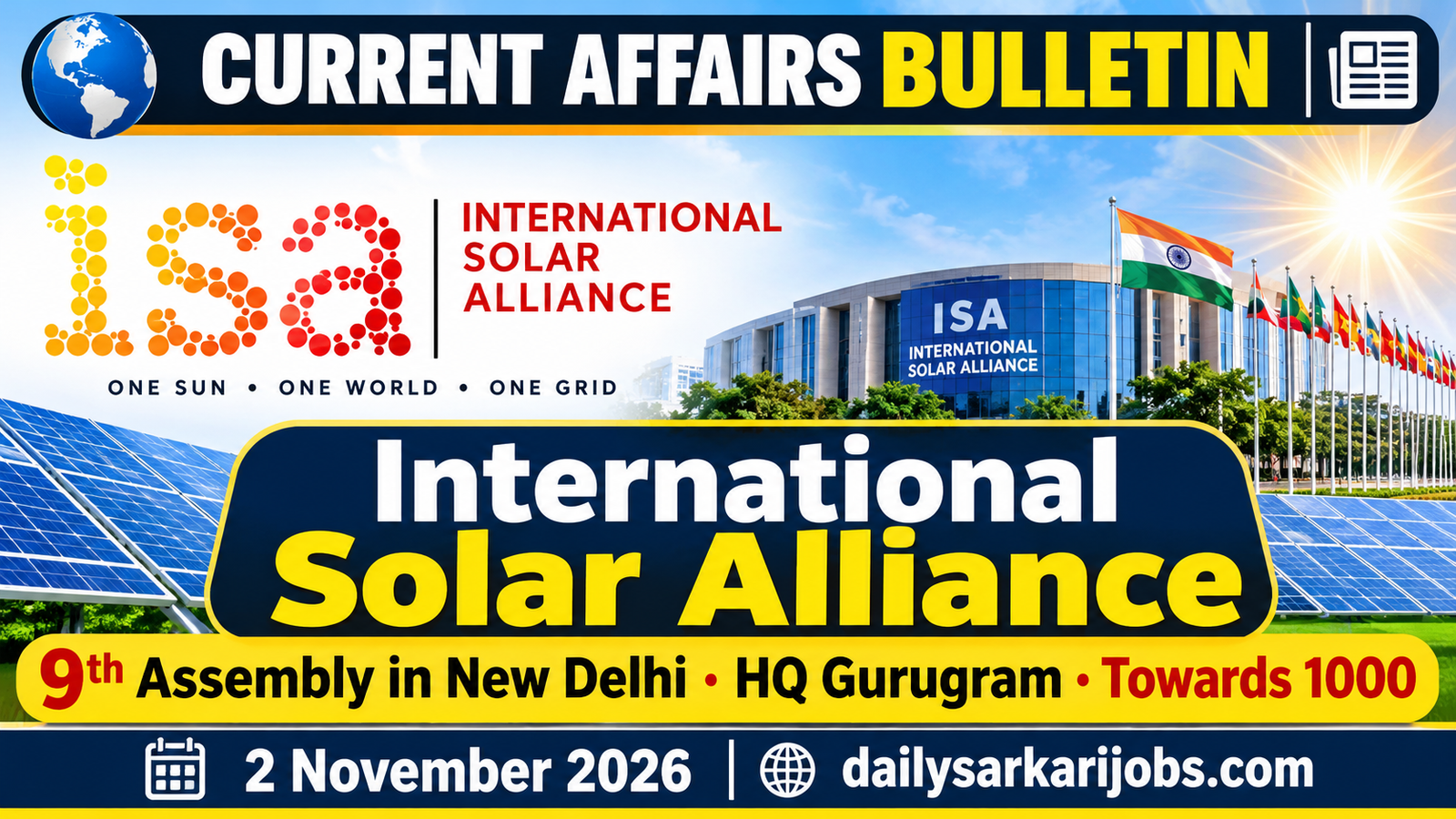
The 9th Session of the International Solar Alliance Assembly opens at Bharat Mandapam, New Delhi, and runs from 2 to 5 November 2026, on the theme Shaping the Future of Global Solar Cooperation.
The ISA turns up in current affairs every year and is almost never explained. It deserves a few minutes, because there is exactly one thing about it that no other organisation in this syllabus can claim.
The Hinge: India’s Own Treaty Organisation
India hosts the offices of many international bodies. The International Solar Alliance is different: it is a treaty-based international organisation whose headquarters is in India. It was not set up by the United Nations and then given an Indian office. It was created by a treaty that India wrote, signed and hosts.
Jargon, defined once. A treaty-based organisation exists because countries signed a legal agreement and then ratified it — that is, got it approved at home and formally deposited that approval. Once enough ratifications arrive, the agreement enters into force and the body legally exists. Signing is a promise; ratifying is the commitment.
That distinction is the whole difference between this post and an earlier one. Our explainer on CBD COP-17 at Yerevan turned on the point that a framework is not a treaty — targets agreed there bind nobody. The ISA is the other case: a real treaty, really in force, with a headquarters and a staff.
How It Was Built, in Four Dates
| When | What happened |
|---|---|
| 2015 | Launched by India and France on the sidelines of CoP-21 in Paris |
| 15 November 2016 | The Framework Agreement opened for signature at CoP-22 in Marrakesh |
| 7 December 2017 | The Framework Agreement entered into force; by then 19 countries had ratified it and 46 had signed |
| 2020 | An amendment opened membership to all United Nations Member States |
That last row is the single most valuable line in this post. When the ISA was set up, membership was open only to countries lying fully or partly between the Tropic of Cancer and the Tropic of Capricorn — the sunniest belt of the world. The 2020 amendment removed that restriction.
A great many study notes still carry the old rule as though it were current. If a question offers the tropics condition as the present rule, it is testing whether you know about the amendment.
Where It Sits and Who Runs It
- Headquarters: Surya Bhawan, on the campus of the National Institute of Solar Energy at Gwal Pahari, Gurugram, Haryana, with a liaison office in New Delhi.
- The Assembly is the highest decision-making body. It meets annually, reviews progress and sets direction, and it is the body that selects the Director General.
- Director General: Ashish Khanna, the ISA’s third. He follows Upendra Tripathy and Ajay Mathur. The post carries a four-year term.
- Membership: the ISA’s own website gives 119 countries as having signed the Framework Agreement and 99 as having ratified it to become full members, while elsewhere describing 120 Member Countries. The counts move as ratifications arrive, so quote them with a date and prefer the signed-versus-ratified distinction over a single number.
What the ISA Is Trying to Do
Its stated strategy is the easiest target in the syllabus to remember, because every number in it is the same one.
The “Towards 1000” strategy aims at:
- USD 1,000 billion of investment in solar energy mobilised by 2030;
- energy access for 1,000 million people;
- 1,000 GW of solar capacity installed;
- 1,000 million tonnes of carbon dioxide emissions mitigated every year.
Four targets, one number. A thousand billion dollars, a thousand million people, a thousand gigawatts, a thousand million tonnes. That is the whole strategy in a single word.
Why the 9th Assembly Is Bigger Than Usual
For the first time, three events are being held together on one platform at Bharat Mandapam:
| Event | Detail |
|---|---|
| 9th Session of the ISA Assembly | 2–5 November 2026; theme Shaping the Future of Global Solar Cooperation; 128 countries invited |
| Bharat Renewable Energy Summit and Expo 2026 | Organised by the Ministry of New and Renewable Energy; to be inaugurated by the Prime Minister; 34 countries invited; logo URJHA Chakra |
| 4th International Conference on Green Hydrogen | Held alongside the other two — the subject of our explainer on the National Green Hydrogen Mission |
Two figures from the Government’s own announcement are worth carrying: India is close to 300 GW of installed non-fossil fuel capacity, and PM Surya Ghar: Muft Bijli Yojana is expected to pass 50 lakh beneficiary households.
Why a Reader Should Care
International organisations are a guaranteed section in General Awareness, and the questions are always the same shape: founded when, by whom, headquartered where, headed by whom. The ISA answers all four cleanly, and it carries the extra weight of being headquartered in India. Our capsule on international organisations and their headquarters has the rest of the list.
Today’s Static GK capsule is on India’s location and extent, and it is the natural companion. The ISA was originally defined by a line of latitude — the Tropic of Cancer — and that same line runs straight across India through eight states. A country’s geography decides which clubs it can even be asked to join.
What Is Not Settled
Two honest notes. The membership figures differ between pages of the ISA’s own website and change as countries ratify, so they should always be quoted with a date. And a few accounts give 6 December 2017 rather than 7 December as the date the Framework Agreement entered into force; the date used above is the one recorded by the UNFCCC.
Practice Questions
Q1. The International Solar Alliance was launched in 2015 as a joint initiative of India and
(a) Germany (b) The United States (c) Japan (d) France
Answer: (d) France The launch took place on the sidelines of CoP-21 in Paris, and the Framework Agreement opened for signature a year later at CoP-22 in Marrakesh.
Q2. The headquarters of the International Solar Alliance is located at
(a) Gurugram, Haryana (b) New Delhi (c) Abu Dhabi (d) Bonn, Germany
Answer: (a) Gurugram, Haryana It stands at Surya Bhawan on the National Institute of Solar Energy campus at Gwal Pahari, which makes the ISA a treaty-based international organisation headquartered in India.
Q3. Originally, membership of the ISA was open only to countries
(a) That were members of the United Nations (b) In the Global South (c) Lying fully or partly between the Tropic of Cancer and the Tropic of Capricorn (d) With more than 1 GW of solar capacity
Answer: (c) Lying fully or partly between the Tropic of Cancer and the Tropic of Capricorn A 2020 amendment to the Framework Agreement removed that condition and opened membership to all United Nations Member States, which many older study notes still miss.
Q4. Which is the highest decision-making body of the International Solar Alliance?
(a) The Secretariat (b) The Council of Ministers (c) The Governing Board (d) The Assembly
Answer: (d) The Assembly It meets annually, sets the Alliance’s direction and selects the Director General for a four-year term.
Q5. Under its “Towards 1000” strategy, the ISA aims to mobilise how much investment in solar energy by 2030?
(a) USD 100 billion (b) USD 1,000 billion (c) USD 10 billion (d) USD 500 billion
Answer: (b) USD 1,000 billion The same figure repeats across the strategy: a thousand million people given energy access, a thousand gigawatts installed and a thousand million tonnes of emissions mitigated a year.
30-Second Revision
- The hinge: the ISA is a treaty-based international organisation headquartered in India — at Gurugram, Haryana. Signing is a promise; ratifying is the commitment; entry into force is when the body legally exists.
- Four dates: launched 2015 at CoP-21, Paris, by India and France; Framework Agreement opened for signature 15 November 2016 at CoP-22, Marrakesh; entered into force 7 December 2017; 2020 amendment opened membership to all UN Member States, replacing the old tropics-only rule.
- Structure: the Assembly is the highest decision-making body; the Director General is Ashish Khanna, the third, after Upendra Tripathy and Ajay Mathur, for a four-year term.
- The 9th Assembly: 2–5 November 2026, Bharat Mandapam, New Delhi, theme Shaping the Future of Global Solar Cooperation, held for the first time alongside the Bharat Renewable Energy Summit and Expo and the 4th International Conference on Green Hydrogen. Strategy: Towards 1000.
Sources
- The International Solar Alliance’s own website — the 2015 founding at CoP-21 as an India and France initiative, the Framework Agreement opening for signature at CoP-22 on 15 November 2016, the 2020 amendment opening membership to all UN Member States, the headquarters at Surya Bhawan on the NISE campus at Gwal Pahari, the signatory and ratification counts, and the dates and theme of the 9th Session of the Assembly.
- UNFCCC, International Solar Alliance Enters into Force — the date of entry into force and the 19 ratifications and 46 signatures recorded at that point.
- Press Information Bureau release of 23 July 2026 on the Bharat Renewable Energy Summit and Expo 2026 — the dates and venue, the Ministry of New and Renewable Energy as organiser, the co-location of the ISA Assembly and the green hydrogen conference, the invitation figures, the URJHA Chakra logo, the approaching 300 GW of non-fossil capacity and the PM Surya Ghar household figure.
- The Towards 1000 strategy targets are as published by the ISA. Membership counts change as ratifications are deposited and should be quoted with a date.