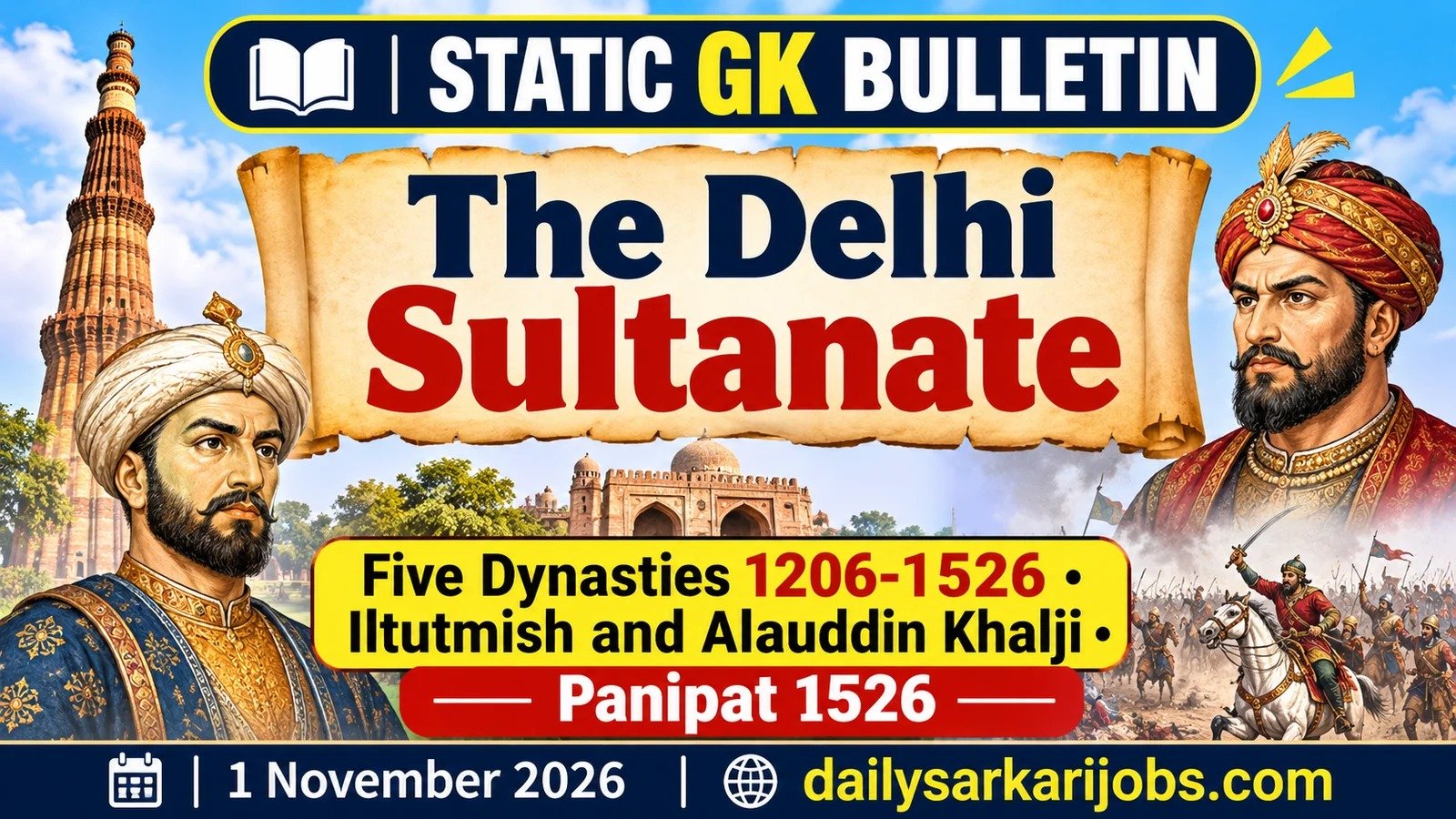
Medieval history is where most candidates lose marks, and the Delhi Sultanate is where it starts. Five dynasties, more than thirty sultans, three hundred and twenty years — and it all looks like a list to be memorised. There is one fact that turns the list into a story.
The Hinge: A Throne Won by the Sword Has No Rule for Who Holds It Next
Our capsule on the Gupta Empire described a state that counted its own years from a fixed point and passed the crown from father to son. The Delhi Sultanate had neither.
There was no accepted law of succession. A sultan’s sons, his slaves, his nobles and his generals all had a claim, and the claim was settled by whoever commanded the army at that moment. That is why this chapter is taught as dynasties rather than lineages, and why the exam asks who founded which dynasty rather than who was whose son.
Hold that one idea and the rest stops being arbitrary. Balban’s elaborate theory of kingship, Alauddin Khalji’s spy network and price controls, Muhammad bin Tughlaq’s restless experiments — these are not personality quirks. They are what a ruler does when nothing but force is keeping him on the throne.
Jargon, Defined Once
- Sultan — a Muslim ruler holding real political power, as distinct from the Caliph, who held religious authority. A sultan who received a robe of investiture from the Caliph could claim his rule was lawful.
- Mamluk — a slave of Turkic origin, trained as a soldier and often freed and promoted. This is why the first dynasty is called the Slave or Mamluk dynasty: its founders began as slaves, though they were freed men by the time they ruled.
- Iqta — a piece of land whose revenue was assigned to an officer in place of a salary, in return for maintaining troops. The holder was a muqti or wali. It was meant to be transferable, not hereditary.
- Khalisa — land kept directly under the sultan, whose revenue went straight to the state treasury rather than to an iqta holder.
The Five Dynasties, in Order
This table is the spine of the chapter. If you learn nothing else, learn the order and the founders.
| Dynasty | Period | Founder |
|---|---|---|
| Slave (Mamluk) | 1206–1290 | Qutbuddin Aibak |
| Khalji | 1290–1320 | Jalaluddin Firuz Khalji |
| Tughlaq | 1320–1414 | Ghiyasuddin Tughlaq |
| Sayyid | 1414–1451 | Khizr Khan |
| Lodi | 1451–1526 | Bahlul Lodi |
Memory trick for the order: S–K–T–S–L. Slave Kings Took Several Lands. Five letters, five dynasties, in order.
The Rulers Who Actually Get Asked About
| Ruler | Dynasty | The fact that is asked |
|---|---|---|
| Qutbuddin Aibak | Slave | Founded the Sultanate in 1206 and began the Qutb Minar; died at Lahore in an accident while playing chaugan, a form of polo |
| Iltutmish | Slave | The real consolidator: shifted the capital to Delhi, introduced the silver tanka and the copper jital, received investiture from the Caliph, and created the Turkan-i-Chahalgani, the Corps of Forty nobles |
| Razia Sultan | Slave | The only woman to sit on the throne of Delhi, 1236 to 1240 |
| Balban | Slave | Theory of kingship as Zill-i-Ilahi, the Shadow of God; enforced sijda and paibos, prostration and kissing the feet; broke the Corps of Forty |
| Alauddin Khalji | Khalji | Market and price control; first to measure land for revenue, fixed at about half the produce; built Siri and the Alai Darwaza; sent Malik Kafur south |
| Muhammad bin Tughlaq | Tughlaq | Moved the capital to Daulatabad; issued token currency in brass and copper; Ibn Battuta visited his court |
| Firuz Shah Tughlaq | Tughlaq | Canals and new towns — Firuzabad, Hisar, Jaunpur, Fatehabad; set up the Diwan-i-Khairat for charity; wrote the Futuhat-i-Firuz Shahi |
| Ibrahim Lodi | Lodi | Defeated and killed by Babur at the First Battle of Panipat, 1526 |
Three Traps Worth Marking
- Aibak founded it; Iltutmish made it a state. Aibak ruled only four years, never struck coins in his own name and never received the Caliph’s investiture. Iltutmish did both — which is why many historians treat him as the real founder of the Sultanate, and why questions are often worded to separate the two.
- Alauddin Khalji’s price control was not welfare. He fixed prices so that he could pay a very large standing army in cash without ruining the treasury. Cheap grain was a by-product of cheap soldiers.
- The token currency failed because it was too easy to copy. Muhammad bin Tughlaq issued brass and copper coins to pass at the value of silver, without the safeguards that would have made forgery difficult — so households minted their own and the treasury had to redeem them.
How It Was Governed
The administrative vocabulary is short and it repeats across papers:
- Iqta for assignments of revenue, held by a muqti; khalisa for land kept under the sultan directly.
- Kharaj, the land tax, was the main source of revenue. Zakat was a religious levy on Muslims, jizya a tax on non-Muslims, and khams the state’s share of war booty.
- The Diwan-i-Wizarat handled finance, the Diwan-i-Arz the army and the Diwan-i-Insha correspondence. Alauddin added the Diwan-i-Riyasat for his market regulations, with a shahna-i-mandi as superintendent of the market.
Note what the iqta system was trying to solve, and how it failed. Paying an officer with land instead of cash saved the treasury money, but a man left on the same land long enough starts to treat it as his own. It is the same trap the Guptas fell into with land grants, three centuries earlier and under a completely different religion and language.
Did You Know: The Sultan Who Fixed the Price of Horses
Alauddin Khalji’s famous market regulations did not stop at grain. He fixed prices for cloth, cattle, slaves and horses as well, and kept a separate department, the Diwan-i-Riyasat, to enforce them.
The horses are the giveaway. A sultan does not control the price of warhorses out of concern for buyers. He does it because his army ran on cavalry, and cavalry ran on horses he could not breed at home. India’s climate and grazing never produced warhorses in the numbers Delhi needed, so the best mounts came overland from Central Asia and by sea from Arabia. The Sultanate’s central strength depended on an import.
Architecture and the Evidence
The buildings are asked as directly as the rulers. The Qutb Minar was begun by Aibak and completed by Iltutmish; the Alai Darwaza was added by Alauddin Khalji; Tughlaqabad was built by Ghiyasuddin Tughlaq. The Qutb Minar complex is on the UNESCO World Heritage list.
On evidence, the Sultanate sits between the two earlier cases in this track. The Mauryan Empire is known from a king’s own inscriptions and the Guptas from a court poet’s eulogy. The Sultanate is known largely from court chronicles — Minhaj-us-Siraj, Ziauddin Barani, Amir Khusrau — written by men who depended on the ruler. Closer to a eulogy than to a record, and it should be read the same careful way.
Why a Reader Should Care
Medieval history is a fixed and finite block that recurs in SSC, Railways, State PCS and the UPSC Prelims, and the Delhi Sultanate supplies more one-mark facts than any other part of it — founders, dynasties, titles, coins, buildings, battles.
The Sultanate is also the bridge chapter: it begins with the end of the Rajput kingdoms and ends at Panipat in 1526, where the Mughal chapter begins. Learn it once and two syllabus units open at the same time.
Today’s Current Affairs capsule is on the eight Next-Generation Corvettes cleared for the Indian Navy, and it asks the Sultanate’s question in modern form. Delhi’s power rested on horses it had to import; the argument for building warships at home is that a capability you must buy from somebody else is a capability somebody else can withhold.
Practice Questions
Q1. Which dynasty of the Delhi Sultanate came immediately after the Khaljis?
(a) The Lodis (b) The Sayyids (c) The Tughlaqs (d) The Slave dynasty
Answer: (c) The Tughlaqs The order runs Slave, Khalji, Tughlaq, Sayyid, Lodi, which the phrase Slave Kings Took Several Lands fixes in place.
Q2. Who introduced the silver tanka and the copper jital?
(a) Qutbuddin Aibak (b) Balban (c) Alauddin Khalji (d) Iltutmish
Answer: (d) Iltutmish He was also the first sultan of Delhi to receive a robe of investiture from the Caliph, which is why he is often treated as the real founder of the Sultanate.
Q3. The ruler who first ordered the measurement of land for assessing revenue was
(a) Firuz Shah Tughlaq (b) Alauddin Khalji (c) Muhammad bin Tughlaq (d) Bahlul Lodi
Answer: (b) Alauddin Khalji The share was fixed at about half the produce, and the same ruler ran the market and price control system enforced through the Diwan-i-Riyasat.
Q4. The transfer of the capital to Daulatabad and the issue of token currency are associated with
(a) Ghiyasuddin Tughlaq (b) Firuz Shah Tughlaq (c) Muhammad bin Tughlaq (d) Khizr Khan
Answer: (c) Muhammad bin Tughlaq Ibn Battuta visited his court, and the token coins failed largely because brass and copper pieces were easy to forge.
Q5. The Delhi Sultanate came to an end with the
(a) Second Battle of Panipat, 1556 (b) Battle of Khanwa, 1527 (c) First Battle of Panipat, 1526 (d) Battle of Talikota, 1565
Answer: (c) First Battle of Panipat, 1526 Babur defeated and killed Ibrahim Lodi there, which closed the Lodi dynasty and opened the Mughal period.
30-Second Revision
- The hinge: the Sultanate had no law of succession, so the throne went to whoever held the army. That is why it is five dynasties rather than one family, and why its rulers spent so much effort on display, spies and control. 1206 to 1526.
- The five, in order: Slave (Aibak, 1206) → Khalji (Jalaluddin Firuz) → Tughlaq (Ghiyasuddin) → Sayyid (Khizr Khan) → Lodi (Bahlul). Slave Kings Took Several Lands.
- Key rulers: Iltutmish (tanka and jital, Caliph’s investiture, Corps of Forty) · Razia (only woman on the throne of Delhi) · Balban (Zill-i-Ilahi, sijda and paibos) · Alauddin Khalji (price control, land measurement, Malik Kafur) · Muhammad bin Tughlaq (Daulatabad, token currency, Ibn Battuta) · Firuz Shah (canals and new towns).
- Administration: iqta held by a muqti, khalisa under the sultan; kharaj the land tax, with zakat, jizya and khams. Ends at the First Battle of Panipat, 1526.
Sources
- The standard chronicles of the period in their published translations — Tabaqat-i-Nasiri of Minhaj-us-Siraj, the Tarikh-i-Firuz Shahi of Ziauddin Barani, the writings of Amir Khusrau and the travels of Ibn Battuta — which supply the dynastic sequence, the titles, Alauddin Khalji’s market regulations and the account of the token currency.
- The dependence of Delhi’s cavalry on horses imported from Central Asia and Arabia is well-established in the scholarship on the period rather than a claim of this post.
- Dynastic dates follow the conventional syllabus chronology; a few regnal years differ by one between published accounts, so the periods above are given as the standard ones rather than as the only possible readings.