Museum questions look like pure memorisation — a name, a city, a year.They are not. The list has a shape, and the shape is a map of where power used to sit.
India’s Oldest Museum Is Not in the Capital, and That Is the Whole Point
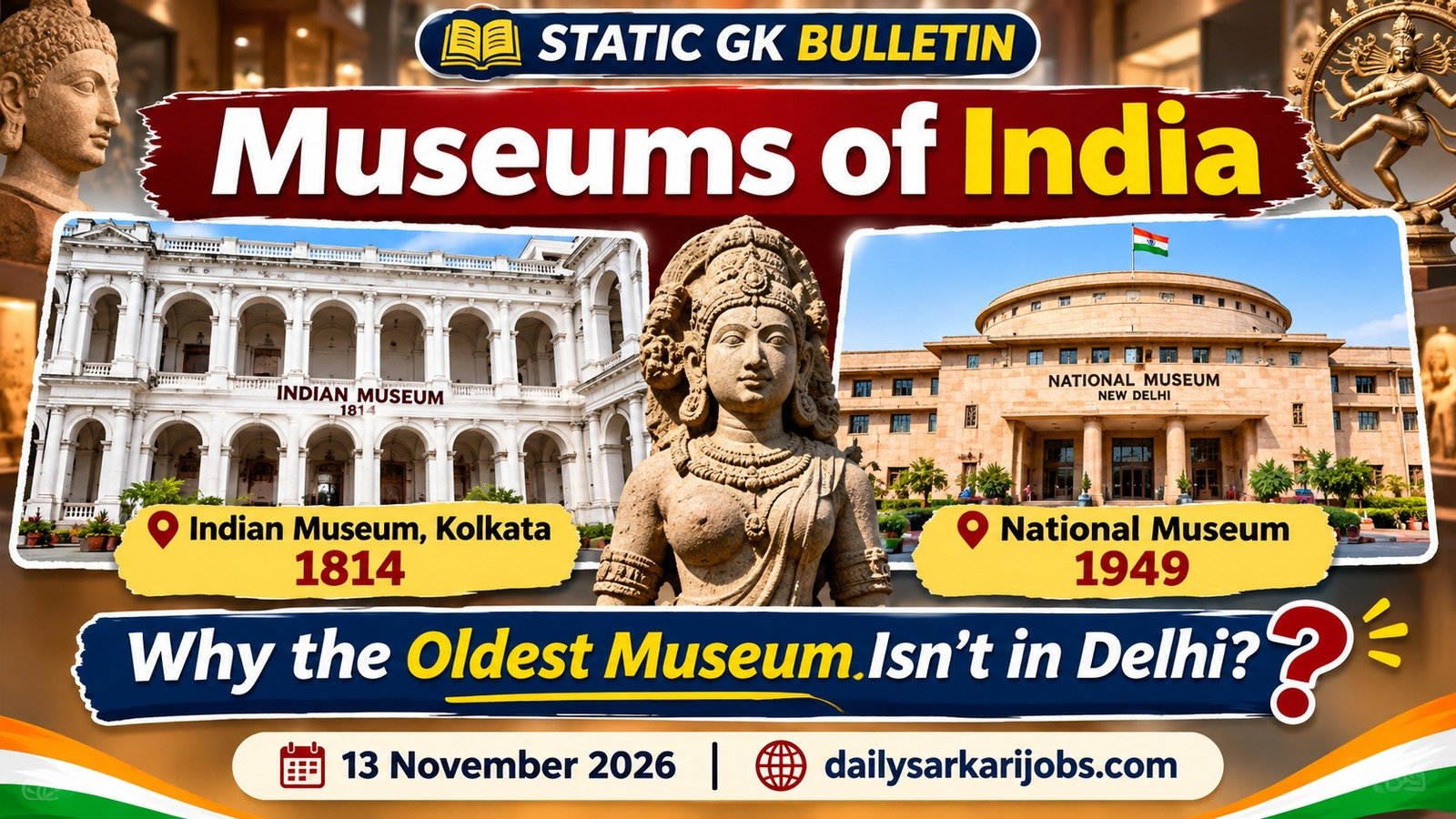
The Indian Museum was founded in Calcutta on 2 February 1814.It is the oldest museum in Asia, and the largest on the continent by the size of its collection. Delhi’s National Museum was inaugurated on 15 August 1949 — a hundred and thirty-five years later.
That gap is not an accident of taste. Calcutta was the capital of British India.The Asiatic Society was founded there in 1784 by Sir William Jones; the museum grew directly out of it, beginning life as the Society’s Oriental Museum, with the Danish botanist Nathaniel Wallich as its founding curator.
So the rule that unlocks the chapter is this: look at a founding date and you can usually name the capital.Eighteenth and nineteenth century institutions cluster in Calcutta. Presidency cities — Madras, Bombay — come next. Delhi’s great national institutions are almost all post-1947, because Delhi only became the capital in the twentieth century and only became an Indian capital in 1947.The dates tell you the politics.
Jargon, Defined Once
The Asiatic Society was a scholarly body founded at Calcutta in 1784 to study Asia — its languages, history, botany and antiquities. Several later institutions grew out of its collections.
A curator is the person responsible for a museum’s collection — what it holds, how it is catalogued and what is shown.
Vastu Sangrahalaya means, roughly, a collection of objects, and is the Marathi and Sanskrit-derived name used for Mumbai’s main museum.
A site museum stands at an archaeological site and holds what was dug up there, rather than gathering objects from everywhere.
The Presidencies were the three great administrative divisions of British India — Bengal, Madras and Bombay — and their capitals got institutions first.
The Museums Worth Knowing
Museum
City
Founded
Indian Museum
Kolkata
1814 — oldest and largest in Asia by collection
Government Museum
Chennai
1851
Albert Hall Museum
Jaipur
1887
Chhatrapati Shivaji Maharaj Vastu Sangrahalaya
Mumbai
1905
Victoria Memorial Hall
Kolkata
built 1906 to 1921
National Museum
New Delhi
15 August 1949
National Gallery of Modern Art
New Delhi
1954
Salar Jung Museum
Hyderabad
from the private collection of the Salar Jung family
Run your eye down the date column.1814, 1851, 1887, 1905, 1906 — Calcutta, Madras, Jaipur, Bombay, Calcutta again. Then a gap, and then 1949 and 1954, both in Delhi. The gap is Independence, and everything after it is a new capital building its own institutions from scratch.
The Salar Jung Exception
One museum on that list was not founded by a government at all.The Salar Jung Museum at Hyderabad began as the private collection of the Salar Jung family, who served as prime ministers of the Nizam’s state. It became a public museum after that collection passed into public hands.
It is worth knowing as the exception that proves the rule.Hyderabad was not a British capital; it was a princely state with its own court and its own wealth. The one great museum outside the colonial pattern came from the one kind of power that sat outside the colonial system.
Exam Alert: Five Traps
The oldest museum in India is the Indian Museum, Kolkata, 1814 — not the National Museum, Delhi.This is the single most common error on the topic.
Indian Museum 1814; Asiatic Society 1784.The Society is older than the museum it created, by thirty years.
The National Museum was inaugurated on 15 August 1949, and the National Gallery of Modern Art in 1954. Both Delhi, both post-Independence, five years apart.
Chhatrapati Shivaji Maharaj Vastu Sangrahalaya is in Mumbai.The long name is the whole difficulty; it was formerly the Prince of Wales Museum.
Salar Jung is Hyderabad.Not Delhi, not Lucknow, and it began as a private collection.
Did You Know: India’s First Museum Curator Was a Danish Botanist
The Indian Museum’s founding curator was Nathaniel Wallich, a Danish surgeon and botanist who had come to Bengal with the Danish settlement at Serampore and stayed on. He was named Honorary Curator of the Asiatic Society’s new museum.
The detail is a small window onto how these institutions actually formed.They were not planned from a capital and rolled out. They were assembled by whoever happened to be in the city and knew enough to catalogue a collection — a Welsh judge who founded the Society, a Danish botanist who ran the museum, a city that was the capital only because a trading company had built its fort there.The grand institutional map of India began as a set of local accidents.
Why a Reader Should Care
Museums are reliable Art and Culture and General Awareness material, because the facts never change and the question is always the same shape: which city, which year, which is oldest. Learning the pattern rather than the list is what makes it stick. This capsule sits with our material on India’s UNESCO World Heritage Sites, on the National Akademis, on Indian classical music and on the Indus Valley Civilisation, whose finds fill a good part of the museums above.
Today’s Current Affairs explainer is on the Yuge Yugeen Bharat Museum approved for the North and South Blocks, and it is the next line of the same story. Calcutta built its museum because it was the capital. Delhi is now converting the building it governs from into one. Two centuries apart, the same rule: the museums go where the power was.
Practice Questions
Q1. The oldest museum in India, and the oldest in Asia, is (a) The National Museum, New Delhi (b) The Indian Museum, Kolkata (c) The Government Museum, Chennai (d) The Salar Jung Museum, Hyderabad Answer: (b) The Indian Museum, Kolkata It was founded in 1814, more than a century before the capital moved to Delhi, and is also the largest in Asia by the size of its collection.
Q2. The Indian Museum was founded by (a) The Archaeological Survey of India (b) The Government of Bengal (c) The Asiatic Society of Bengal (d) The East India Company’s board of directors Answer: (c) The Asiatic Society of Bengal That body had itself been founded at Calcutta in 1784 by Sir William Jones, and the museum began as its Oriental Museum.
Q3. The National Museum in New Delhi was inaugurated in (a) 1947 (b) 1954 (c) 1814 (d) 1949 Answer: (d) 1949 The National Gallery of Modern Art, also in the capital, followed in 1954.
Q4. The Chhatrapati Shivaji Maharaj Vastu Sangrahalaya is located in (a) Pune (b) Mumbai (c) Nagpur (d) Kolhapur Answer: (b) Mumbai Founded in 1905, it was formerly known as the Prince of Wales Museum.
Q5. The Salar Jung Museum is in Hyderabad and is notable because it (a) Is the oldest museum in India (b) Is run by the Archaeological Survey of India (c) Began as a private family collection (d) Holds only Indus Valley material Answer: (c) Began as a private family collection The family served as prime ministers of the Nizam’s state, which is why the one great museum outside the colonial pattern grew up in a princely capital.
30-Second Revision
The hinge:institutions follow the capital.Read a founding date and you can usually name where power sat.
The oldest:Indian Museum, Kolkata, 1814, founded by the Asiatic Society of Bengal (itself 1784, Sir William Jones); oldest and largest in Asia.
Delhi’s two:National Museum, 15 August 1949; National Gallery of Modern Art, 1954. Both post-Independence.
The others:Government Museum, Chennai (1851); Albert Hall, Jaipur (1887); Chhatrapati Shivaji Maharaj Vastu Sangrahalaya, Mumbai (1905); Victoria Memorial, Kolkata (1906–1921).
The exception:Salar Jung, Hyderabad — a private princely collection, not a colonial foundation.
What Is Not Settled
One caution about the superlatives, because they are worded differently in different places.The Indian Museum is described as the oldest museum in Asia and the largest in Asia by size of collection. You will also see it called simply the oldest and largest in India, which is true but weaker. Answer with whichever claim the question offers; both are defensible, and the Asia version is the stronger one.
Second, founding years for older museums are sometimes given a year or two apart, because a society may be formed in one year, a collection opened to the public in another and a building completed in a third. The Indian Museum’s own date of 2 February 1814 is the foundation; its present Chowringhee building was completed in 1875. Quote the foundation year unless the question asks about the building.
Sources
Reference material on the Indian Museum, Kolkata — its foundation on 2 February 1814 by the Asiatic Society of Bengal as the Society’s Oriental Museum, the founding of the Society in 1784 by Sir William Jones, its description as the oldest and the largest museum in Asia by size of collection, the appointment of the Danish botanist Nathaniel Wallich as founding Honorary Curator, and the completion of the present Chowringhee building in 1875.
Reference listings of museums in India for the cities and founding years above — the National Museum, New Delhi inaugurated 15 August 1949, the National Gallery of Modern Art, New Delhi (1954), the Government Museum, Chennai (1851), the Albert Hall Museum, Jaipur (1887), the Chhatrapati Shivaji Maharaj Vastu Sangrahalaya, Mumbai (1905), the Victoria Memorial Hall, Kolkata (built 1906 to 1921) and the Salar Jung Museum, Hyderabad.
Where a superlative is worded differently between sources, both wordings are given above rather than one being chosen silently.