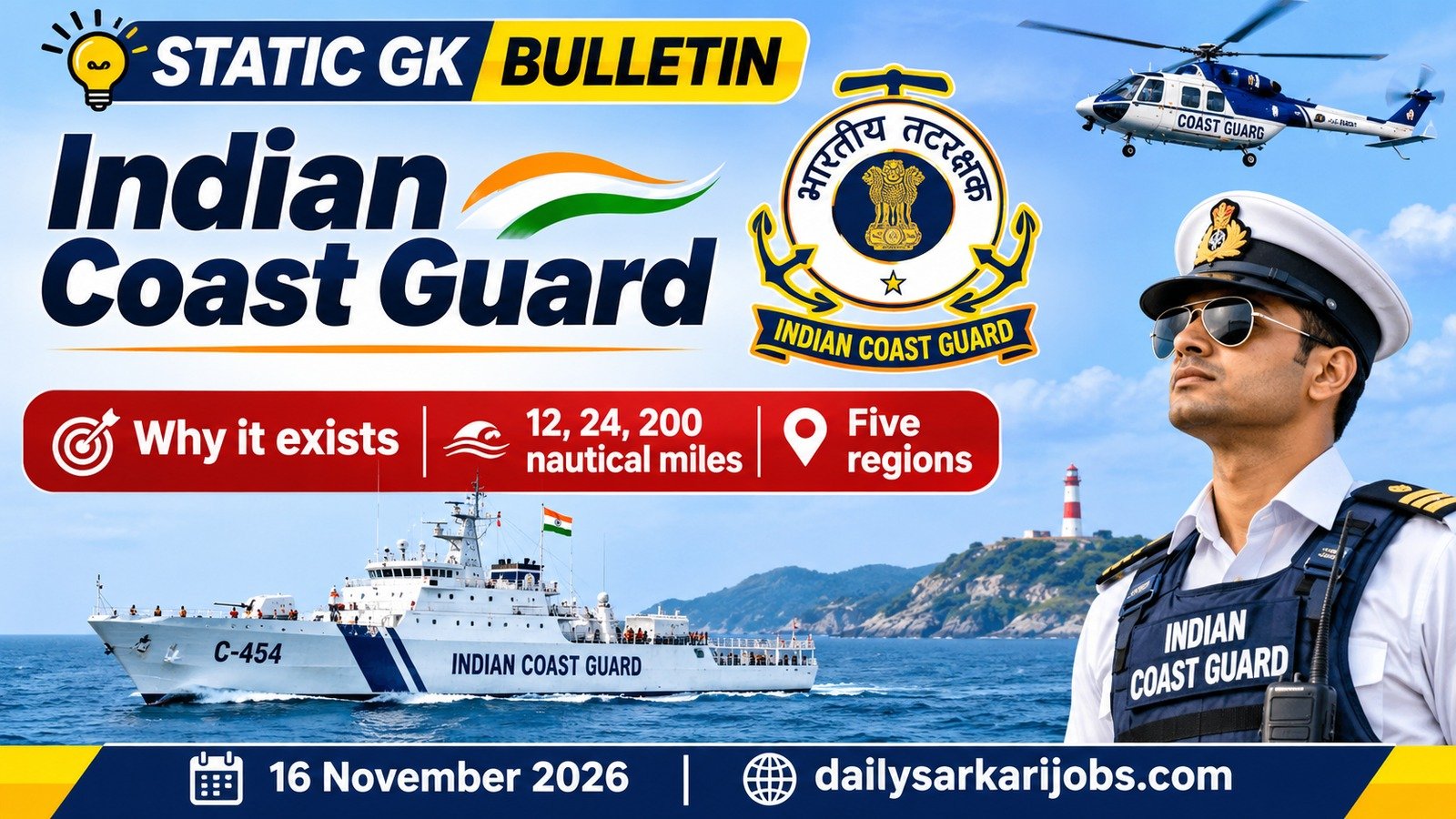
The Indian Coast Guard is often described as a junior navy. It is not.It was created for a reason that has nothing to do with war, and once you know the reason, every odd thing about the force makes sense.
It Exists Because of Smuggling, Not Because of War
In September 1974 the government appointed a committee under K. F. Rustamji to look at a very specific failure: goods were being smuggled in across the sea and nobody was stopping them.Customs and the fisheries departments did not have the boats. The Navy had the boats but did not want to spend warships on patrol work. Between the two sat a gap, and the smugglers lived in it.
The committee reported in 1975 and recommended a Coast Guard-type organisation to police India’s sea areas.Two other pressures pushed the same way: the Maritime Zones Act of 1976 gave India an exclusive economic zone of roughly 2.01 million square kilometres that somebody had to watch, and the new offshore oil platforms at Bombay High needed protecting.
So the force was built as sea police with a defence ministry address — and that is why its everyday work is customs, fishermen, pollution and rescue rather than battle. Only in war does it come under the operational control of the Navy.
Jargon, Defined Once
A nautical mile is the unit used at sea, a little longer than a land mile. Every maritime limit below is counted in these.
The baseline is the line along the coast from which all sea limits are measured outwards. Get the baseline wrong and every zone shifts.
An armed force of the Union is a force raised by a law of Parliament and armed by it. It is not the same phrase as the Armed Forces — see the warning below.
Innocent passage is the right of a foreign ship to pass through another country’s territorial waters without stopping or doing harm.
An Inspector General is the officer commanding one Coast Guard region; the Director General heads the whole force from New Delhi.
The Word Trap: Armed Force of the Union
Section 4 of the Coast Guard Act, 1978 says there shall be an armed force of the Union called the Coast Guard.That wording is exact and it is the source of the confusion.
India’s Armed Forces are three: the Army, the Navy and the Air Force.The Coast Guard is not one of them. It is an armed force of the Union in the legal sense, raised under its own Act, sitting under the Ministry of Defence, with its own ranks and its own chief — and it is outside the three Services.Both statements are true at the same time, which is exactly why the question gets set.
India’s Maritime Zones
Zone
Limit from the baseline
What India can do there
Territorial waters
12 nautical miles
Full sovereignty over water, seabed and the air above. Foreign ships have innocent passage
Contiguous zone
24 nautical miles
Enforce customs, immigration, sanitation and fiscal laws
Exclusive economic zone
200 nautical miles
Rights over resources and energy. Foreign ships keep navigation rights
Continental shelf
Up to 200 nautical miles, where applicable
Sovereign rights to explore and exploit the seabed’s resources
Learn the three numbers as a ladder: 12, 24, 200.Sovereignty at 12, policing powers at 24, resource rights at 200. They come from the Territorial Waters, Continental Shelf, Exclusive Economic Zone and Other Maritime Zones Act of 1976, and they are the waters the Coast Guard patrols.
How the Force Is Organised
Headed by a Director General at New Delhi, under the Ministry of Defence.
Five regions, each commanded by an Inspector General: North-West at Gandhinagar, West at Mumbai, East at Chennai, North-East at Kolkata and Andaman and Nicobar at Port Blair.
The motto is Vayam Rakshamah, meaning We Protect.
Its duties under Section 14 of the Act — safeguarding offshore installations and artificial islands, helping fishermen in distress, protecting the marine environment and fighting pollution, assisting customs against smuggling, enforcing the law in the maritime zones, and collecting scientific data.
In wartime it operates under the Indian Navy, but in peacetime it answers to its own Director General.
Exam Alert: Five Traps
The Coast Guard is under the Ministry of Defence, not the Ministry of Home Affairs.The central armed police forces are the ones under Home Affairs.
It is an armed force of the Union but not one of the three Armed Forces.The most commonly set catch on this topic.
Raising Day is 1 February, from the interim force of 1977, even though the Coast Guard Act is of 1978.Two years, two facts, do not merge them.
12, 24 and 200 nautical miles — territorial waters, contiguous zone, exclusive economic zone, in that order.
Regions are commanded by Inspectors General; the whole force by the Director General.
Did You Know: A Policeman Designed India’s Sea Force
K. F. Rustamji, who chaired the committee that recommended the Coast Guard, was not a sailor.He was an Indian Police Service officer and had been the first Director General of the Border Security Force.
It shows in the result.A naval committee would probably have proposed more warships. A policeman looked at the same sea and saw a beat that nobody was walking, so he proposed a force that patrols, inspects and arrests — and then placed it under the Ministry of Defence, because that is where the ships and the training were.The force’s divided character was designed in from the first day.
Today’s Current Affairs explainer is on Janjatiya Gaurav Diwas and Birsa Munda, and the two have an unexpected echo. Birsa Munda’s rising was about land the law did not protect until 1908. The Coast Guard was raised for a stretch of sea nobody was policing until 1977. Both are about the distance between what a state claims and what it actually guards.
Practice Questions
Q1. The Indian Coast Guard functions under which ministry? (a) Ministry of Home Affairs (b) Ministry of Shipping (c) Ministry of Defence (d) Ministry of External Affairs Answer: (c) Ministry of Defence The central armed police forces, with which it is often confused, come under Home Affairs instead.
Q2. The Indian Coast Guard was constituted as an armed force of the Union by (a) The Navy Act, 1957 (b) The Coast Guard Act, 1978 (c) The Maritime Zones Act, 1976 (d) The Border Security Force Act, 1968 Answer: (b) The Coast Guard Act, 1978 Section 4 of that law states that there shall be an armed force of the Union called the Coast Guard.
Q3. India’s contiguous zone extends up to how many nautical miles from the baseline? (a) 12 (b) 200 (c) 100 (d) 24 Answer: (d) 24 Within it India may enforce its customs, immigration, sanitation and fiscal laws, though it is not sovereign territory.
Q4. The exclusive economic zone extends to (a) 200 nautical miles (b) 12 nautical miles (c) 24 nautical miles (d) 50 nautical miles Answer: (a) 200 nautical miles India’s zone covers roughly 2.01 million square kilometres, and the need to police it was one reason the Coast Guard was created.
Q5. The committee whose 1975 report recommended setting up the Indian Coast Guard was chaired by (a) Vice Admiral V. A. Kamath (b) K. Santhanam (c) K. F. Rustamji (d) Morarji Desai Answer: (c) K. F. Rustamji He was a police officer and had been the first Director General of the Border Security Force; the officer named first became the Coast Guard’s first Director General.
30-Second Revision
The hinge:it exists because of smuggling, not war — the Rustamji Committee of 1974, reporting in 1975, found a policing gap between customs and the Navy.
The law: the Coast Guard Act, 1978, whose Section 4 makes it an armed force of the Union — but not one of the three Armed Forces.
The dates:Raising Day 1 February, interim force 1977, formal inauguration 1978. Ministry: Defence. Motto: Vayam Rakshamah.
The structure: a Director General at New Delhi and five regions — Gandhinagar, Mumbai, Chennai, Kolkata, Port Blair — each under an Inspector General.
The zones:12 nautical miles territorial waters, 24 contiguous zone, 200 exclusive economic zone, under the Maritime Zones Act, 1976.
What Is Not Settled
Two different dates are given for the force’s beginning, and both are correct in their own way.The interim Coast Guard came into being on 1 February 1977, which is why Raising Day falls then; the force was formally inaugurated on 19 August 1978 after the Coast Guard Act was passed. A question asking when the Coast Guard was established can be answered either way, so read whether it asks about Raising Day or about the Act.
Second, the force’s own official history and general reference accounts describe its early organisation slightly differently, including how the regions and the two seaboard commands fit together. The five regions and their headquarters are consistent across sources and are what an objective paper will ask for; the finer command structure is better left alone.
Sources
The Indian Coast Guard’s own official history page — for the Rustamji Committee appointed in September 1974 under K. F. Rustamji, a former Indian Police Service officer and former Director General of the Border Security Force, its 1975 recommendation of a Coast Guard-type organisation, the interim Coast Guard of 1 February 1977 with two frigates and five patrol boats transferred from the Navy, the formal inauguration by Prime Minister Morarji Desai on 19 August 1978, the first Director General Vice Admiral V. A. Kamath, the exclusive economic zone of about 2.01 million square kilometres, and the reasons for creation — sea-borne smuggling, the new maritime zones and the offshore platforms at Bombay High.
The text of the Coast Guard Act, 1978 (Act 30 of 1978) — for Section 4, which constitutes an armed force of the Union called the Coast Guard, and Section 14, which lists its duties: safeguarding offshore installations and artificial islands, assisting fishermen in distress, protecting the marine environment and controlling pollution, assisting customs against smuggling, enforcing the law in the maritime zones, and collecting scientific data.
Reference material on the force’s organisation — the Ministry of Defence as its parent ministry, the motto Vayam Rakshamah, the Director General at New Delhi, the five regions with headquarters at Gandhinagar, Mumbai, Chennai, Kolkata and Port Blair each under an Inspector General, and the operational control of the Navy during hostilities.
Reference material on the Territorial Waters, Continental Shelf, Exclusive Economic Zone and Other Maritime Zones Act, 1976 — territorial waters of 12 nautical miles, a contiguous zone of 24, an exclusive economic zone of 200, the continental shelf, and the rights India holds in each.
Where the date of the force’s establishment is reported two ways, both are given above with the reason for the difference rather than one being chosen silently.