Our capsule on the Delhi Sultanate ended at Panipat in 1526. This one begins there. The Mughal Empire is the most heavily tested chapter in medieval history, and it is usually taught as a parade of six emperors. There is a better way in, and it is not a battle.
The Hinge: The First Indian Empire That Counted Itself
This series has been following one thread through five capsules, and the Mughals complete it. The question each time is simple: who is doing the telling?
| Period | Who speaks | What survives |
|---|---|---|
| Indus Valley | Nobody | Objects only; the script cannot be read |
| Mauryan | The king himself | Ashoka’s edicts, in plain Prakrit |
| Gupta | A court poet | Harisena’s eulogy on an Ashokan pillar |
| Delhi Sultanate | Court chroniclers | Barani, Minhaj-us-Siraj, Amir Khusrau |
| Mughal | The state’s own accountants | Memoirs by emperors, and a statistical survey of the empire |
Babur wrote his own memoir and so did Jahangir. But the real break is the Ain-i-Akbari, Abul Fazl’s account of Akbar’s administration: prices, yields, ranks, provinces, wages, all set out in tables. It is less a chronicle than a spreadsheet.
And this is why the exam asks about Mughal systems rather than Mughal battles. The mansabdari ranks and the dahsala revenue settlement are askable precisely because somebody wrote the numbers down. An empire that measures itself leaves questions behind it.
Jargon, Defined Once
- Mansabdar — a holder of a mansab, or rank. Every officer, civil or military, had one. The system fixed pay and status in a single ladder.
- Zat and sawar — the two numbers in every mansab. Zat fixed personal status and salary; sawar fixed how many horsemen the officer had to maintain. Two ranks, one man.
- Jagir — land whose revenue was assigned to an officer in place of cash salary. It was meant to be transferable, exactly as the Sultanate’s iqta was.
- Suba — a province, under a subadar. Below it came the sarkar under a faujdar, and the pargana under a shiqqdar.
The Six Emperors Who Get Asked About
| Emperor | Reign | What is asked |
|---|---|---|
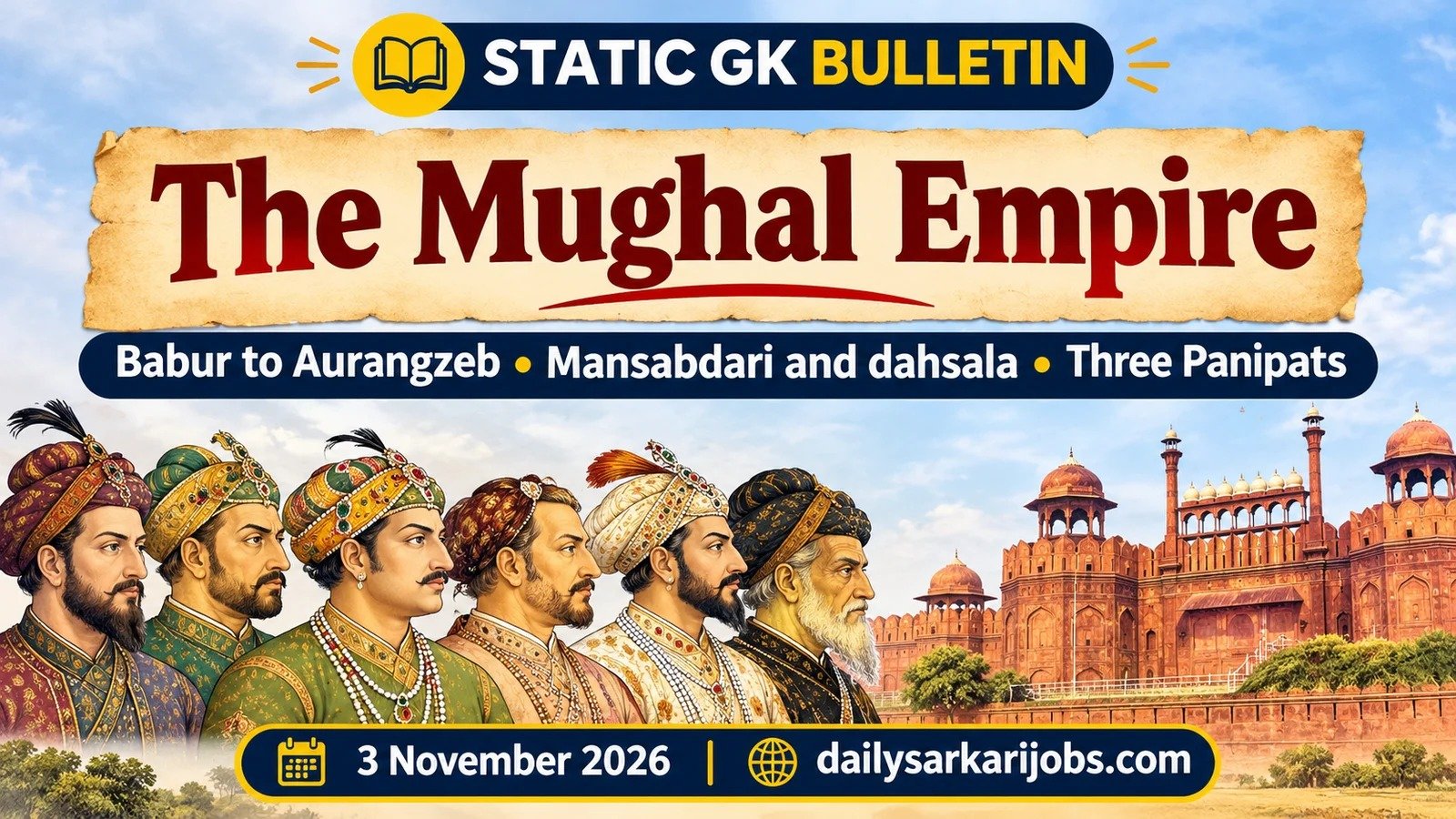
| Babur | 1526–1530 | First Battle of Panipat (1526) against Ibrahim Lodi, then Khanwa (1527) against Rana Sanga; wrote the Baburnama in Chagatai Turkish |
| Humayun | 1530–1540, 1555–1556 | Lost to Sher Shah Suri at Chausa (1539) and Kanauj (1540); regained the throne in 1555 and died falling from the stairs of Sher Mandal |
| Akbar | 1556–1605 | Second Battle of Panipat (1556); mansabdari; zabt revenue with Todar Mal; abolished jizya in 1564; Ibadat Khana and Din-i-Ilahi (1582); built Fatehpur Sikri |
| Jahangir | 1605–1627 | The chain of justice; wrote the Jahangirnama; received Captain Hawkins and Sir Thomas Roe (1615); Nur Jahan |
| Shah Jahan | 1628–1658 | The Taj Mahal, the Red Fort and Shahjahanabad; the Peacock Throne |
| Aurangzeb | 1658–1707 | Title Alamgir; reimposed jizya in 1679; the long Deccan wars; the Fatawa-i-Alamgiri |
One name belongs in the middle of that list and is not a Mughal. Sher Shah Suri ruled from 1540 to 1545 in the gap between Humayun’s two reigns, and his reforms outlasted him: the silver rupiya, the restored Grand Trunk Road, the sarais along it and the dak chowki postal relay. Akbar’s revenue system was built on foundations Sher Shah laid.
The Two Systems That Carry the Chapter
Mansabdari, introduced by Akbar, gave every officer two numbers rather than one. The point of the second number is control: an officer’s obligation to maintain cavalry was written into his rank, so the emperor always knew what the empire’s army actually was.
Zabt, also called the dahsala or ten-year system, was worked out with Raja Todar Mal. Land was measured, the average of ten years of yields and prices was taken, and revenue was then fixed in cash.
Fixing revenue in cash is the detail that matters. A peasant paying in grain can pay from the field; a peasant paying in coin must first sell the grain. So the revenue system pushed the countryside into the market, and the empire’s demand for silver became the engine of its economy. One administrative choice reshaped everything below it.
Three Traps Worth Marking
- The three battles of Panipat are a favourite confusion. 1526: Babur defeats Ibrahim Lodi. 1556: Akbar’s forces under Bairam Khan defeat Hemu. 1761: Ahmad Shah Abdali defeats the Marathas. Same field, three centuries, three different winners.
- Jizya was abolished and then brought back. Akbar abolished it in 1564; Aurangzeb reimposed it in 1679. A question giving only one of the two dates is testing whether you know there are two.
- The Ain-i-Akbari is not a separate book. It is the third part of the Akbarnama, both by Abul Fazl. And Babur wrote in Chagatai Turkish, not Persian — the Persian translation came later, under Akbar.
A fourth is worth a line because this series has met it before. Akbar’s navaratnas are a tradition rather than a contemporary list, exactly as the nine gems of Vikramaditya were in our capsule on the Gupta Empire. The individuals — Todar Mal, Abul Fazl, Birbal, Tansen, Man Singh — are real and well attested; the tidy list of nine is later storytelling.
Did You Know: The Empire That Owned the Coast but Not the Sea
At its height the Mughal Empire held Bengal and Gujarat, two of the richest trading regions in the world. It never built a sea-going navy to match its armies. Mughal naval power meant river fleets in Bengal and coastal craft, not a fleet that could hold open water.
The consequence was immediate and humiliating. Mughal merchant and pilgrim ships sailing from Surat carried Portuguese passes — a European permit to use an Indian empire’s own sea. The emperors treated the ocean as somebody else’s problem, and in the end the people who controlled it took the country.
Architecture and the End
The buildings are asked as directly as the emperors: Humayun’s Tomb, India’s first great garden tomb; Fatehpur Sikri with its Buland Darwaza; the Taj Mahal, the Agra Fort and the Red Fort. Several are on the UNESCO World Heritage list.
After Aurangzeb’s death in 1707 the empire shrank quickly, held together in name while the Marathas, the regional nawabs and then the East India Company took the substance. The last emperor, Bahadur Shah Zafar, was deposed and exiled in 1858 after the Revolt of 1857.
Why a Reader Should Care
No single chapter in medieval history pays better. Emperors, battles, revenue systems, administrative vocabulary, monuments and foreign travellers all come from this one period, and the facts do not change from year to year.
It is also the hinge of the whole syllabus. It begins where the Delhi Sultanate ends and it ends where modern history begins, with the Company and the Revolt of 1857. Learn the Mughals properly and three units connect.
Today’s Current Affairs capsule is on the first BIMSTEC Maritime Security Exercise, and it answers the Did You Know above. The Bay of Bengal that the Mughals never contested is now the organising idea of a seven-country grouping in which India leads the security sector. The same water, and a very different approach to it.
Practice Questions
Q1. The Mughal Empire was founded after which battle?
(a) The Battle of Khanwa, 1527 (b) The Second Battle of Panipat, 1556 (c) The First Battle of Panipat, 1526 (d) The Battle of Chausa, 1539
Answer: (c) The First Battle of Panipat, 1526 Babur defeated Ibrahim Lodi there, which closed the Lodi dynasty and the Delhi Sultanate with it.
Q2. In the mansabdari system, the rank that fixed how many horsemen an officer had to maintain was
(a) Zat (b) Sawar (c) Jagir (d) Suba
Answer: (b) Sawar The other rank fixed personal status and salary, so every officer carried two numbers at once.
Q3. The zabt or dahsala revenue system is associated with
(a) Sher Shah Suri (b) Raja Man Singh (c) Abul Fazl (d) Raja Todar Mal
Answer: (d) Raja Todar Mal Land was measured, an average of ten years of yields and prices was taken, and the revenue was fixed in cash.
Q4. Who abolished the jizya in 1564 and who reimposed it in 1679?
(a) Akbar abolished it; Aurangzeb reimposed it (b) Jahangir abolished it; Shah Jahan reimposed it (c) Humayun abolished it; Akbar reimposed it (d) Shah Jahan abolished it; Aurangzeb reimposed it
Answer: (a) Akbar abolished it; Aurangzeb reimposed it A question that gives only one of the two dates is testing whether you know the tax was removed and then brought back.
Q5. The Ain-i-Akbari was written by
(a) Badauni (b) Abul Fazl (c) Faizi (d) Abdul Hamid Lahori
Answer: (b) Abul Fazl It forms the third part of the Akbarnama and is a statistical account of the empire rather than a narrative chronicle.
30-Second Revision
- The hinge: the Mughals are the first Indian empire that measured itself. Babur and Jahangir wrote memoirs, and the Ain-i-Akbari by Abul Fazl sets out the empire in tables. That is why the exam asks about systems, not battles.
- Emperors: Babur (1526) → Humayun → [Sher Shah Suri, 1540–45: rupiya, Grand Trunk Road, dak chowki] → Akbar (1556–1605) → Jahangir → Shah Jahan → Aurangzeb (d. 1707); last emperor Bahadur Shah Zafar, deposed 1858.
- Two systems: mansabdari with zat (status and pay) and sawar (cavalry to maintain); zabt or dahsala with Todar Mal, averaging ten years and collecting in cash. Provinces: suba → sarkar → pargana.
- Traps: Panipat 1526, 1556 and 1761 have three different winners; jizya abolished 1564, reimposed 1679; the Ain-i-Akbari is part of the Akbarnama; the Baburnama is in Chagatai Turkish; and the navaratnas are a later tradition.
Sources
- The standard primary material of the period in published translation — the Baburnama, the Jahangirnama, and the Akbarnama with its third part the Ain-i-Akbari by Abul Fazl — which supply the memoirs, the administrative vocabulary, the mansabdari ranks and the revenue settlement.
- Dynastic and regnal dates follow the conventional syllabus chronology; one or two reign years are given differently in some accounts, so the periods above are the standard ones.
- The absence of a Mughal sea-going navy, the reliance on river fleets, and the use of Portuguese passes by ships sailing from Surat are well established in the scholarship on the period rather than claims of this post.
- The navaratna list is flagged above as a later tradition; the individuals named are separately attested in the contemporary record.