The Gupta period is usually taught as a list of superlatives — golden age, great poets, beautiful coins. That is the least useful way to learn it. There is a sharper way in, and it starts with a single pillar at Prayagraj that carries two inscriptions from two different empires.
The Hinge: One Pillar, Two Ways of Being Remembered
Our capsule on the Mauryan Empire rested on one fact: Ashoka wrote his own orders on rock, in plain Prakrit, and said he was sorry. The Guptas are the opposite case, and the contrast is carved into the same stone.
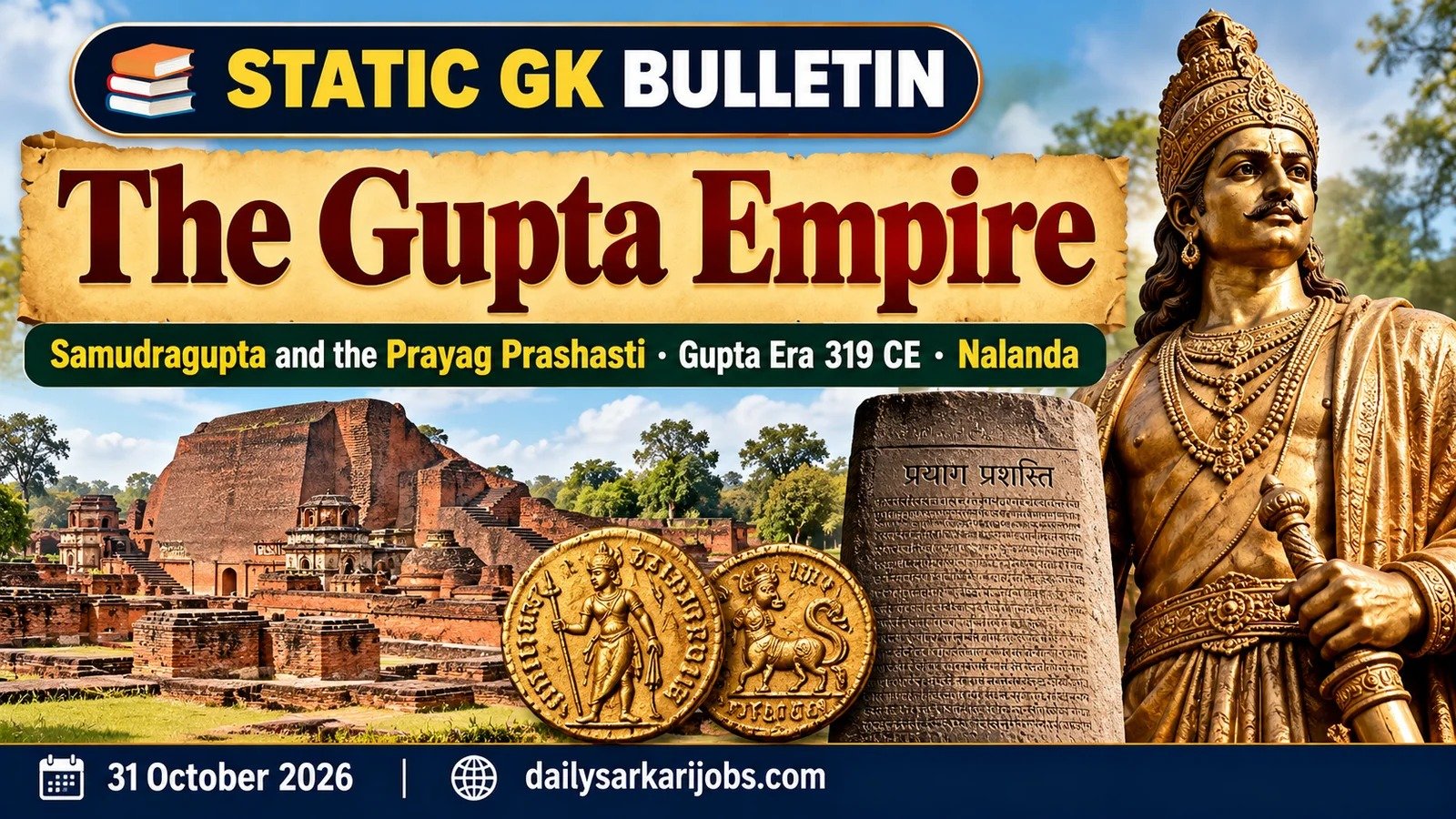
The Allahabad (Prayagraj) Pillar is an Ashokan pillar. Centuries after Ashoka, Samudragupta’s court poet Harisena had a long eulogy added to it — the Prayag Prashasti, in polished Sanskrit, listing conquests and comparing the king to the gods.
| Ashoka’s edicts | The Prayag Prashasti | |
|---|---|---|
| Who is speaking | The king himself | A court poet, Harisena |
| Language | Prakrit, the everyday speech | Sanskrit, the learned language |
| Subject | Conduct, remorse, instruction | Conquest, lineage, praise |
| Purpose | To be obeyed | To be admired |
That is the hinge, and it explains the whole chapter. Because the Gupta record is praise rather than instruction, the exam asks about titles, campaigns, coins and patronage — the things a eulogy records. And it is why everything about the Guptas has to be read with one eye open: a poet paid by the king is not a neutral witness.
It is the third position in a sequence worth holding together. In the Indus Valley Civilisation nobody speaks, because the script cannot be read. Under the Mauryas the king speaks. Under the Guptas, somebody speaks for the king.
Jargon, Defined Once
- Prashasti — a formal eulogy of a ruler, usually in verse and usually carved in stone. It is praise literature, not a report.
- Era — a numbering of years from one fixed starting point. The Gupta Era counts from 319–320 CE, which is why an inscription dated to a Gupta year can be converted to a CE year by adding 319.
- Land grant — a gift of revenue from a village, usually to a Brahmana or a temple, recorded on copper plates. A grant to Brahmanas is often called an agrahara.
- Huna — the Indian name for a Central Asian people who pressed into north-western India from the fifth century. Their leaders included Toramana and Mihirakula.
The Rulers the Exam Actually Asks About
| Ruler | Period (approx.) | What is asked |
|---|---|---|
| Chandragupta I | c. 319–335 CE | First great ruler; took the title Maharajadhiraja; married the Licchavi princess Kumaradevi; the Gupta Era (319–320 CE) dates from his reign; king-and-queen type gold coins |
| Samudragupta | c. 335–375 CE | The Prayag Prashasti by Harisena; performed the Ashvamedha; lyrist type coins show him playing the vina; called the Indian Napoleon by the historian V. A. Smith |
| Chandragupta II | c. 375–415 CE | Title Vikramaditya; destroyed the Western Kshatrapas (Shakas), hence Shakari; the Chinese pilgrim Fa-Hien visited; began silver coinage |
| Kumaragupta I | c. 415–455 CE | Title Mahendraditya; founded the Nalanda Mahavihara |
| Skandagupta | c. 455–467 CE | Repelled the Hunas; the Junagadh rock inscription records his repair of the Sudarshana lake |
Chronologies differ by a few years between published accounts, so carry these as approximate. The order of the five, however, is fixed and is itself a common question.
Reading the Prayag Prashasti Properly
Harisena does not simply say Samudragupta won. He describes two different kinds of victory, and the difference is the single best-paying detail in this chapter.
| Region | What was done | The point |
|---|---|---|
| Aryavarta (the north) | Nine kings uprooted and their territory annexed | Direct rule, close to home |
| Dakshinapatha (the south) | Twelve kings captured and then released, restored to their thrones | Submission and tribute, not annexation |
Nine uprooted in the north, twelve reinstated in the south. An empire keeps what it can govern and settles for tribute from what it cannot — which is a far better answer to “how large was the Gupta Empire?” than any map. The pillar also lists frontier kingdoms and foreign rulers who offered submission.
A second detail worth carrying: the Prashasti is written in champu style — a mixture of prose and verse — and it contains no date. That silence is why it has to be placed by other evidence.
Administration: The Opposite of the Mauryas
This comparison is asked directly, and most candidates get it the wrong way round.
| Mauryan state | Gupta state | |
|---|---|---|
| Control | Highly centralised, officers paid from the treasury | Decentralised, with powerful feudatories |
| Paying officials | Mainly in cash | Increasingly by land grants |
| Provinces | Under royal princes (Kumaras) | Bhukti under an Uparika |
| Districts | Under officers such as Pradeshikas | Vishaya under a Vishayapati |
The land grant is the whole story of Gupta decline in one institution. A king who pays an officer in cash can stop paying him. A king who pays him with a village has given away the village and the officer both. Repeated often enough, the empire becomes a collection of lords who owe the throne loyalty rather than revenue — and when the Hunas came, there was less of an empire to defend than the inscriptions suggest.
The Golden Age, and the Honest Caveat
The achievements are real and are the most quoted part of the chapter:
- Literature: Kalidasa (Abhijnanashakuntalam, Meghaduta) and Vishakhadatta (Mudrarakshasa).
- Science: Aryabhata, whose Aryabhatiya is dated 499 CE, argued that the earth rotates on its axis and worked on the value of pi.
- Learning: the Nalanda Mahavihara, founded under Kumaragupta I, which grew into the most famous centre of learning in Asia.
- Art: the finest Ajanta paintings, especially in Caves 16 and 17; the Dashavatara temple at Deogarh and the brick temple at Bhitargaon, where the Nagara style of temple building begins to take shape.
- Coins: the Guptas issued more gold coins than any other ancient Indian dynasty, known as dinaras.
But the label is debated, and knowing why is worth marks in a descriptive paper. The same period shows the spread of land grants, a hardening of social hierarchy and a decline in the position of women and of the lower orders. A golden age for the court is not automatically a golden age for everyone in it.
Nalanda and Ajanta both sit on the UNESCO World Heritage list, and the Buddhist institutions the Guptas inherited are covered in our capsule on Buddhism and Jainism.
Three Traps Worth Marking
- The Navaratnas are a tradition, not a record. The idea of nine gems at Vikramaditya’s court, Kalidasa among them, comes from much later literature and is not attested by any Gupta-period source. Treat it as a legend linked to the name Vikramaditya rather than as established fact.
- Vikram Samvat is not the Gupta Era. The Vikram Samvat begins in 57 BCE; the Gupta Era begins in 319–320 CE. The shared name Vikramaditya is exactly what the question is testing.
- Fa-Hien came for Buddhism, not for the king. He travelled during Chandragupta II’s reign but wrote about monasteries and daily life, and never names the ruler — which is why his account is used as social evidence rather than political evidence.
Did You Know: One Lake, Four Dynasties
The Sudarshana lake in Saurashtra was built by a governor of Chandragupta Maurya, fitted with conduits under Ashoka, repaired after a flood under the Shaka ruler Rudradaman, and repaired again under Skandagupta. All four facts come from inscriptions on the same rock at Junagadh.
Roughly eight centuries of Indian political history, recorded on one boulder, because each new ruler wanted credit for mending the same dam. If you remember nothing else about Junagadh, remember that it is the one place where the Mauryas, the Shakas and the Guptas appear together.
Why a Reader Should Care
Ancient history is finite, fixed and repeatedly tested, and the Gupta chapter is where the question-setters go for inscriptions, coins, titles and court figures. Those are clean one-mark facts, and they do not change.
The period also supplies the standard comparison question — Mauryan centralisation against Gupta decentralisation — which is worth a full paragraph in any descriptive paper. Pair this capsule with the Mauryan Empire and you have both halves of it.
Today’s Current Affairs capsule is on the new Container Manufacturing Promotion Scheme, and it shares something real with this one. A container works because the whole world agreed on one size; the Gupta Era works because a whole empire agreed on one year to count from. An agreed standard is what lets separate things be compared at all.
Practice Questions
Q1. The Gupta Era, used to date inscriptions of the period, begins in
(a) 58 BCE (b) 78 CE (c) 319–320 CE (d) 606 CE
Answer: (c) 319–320 CE Adding 319 to a Gupta year converts it to a CE year. The first option is the Vikram Samvat and the second the Shaka Era, which is the commonest confusion here.
Q2. The Prayag Prashasti, the main source for Samudragupta’s reign, was composed by
(a) Kalidasa (b) Harisena (c) Vishakhadatta (d) Banabhatta
Answer: (b) Harisena He was the king’s court poet, and the eulogy was carved on a pillar that Ashoka had put up centuries earlier.
Q3. The Chinese pilgrim Fa-Hien visited India during the reign of
(a) Chandragupta I (b) Samudragupta (c) Kumaragupta I (d) Chandragupta II
Answer: (d) Chandragupta II He came in search of Buddhist texts and wrote about monasteries and everyday life without ever naming the ruler, which is why his account is read as social rather than political evidence.
Q4. The Nalanda Mahavihara was founded during the reign of
(a) Skandagupta (b) Kumaragupta I (c) Samudragupta (d) Chandragupta I
Answer: (b) Kumaragupta I His title was Mahendraditya, and the institution he founded went on to become the most famous centre of learning in Asia.
Q5. The Junagadh rock inscription records the repair of the Sudarshana lake by which Gupta ruler?
(a) Chandragupta II (b) Kumaragupta I (c) Skandagupta (d) Samudragupta
Answer: (c) Skandagupta The same rock carries the earlier record of Rudradaman repairing the lake, and the lake itself was first built under Chandragupta Maurya.
30-Second Revision
- The hinge: Ashoka spoke for himself; the Guptas were spoken for. Harisena’s Prayag Prashasti is a court eulogy in Sanskrit, carved on an Ashokan pillar at Prayagraj. Read it as praise, not as a report.
- Rulers: Chandragupta I (Maharajadhiraja, Kumaradevi, Gupta Era 319–320 CE) → Samudragupta (Prayag Prashasti, Ashvamedha, lyrist coins, the Indian Napoleon) → Chandragupta II (Vikramaditya, Shakari, Fa-Hien) → Kumaragupta I (Nalanda) → Skandagupta (Hunas, Junagadh).
- The Prashasti’s two victories: nine Aryavarta kings uprooted, twelve Dakshinapatha kings captured and released. Administration: bhukti under an Uparika, vishaya under a Vishayapati, and payment by land grant instead of cash.
- Golden age: Kalidasa, Aryabhata (Aryabhatiya, 499 CE), Ajanta Caves 16 and 17, Deogarh and Bhitargaon, and the most gold coins of any ancient dynasty. Traps: the Navaratnas are later legend, and Vikram Samvat (57 BCE) is not the Gupta Era.
Sources
- The Allahabad (Prayagraj) Pillar Inscription of Samudragupta, composed by Harisena, in the standard published readings — the champu style, the absence of a date, the nine uprooted kings of Aryavarta and the twelve kings of Dakshinapatha who were captured and reinstated.
- The Junagadh rock inscriptions — Rudradaman’s record of the Sudarshana lake and Skandagupta’s record of its later repair, both on the rock that also carries Ashoka’s edicts.
- The Mehrauli iron pillar inscription of a king named Chandra, generally identified with Chandragupta II, and the account of Fa-Hien (Faxian) of his travels in India.
- Dynastic dates are given as approximations because published chronologies differ by a few years, and the Navaratna tradition is flagged above because no Gupta-period source records it. The rest is standard ancient-history syllabus material rather than press-release fact.