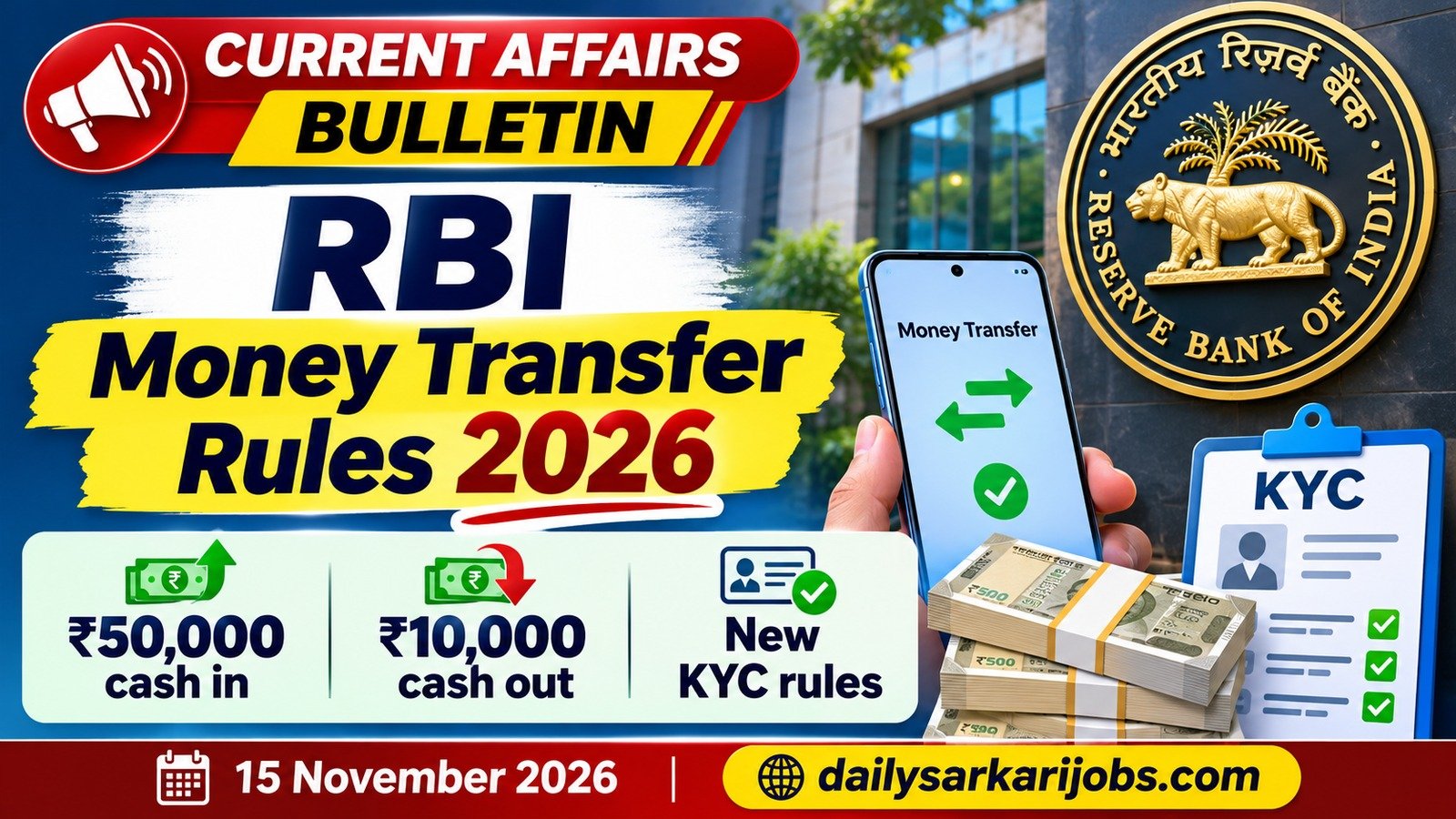
The Reserve Bank issued a new set of rules for sending money within India on 11 November 2026, and they took effect at once.The rules look like a list of numbers. They are not. They are one idea, applied in two directions, and the idea is the thing to learn.
Cash Goes In Easily. It Comes Out Hard.
A person with no bank account can walk into a bank branch and send up to ₹50,000 in cash to someone else’s bank account.That is the way in, and it is generous.
Going the other way, the ceiling collapses.Money sent from a bank account so that someone without an account can collect it in cash is capped at ₹10,000 in a single transaction and ₹25,000 a month for each person collecting it. That is one fifth of the inbound limit per transaction.
The reason is the whole logic of the framework.Cash paid in at a counter ends up inside a bank account, where it carries a name, an account number and a trail. Cash handed over at the other end leaves the banking system entirely and becomes untraceable.So the Reserve Bank is relaxed about money entering the system and strict about money leaving it.Every limit in the Directions follows from that single asymmetry.
Jargon, Defined Once
A walk-in customer is someone who uses a bank’s counter without holding an account there. The entire framework exists for people outside the banking system.
NEFT (National Electronic Funds Transfer) and IMPS (Immediate Payment Service) are the Reserve Bank’s electronic routes for moving money between accounts.
A Business Correspondent is an agent appointed by a bank to offer basic banking in places with no branch — a shop counter standing in for a bank.
KYC means Know Your Customer, the identity check a bank must run. An OVD is an Officially Valid Document, the kind of proof of identity that satisfies it.
AFA is an Additional Factor of Authentication — a second proof that it is really you, such as a one-time password, on top of the first one.
A velocity check watches how fast and how often money moves through an account, because a sudden burst of small transfers is the usual shape of misuse.
The Limits, In One Place
What is happening
Channel
Limit
Cash pay-in(no account, sending money)
At a bank branch, by NEFT
₹50,000
Cash pay-in
Business Correspondent, ATM and similar
₹5,000 per transaction; ₹25,000 a month per sender
Cash pay-out(no account, collecting money)
ATM, Business Correspondent or other authorised channel
₹10,000 per transaction; ₹25,000 a month per beneficiary
Notice the second row.The same service — a person with no account sending cash — is worth ₹50,000 at a bank branch and only ₹5,000 through a Business Correspondent. The money is identical; the verification is not. At the branch a trained employee sees the person and the document. At an agent’s counter nobody from the bank is present.The limit tracks the quality of the check, not the size of the need.
What Else the Directions Require
The sender must be registered first, using a verified mobile number and a self-certified Officially Valid Document, under the KYC Directions, 2025.
Every transaction needs an Additional Factor of Authentication.No exceptions for small amounts.
For a cash pay-out, the remitting bank must record the beneficiary’s name and address.
The sender’s details and a cash-remittance identifier must travel inside the NEFT or IMPS message itself, so the receiving bank can see where the money came from.
Banks must run velocity checks, alert customers to credits, look into unusual spikes and report suspicious activity.
Transfers should be real-time or near real-time, and complaints go to the Reserve Bank — Integrated Ombudsman Scheme, 2026.
Card-to-card transfers are left out of these Directions and stay under the rules for the payment instrument concerned.
Exam Alert: Five Traps
₹50,000 is the cash pay-IN limit at a branch; ₹10,000 is the cash pay-OUT limit per transaction.Swapping the two is the obvious wrong answer.
₹25,000 a month appears twice — per beneficiary on the way out, and per sender on the Business Correspondent route in. Read which one the question asks for.
The Directions were issued on 11 November 2026 and are effective immediately, not from the start of a quarter or a financial year.
They repeal the circulars of 5 October 2011 and 24 July 2024.This is a consolidation, not a brand-new idea.
Card-to-card transfers are excluded.A question that puts them inside the framework is wrong.
Did You Know: These Rules Are Fifteen Years Old and Were Rewritten Twice
The domestic money transfer framework began with a Reserve Bank circular of 5 October 2011, written for a country where a construction worker in Mumbai had no way to send wages home except by hand or by courier. It was reviewed on 24 July 2024, and both of those documents are now repealed and folded into the 2026 Directions.
Which is why the headline numbers have barely moved.The ₹50,000 cash NEFT ceiling has been carried forward rather than raised. What has changed is everything around it — registration, authentication, the data that travels with the money, and the bank’s duty to watch. The Reserve Bank did not widen the pipe; it put meters on it.
Today’s Static GK capsule is on India’s temple architecture, and the two have an odd thing in common. In both, the part you notice first is not the part that matters. In a South Indian temple the tallest tower is usually the gateway, not the shrine. In these Directions the eye goes to ₹50,000, while the rule that actually shapes behaviour is the ₹10,000 on the way out.
Practice Questions
Q1. The Reserve Bank of India (Domestic Money Transfer) Directions, 2026 were issued on (a) 5 October 2011 (b) 24 July 2024 (c) 11 November 2026 (d) 1 April 2026 Answer: (c) 11 November 2026 They took effect immediately on issue, rather than from the start of a quarter or financial year.
Q2. Under the Directions, a walk-in customer at a bank branch may send how much in cash to a beneficiary’s account by NEFT? (a) ₹5,000 (b) ₹10,000 (c) ₹25,000 (d) ₹50,000 Answer: (d) ₹50,000 Through a Business Correspondent or an ATM the same service is capped at ₹5,000 per transaction.
Q3. The cash pay-out limit for a beneficiary without a bank account is (a) ₹10,000 per transaction and ₹25,000 per month (b) ₹50,000 per transaction (c) ₹25,000 per transaction and ₹50,000 per month (d) There is no limit Answer: (a) ₹10,000 per transaction and ₹25,000 per month Cash leaving the banking system is harder to trace than cash entering it, which is why the outbound ceiling is the tighter one.
Q4. Which of these is NOT covered by the 2026 Directions? (a) Cash pay-out through an ATM (b) Card-to-card transfers (c) Cash pay-in through a Business Correspondent (d) Walk-in cash pay-in at a branch Answer: (b) Card-to-card transfers Such transfers continue to be governed by the rules applying to the payment instrument itself.
Q5. Every transaction under the Directions must be validated by (a) A physical signature (b) A branch manager’s approval (c) An Additional Factor of Authentication (d) A notarised affidavit Answer: (c) An Additional Factor of Authentication The sender must also be registered beforehand with a verified mobile number and a self-certified Officially Valid Document.
30-Second Revision
The hinge:cash goes in easily and comes out hard — ₹50,000 in at a branch, only ₹10,000 out per transaction, because money leaving the system cannot be traced.
The date:11 November 2026, effective immediately; repeals the circulars of 5 October 2011 and 24 July 2024.
Cash pay-in:₹50,000 at a branch by NEFT; ₹5,000 per transaction and ₹25,000 a month through a Business Correspondent or ATM.
Cash pay-out:₹10,000 per transaction, ₹25,000 a month per beneficiary, whose name and address the remitting bank must record.
The safeguards: registration with a verified mobile number and a self-certified OVD, AFA on every transaction, velocity checks, and the Integrated Ombudsman Scheme, 2026 for complaints. Card-to-card is excluded.
What Is Not Settled
The issuing department is not named in so many words in the sources used here.The reference number carries the letters DPSS, which is the Reserve Bank’s Department of Payment and Settlement Systems, and that is the department these Directions would normally come from — but the notification text seen here does not spell it out, so treat the inference as an inference.
Second, a separate report that the Reserve Bank is considering limits on private equity firms controlling several non-banking financial companies is a different matter altogether, and is not part of these Directions. The two were reported in the same week and should not be merged.
Sources
The Reserve Bank of India notification Reserve Bank of India (Domestic Money Transfer) Directions, 2026, reference RBI/DPSS/2026-27/476, dated 11 November 2026 — for the statement that the Directions are effective immediately, the cash pay-out limits of ₹10,000 per transaction and ₹25,000 per beneficiary per month, the requirement that the remitting bank record the beneficiary’s name and address, the cash pay-in limit of ₹50,000 for a walk-in customer at a branch by NEFT and of ₹5,000 per transaction with a ₹25,000 monthly cap through Business Correspondents and ATMs, the exclusion of card-to-card transfers, registration with a verified mobile number and a self-certified Officially Valid Document under the KYC Directions, 2025, the Additional Factor of Authentication on every transaction, the inclusion of remitter details and a cash-remittance identifier in the IMPS or NEFT message, the velocity checks and customer alerts, the reference of grievances to the Integrated Ombudsman Scheme, 2026, and the repeal of the circulars dated 5 October 2011 and 24 July 2024.
Reporting of 12 November 2026 summarising the same notification, used to cross-check every limit above. Both accounts agree on all figures.
Where the issuing department is an inference from the reference code rather than a stated fact, the post says so above rather than asserting it.