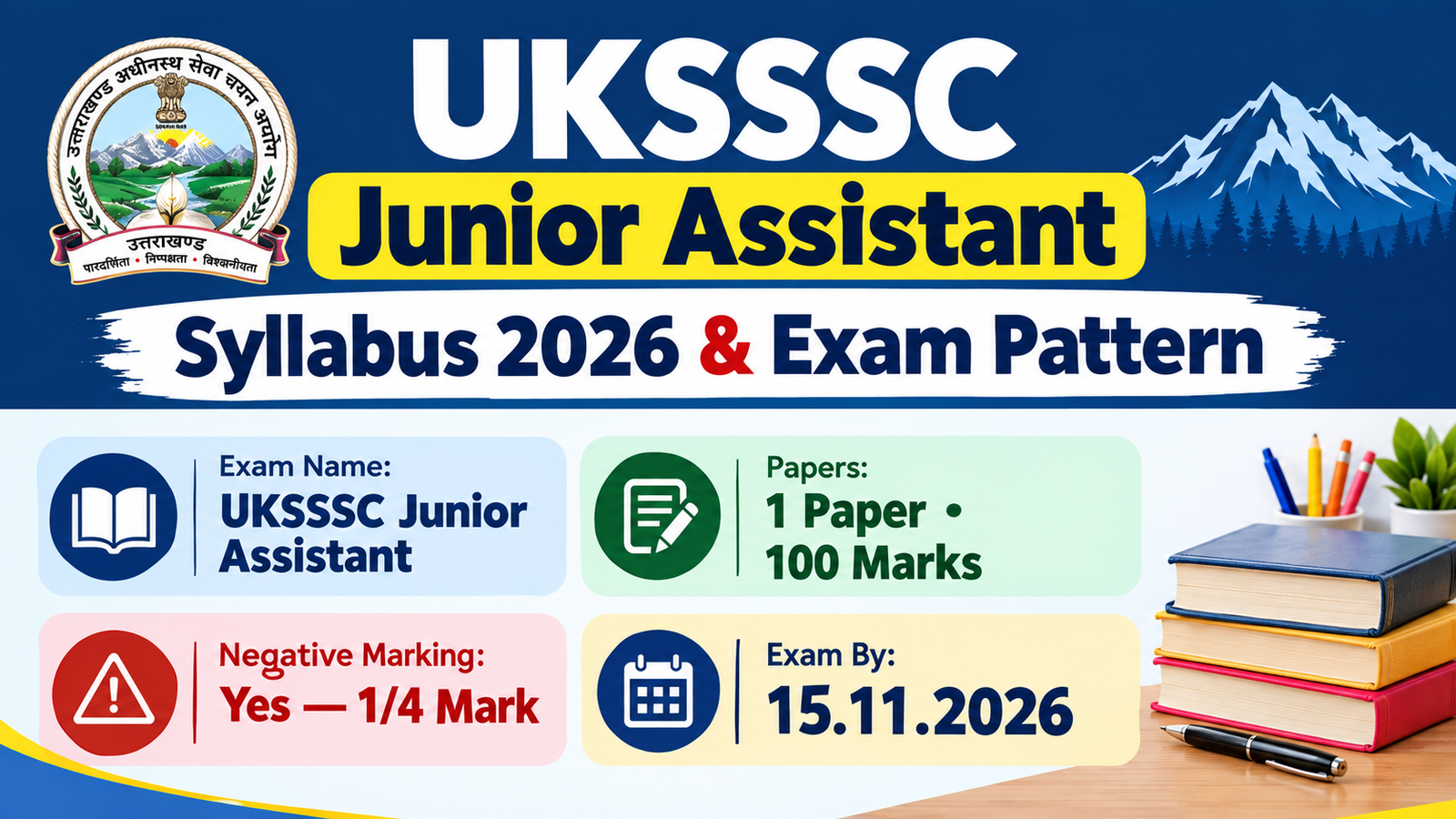
The Uttarakhand Subordinate Service Selection Commission (UKSSSC) has released the complete exam scheme and topic-wise syllabus for the Junior Assistant and other Intermediate-level Group C posts advertised under Advertisement No. 80/UKSSSC/2026. The selection is decided by a single offline objective paper of 100 marks carrying negative marking, followed by a qualifying typing test. The syllabus below is reproduced from Appendix-1 of the official notification, subject by subject.
Written Competitive Exam (outer limit stated in notification)
15.11.2026
Note: The notification states 15.11.2026 as the last date by which the written exam will be held. UKSSSC will announce the exact exam date separately on its website and through press releases, so candidates should keep checking sssc.uk.gov.in.
Exam Pattern
Stage
Details
Stage 1 — Written Competitive Exam
One objective-type paper covering General Hindi, General Knowledge and General Studies. 100 questions, 100 marks, 2 hours, held offline on an OMR sheet. Every question carries four options and only the single best option is to be marked. This is the merit stage — the entire selection list is prepared from this paper alone.
Negative Marking
One-fourth (1/4) of the marks allotted to a question is deducted for each wrong answer. Marking more than one option counts as a wrong answer even if one of the marked options is correct. A question left blank carries no penalty. Using whitener, or scratching and cutting options on the OMR sheet, also attracts negative marks.
Minimum Qualifying Marks
45% for Unreserved, EWS and OBC candidates. 35% for Scheduled Caste and Scheduled Tribe candidates. Anyone scoring below this is treated as failed in the written exam.
Stage 2 — Typing Test
Qualifying only — the marks do not count towards the merit list. It applies to the posts that require typing, where the essential qualification is Hindi typing on a computer at a minimum speed of 4000 key depressions per hour along with knowledge of MS Office.
Merit and Tie-breaker
The merit list is prepared only from the written exam marks. If two candidates score the same marks, the older candidate is placed higher; if their age is also the same, the English alphabetical order of their names decides.
OMR Sheet Rules
The OMR answer sheet is in triplicate. The original and the second copy must be handed to the invigilator before leaving the hall — failing to do so makes the result zero. Candidates may carry the question booklet and the third copy of the OMR sheet home. A wrong or missing roll number or booklet series on the OMR sheet means the sheet is not evaluated at all.
Subject-wise Marks Distribution
Subject
Marks
General Hindi
20
General Knowledge and General Studies
40
General Knowledge of Uttarakhand
40
Total
100
Uttarakhand General Knowledge alone carries 40 of the 100 marks — the same weight as the entire national and international General Studies section. It is the single highest-scoring part of this paper.
Topic-wise Syllabus
Subject
Topics
1. General Hindi (20 marks)
Language and Hindi: language and its types, development of Hindi, various forms of Hindi, official (karyalayi) Hindi, major dialects of Uttarakhand — Kumaoni and Garhwali. Script and alphabet: development of the Devanagari script, its merits and shortcomings, Indian languages written in Devanagari, vowels and consonants. Spelling: spelling analysis, correct and incorrect words, punctuation marks, Hindi numerals. Word formation: varn, akshar, pratyay, upsarg, sangya, sarvanam, kriya, vachya, pad, ling, vachan, purush, visheshan, kriya-visheshan, karak, avyay. Vocabulary: tatsam, tadbhav, deshaj and aagat words, ekarthi, anekarthi, vipritarthi (vilom), samanarthi, paryayvachi, shabd-yugm, shrutisambhinnarthak words. Sandhi: sandhi vichhed and its types. Sentences: meaning and definition of a sentence, types of sentences by structure, vakya-shuddhi. Idioms and proverbs: definition, meaning and usage. Letter writing: tippan, praroopan, vigyapti, government and semi-government letters. Mass communication: the various media. Use of computers in Hindi.
2.1 Reasoning
Verbal reasoning: Alphabetical Test, Coding-Decoding, Analogy, Order Arrangement, Blood Relations, Classification, Word Formation, Direction and Distance, Venn Diagram, Calendar, Problem Solving. Non-verbal reasoning: Classification, Figure Counting, Figure Completion, Grouping of Identical Figures, Mirror and Water Image, Paper Folding and Cutting, Cube and Dice.
2.2 History
Political, social, economic and cultural history of Ancient India (from the Harappan civilization to 1206 AD), Medieval India and Modern India. The Indian National Movement and major events after independence. Major events of world history — the Renaissance in Europe, the American War of Independence, the French Revolution, the Russian Revolution, and the First and Second World Wars.
2.3 Geography
Geography of India: geographical introduction, relief, climate, drainage system; resources — natural vegetation, soil, water, minerals and energy; crops, population, air and water pollution. World geography: origin of the solar system, latitude and longitude, relief, rocks, ocean currents, tides, climate, major industries and population.
2.4 Political Science
National awakening in India — important leaders, organizations and events. Important events of the Indian National Movement, Gandhian ideas, salient features of the Constitution of India, Fundamental Rights, Directive Principles of State Policy, the Parliament of India, political parties and the electoral process in India, the concept of local self-government, and the United Nations Organization.
2.5 Economics
Features of the Indian economy, population, features and problems of Indian agriculture, food security, industrial development and its problems, money and banking, the New Economic Policy, human capital formation, poverty, employment, the Indian tax system, foreign trade of India, balance of payments, globalisation and the Indian economy.
2.6 Current Affairs
India: state-related information, national symbols, geographical information, important places, languages and literature, sports, awards and other current events. International: important discoveries and inventions, important organizations and other current events.
2.7 Fundamentals of Computers
Computer fundamentals: history and basics, classification, hardware and software, processors, memory, computer languages, algorithms and flowcharts. Operating systems: functions and types, processes, GUI-based operating systems. Database management systems: database concepts, the need for databases, types of keys. Office automation: word processing, spreadsheets and presentation software. Networking and internet: computer networks, internet basics, ISP, web browsers, World Wide Web, URL, domain names, search engines, email, net etiquette, social impact of ICT, websites, web pages, HTML basics and common HTML tags. Cyber security and emerging technologies: cyber threats, cyber security techniques, the Indian IT Act, introduction to Artificial Intelligence, Machine Learning, Internet of Things and Cloud Computing.
2.8 General Knowledge of Uttarakhand (40 marks)
Geographical introduction: location and extent, mountain peaks, glaciers, rivers, lakes, forests, national parks and sanctuaries. History: important dynasties, the period of British rule, Uttarakhand from the perspective of the Indian freedom struggle, important social movements and the Uttarakhand statehood movement. Economy: agriculture, important industries, tourism, important statistical data, employment and important schemes. Culture: cultural aspects and traditions of Uttarakhand. Environment: bio-diversity, water resources, environment, pollution and disaster management in Uttarakhand. Administration: the general administrative system, local self-government and important initiatives in Uttarakhand. Current affairs related to Uttarakhand.
How to Apply
Applications for this recruitment are still open at the time of writing, so candidates preparing from this syllabus can apply through the same portal.
Register using your Aadhaar number along with your own mobile number and email ID. One Aadhaar can be used only once.
Fill in your personal, educational and reservation details exactly as they appear on your High School certificate.
Upload your scanned colour passport photograph (150w x 200h px), signature (150w x 100h px) and left thumb impression (150w x 100h px) in JPG or JPEG format, along with your High School certificate and both sides of your Aadhaar card.
Pay the fee online by credit card, debit card, net banking or UPI, then submit and print the application. The form is complete only when the status shows "Completed".
Note: Applications are accepted online only — no printout or document needs to be sent to the Commission at this stage. The last date is 07.10.2026. Full eligibility, fee and vacancy details are in the main recruitment post.
Treating Uttarakhand General Knowledge as a small section — it carries 40 of the 100 marks, as much as the whole national General Studies portion.
Guessing blindly. One-fourth of a mark is cut for every wrong answer, and a blank question costs nothing, so a pure guess is a losing bet.
Marking two options hoping one will count — the Commission treats that as a wrong answer and deducts marks for it.
Using whitener or scratching out an option on the OMR sheet, which also attracts negative marks.
Walking out with the original OMR sheet. Only the third copy may be taken home; not handing over the original and second copy makes the result zero.
Ignoring the minimum qualifying marks — scoring under 45% (35% for SC and ST) means failing the exam no matter where you stand in the merit order.
Frequently Asked Questions
What is the exam pattern for the UKSSSC Junior Assistant exam 2026?
It is a single offline objective paper of 100 multiple-choice questions worth 100 marks, to be completed in 2 hours, followed by a qualifying typing test.
Is there negative marking in the UKSSSC Junior Assistant exam?
Yes — one-fourth (1/4) of the marks allotted to a question is deducted for every wrong answer, and marking more than one option also counts as wrong.
What are the subjects in the UKSSSC Junior Assistant syllabus 2026?
General Hindi for 20 marks, General Knowledge and General Studies for 40 marks, and General Knowledge of Uttarakhand for 40 marks.
What are the minimum qualifying marks in this exam?
Unreserved, EWS and OBC candidates must score at least 45%, while Scheduled Caste and Scheduled Tribe candidates must score at least 35%.
When will the UKSSSC Junior Assistant exam 2026 be held?
The notification states the written exam will be held by 15.11.2026, with the exact date to be announced separately on sssc.uk.gov.in.
Does the typing test count towards the final merit list?
No — the typing test is qualifying only, and the merit list is prepared solely from the marks of the written competitive exam.
What typing speed is required for the UKSSSC Junior Assistant post?
A minimum of 4000 key depressions per hour in Hindi typing on a computer, along with knowledge of MS Office, for the posts that require typing.
How is a tie between two candidates with equal marks resolved?
The older candidate is placed higher, and if both are the same age, the English alphabetical order of their names decides the position.
Disclaimer: The information above has been compiled from the official notification for the convenience of job seekers. Candidates are advised to verify all details from the official website before applying.