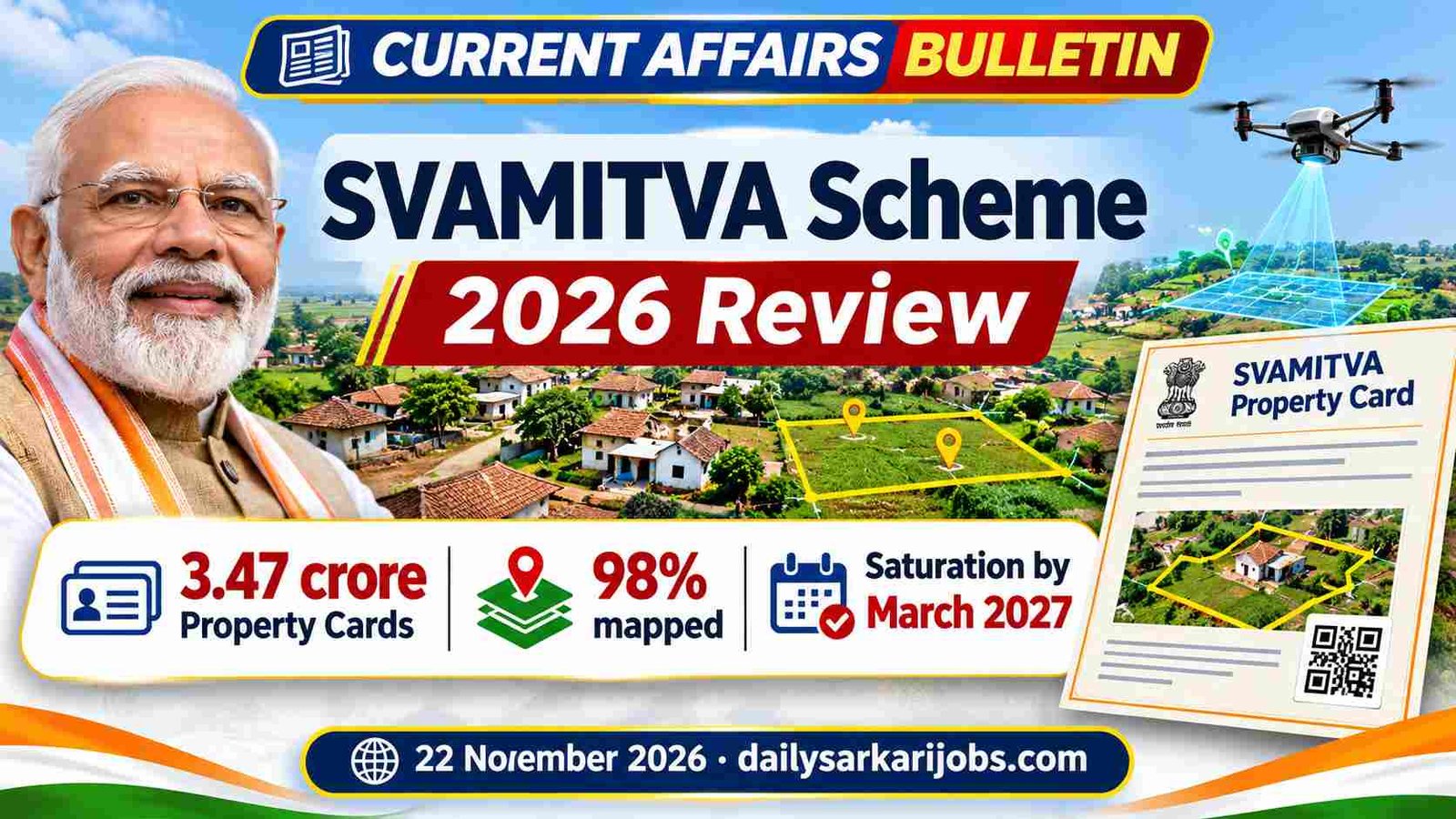
At a national review meeting in New Delhi on 20 November 2026, the Centre asked every state to finish the SVAMITVA scheme by 31 March 2027. Two numbers in that meeting tell the real story, and they sit oddly together. 3.47 crore Property Cards have been issued to rural households. Against those cards, 16,614 loans have been taken. That is roughly one loan for every two thousand cards. The point of this scheme was never the map — it was to turn the house you already live in into something a bank will lend against. The mapping is nearly finished. The lending has barely started. Understanding that gap is understanding the scheme.
⚡ QUICK FACTS
Launched
24 April 2020
Ministry
Panchayati Raj
Property Cards issued
3.47 crore
Saturation target
31 March 2027
What SVAMITVA is
The full form is Survey of Villages Abadi and Mapping with Improvised Technology in Village Areas. The word abadi matters: it means the inhabited part of a village — the houses, lanes and yards where people actually live, as opposed to the farmland around it.
Here is the problem it was built to solve. Indian farmland has been surveyed and recorded for generations, so a farmer can usually prove which field is his. The land his house stands on often has no such record. Families have lived on it for generations, everyone in the village knows it is theirs, but there is no paper. Without paper, the house cannot be used as collateral — the security a bank holds against a loan — and every boundary argument becomes a quarrel with no referee.
SVAMITVA flies a drone over the inhabited area, produces an accurate map, lets villagers raise objections and claims, and then issues each household a Property Card: a record of rights over the land under its own home.
Item
Detail
Full form
Survey of Villages Abadi and Mapping with Improvised Technology
Launched
24 April 2020, on National Panchayat Day
Launched by
Prime Minister Narendra Modi
Type
Central Sector scheme
Nodal ministry
Ministry of Panchayati Raj
Technology partner
Survey of India
State nodal body
Revenue or Land Records Department
Covers
Abadi, the inhabited area, not farmland
Note the launch date. 24 April is National Panchayat Day, the anniversary of the 73rd Constitutional Amendment coming into force. Choosing it was deliberate — this is a panchayat scheme, not a revenue-department scheme, which is why the Ministry of Panchayati Raj runs it. For the constitutional machinery behind that, see our capsule on Panchayati Raj and Part IX.
Where the work has reached
These are the figures given at the 20 November review. Read them as a pipeline: every stage is a little behind the one before it, which is exactly what you would expect.
Stage
Villages
Share
Target
3.33 lakh
100%
Drone survey completed
3.28 lakh
98%
Maps handed to states
3.17 lakh
95%
Ground verification done
2.69 lakh
81%
Maps open to objections
2.46 lakh
74%
Property Cards generated
2.20 lakh
66%
3.47 crore Property Cards have come out of those 2.20 lakh villages. The drop from 98 per cent to 66 per cent across the pipeline is not failure; it is the slow part. A drone can map a village in a morning. Walking the boundaries with the families who live there, hearing objections and settling them takes very much longer — and it is that slow part, not the flying, that makes the card worth anything.
The number that matters most
Against all those cards, 16,614 loans worth Rs 1,769.56 crore have been taken, and only in seven states and union territories: Madhya Pradesh, Rajasthan, Maharashtra, Gujarat, Mizoram, Jammu and Kashmir, and Ladakh.
That works out to about Rs 10.6 lakh per loan — so where the system does work, it is lending real money, not token amounts. But one loan per two thousand cards tells you the credit side is still at the beginning. Economists have a name for this problem: dead capital — wealth that exists but cannot be used, because it cannot be proved. SVAMITVA is an attempt to wake that capital up. Issuing the card is step one; a bank manager treating it as security is step two, and step two has a long way to run. For how lending and collateral work, see our capsule on banking awareness.
The minister told the meeting that banks now accept SVAMITVA Property Cards as collateral. Treat that as a statement of practice rather than a legal rule: the release cites no circular or provision behind it.
What else the maps are used for
This is the part most notes miss, and it is the part that makes SVAMITVA bigger than land titling. Once a village has an accurate map, several unrelated problems become solvable.
Gram Panchayat Development Plans. A GPDP is the annual plan a village panchayat prepares for its own spending. With a real map, that plan can be drawn on geography rather than guesswork.
Property tax. Panchayats can assess tax on properties they can actually see and measure, which gives them their own revenue.
Infrastructure planning. Drainage networks, street lighting and solar installations can be sited properly.
Solar potential. Rooftop area can be estimated from the mapping data.
Fewer disputes. A recorded boundary turns a quarrel into a question with an answer.
The data is GIS-based — a Geographic Information System, meaning a map where every feature carries information attached to its exact location, so it can be searched and measured rather than merely looked at. That is why one survey can serve many departments. The same village-level ambition runs through PM Viksit Gram Swaraj Yojana and PM Dhan-Dhaanya Krishi Yojana.
Who said what on 20 November
Person
Role
Rajiv Ranjan Singh (Lalan Singh)
Union Minister of Panchayati Raj
Prof. S. P. Singh Baghel
Minister of State, Panchayati Raj
Dr Vineet Joshi
Secretary, Ministry of Panchayati Raj
Ministers from nine states attended, along with officials from the states and union territories and from the Survey of India. The call was for time-bound action plans to reach saturation by 31 March 2027.
Exam Alert
SVAMITVA = Survey of Villages Abadi and Mapping with Improvised Technology in Village Areas. The word Abadi inside the acronym is the giveaway.
Launched 24 April 2020, on National Panchayat Day. It is a Central Sector scheme, not a Centrally Sponsored one.
Run by the Ministry of Panchayati Raj, with the Survey of India as technology partner. A question naming the Ministry of Rural Development is wrong.
It maps the inhabited area only. Agricultural land is outside its scope — a very common trap.
Current figures: 3.28 lakh villages drone-surveyed of 3.33 lakh, 3.47 crore Property Cards, 16,614 loans worth Rs 1,769.56 crore.
Saturation target: 31 March 2027.
The document issued is a Property Card, giving a record of rights.
Did You Know?
Almost every card is still unborrowed against. 3.47 crore Property Cards have produced 16,614 loans — about one in every two thousand. The map was the easy half.
The loans are not small. Rs 1,769.56 crore across 16,614 loans averages about Rs 10.6 lakh each, so where the card does work it unlocks serious money.
Mizoram and Ladakh are on the lending list alongside Madhya Pradesh and Maharashtra — a reminder that the scheme is not only a large-state story.
The survey has uses nobody planned for. The same drone data that proves who owns a house can estimate how much solar power its roof could generate.
30-Second Quick Revision
What: SVAMITVA maps the inhabited part of villages by drone and issues Property Cards.
Who and when: Ministry of Panchayati Raj with Survey of India; launched 24 April 2020.
The news: review meeting on 20 November 2026 set saturation by 31 March 2027.
The gap: only 16,614 loans worth Rs 1,769.56 crore so far, in seven states and union territories.
The idea: turning dead capital into usable security — proof first, credit afterwards.
Test Your Knowledge
Q1. SVAMITVA scheme is implemented by which ministry? (a) Ministry of Rural Development (b) Ministry of Panchayati Raj (c) Ministry of Housing and Urban Affairs (d) Ministry of Agriculture Answer: (b) Ministry of Panchayati Raj The Survey of India is its technology partner, and the state nodal body is usually the Revenue or Land Records Department.
Q2. SVAMITVA surveys which part of a village? (a) Agricultural land only (b) Forest land (c) The inhabited or abadi area (d) Grazing commons Answer: (c) The inhabited or abadi area The word abadi sits inside the acronym itself; farmland is outside the scheme’s scope.
Q3. On which day was the SVAMITVA scheme launched in 2020? (a) Republic Day (b) National Panchayat Day, 24 April (c) Independence Day (d) Good Governance Day Answer: (b) National Panchayat Day, 24 April That date marks the 73rd Constitutional Amendment coming into force, which is why a panchayat ministry runs the scheme.
Q4. What document does a household receive under SVAMITVA? (a) A Property Card (b) A ration card (c) A Kisan Credit Card (d) A patta lease Answer: (a) A Property Card It provides a record of rights over the land beneath the house, which can then be offered to a lender as security.
Q5. The Centre has asked states to achieve SVAMITVA saturation by (a) 31 December 2026 (b) 31 March 2028 (c) 31 March 2027 (d) 15 August 2027 Answer: (c) 31 March 2027 The call was made at the national review meeting held in New Delhi on 20 November 2026.
Want the full ten-question set as a PDF? Head to our Test Your Knowledge page.
Verified on 22 November 2026 against the Press Information Bureau release of 20 November 2026 on the SVAMITVA review meeting, and the Survey of India’s own page on the scheme for the full form, launch date and partner roles.