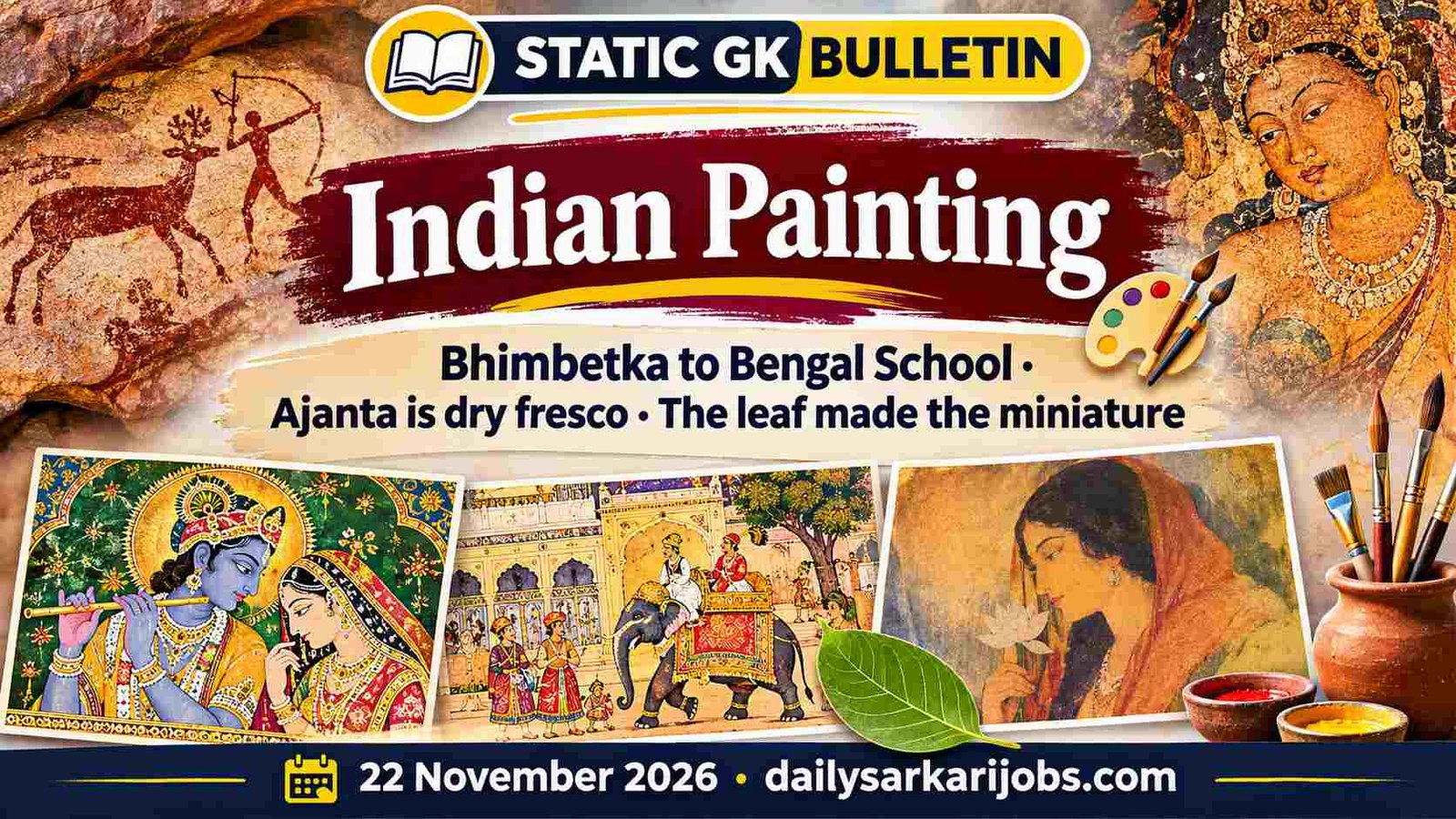
Most lists of Indian painting are a pile of school names in no particular order, which is why they are so hard to remember. There is a thread, and it is a physical one: Indian painting changed every time the surface changed. Rock shelter, cave wall, palm leaf, paper, cloth and mud wall — each new surface set a new size, and the size decided everything else. Here is the proof in one figure: a Pala manuscript painting is about 2.25 by 3 inches, because that is how big a palm leaf is. The miniature was not an artistic choice. It was the shape of a leaf. Hold that idea and the schools arrange themselves.
⚡ QUICK FACTS
Oldest
Bhimbetka, Madhya Pradesh
Greatest murals
Ajanta, Maharashtra
First miniatures
Pala, on palm leaf
Court peak
Mughal, from 1555
Surface one: the rock shelter
The Bhimbetka rock shelters sit in Raisen district, Madhya Pradesh, about 45 km south-east of Bhopal, inside the Ratapani Wildlife Sanctuary. They became a UNESCO World Heritage Site in 2003. The earliest paintings are dated to around 10,000 BCE, in the Mesolithic, and the shelters carry work from seven different periods, running all the way down to medieval times.
W. Kincaid first mentioned the site in a paper in 1888, wrongly describing it as Buddhist. V. S. Wakankar was the first archaeologist to recognise what it actually was, reporting prehistoric shelters in 1957. The subjects are hunting scenes, animals and dancers — painted large, because a rock wall is large. See also India’s UNESCO World Heritage Sites.
Surface two: the cave wall
The Ajanta Caves are in Aurangabad district, Maharashtra, cut between the 2nd century BCE and about 480 CE in two phases. They are Buddhist, and the paintings tell the Jataka tales — stories of the Buddha’s previous lives. UNESCO inscribed them in 1983.
The single biggest trap in this topic is the word fresco. Ajanta is commonly called fresco painting, but a true fresco is painted into wet plaster so the colour binds as it dries. Ajanta is dry fresco: the paint was applied on top of a plaster surface that had already dried. If an option says Ajanta used the wet or true fresco technique, it is wrong.
The rediscovery is a good story and a good question. On 28 April 1819, a British officer, Captain John Smith, out on a tiger hunt, was shown the entrance to Cave 10 by a local shepherd boy. The caves had never been lost to the people living around them; they were lost only to the record.
Mural site
Note
Ajanta
Buddhist, Jataka tales, Maharashtra
Ellora, Kailasanatha temple
Mural work inside the rock-cut temple
Bagh caves
Mural site, close in style to Ajanta
Sittanavasal
Jain cave paintings, Tamil Nadu
Armamalai cave
Tamil Nadu
Jogimara and Sitabenga
Chhattisgarh, 3rd to 1st century BCE, secular themes
Jogimara and Sitabenga are worth a second look: they are among the rare non-religious early paintings in India. For the rock-cut architecture that carried these murals, see our capsule on Indian temple architecture, and for the faiths behind the subjects, Buddhism and Jainism.
Surface three: the palm leaf
Around the 10th century the surface shrank dramatically, and the miniature was born out of necessity. Under the Pala rulers of Bengal and Bihar, Buddhist texts were illustrated on palm-leaf manuscripts and their wooden covers. The centres were the great monastic universities — Nalanda, Vikramshila, Odantapuri and Somarpura.
The earliest dated example comes from the sixth regnal year of Mahipala, about 993 CE, and is held by the Asiatic Society, Kolkata. The style died out in the late 12th century, when the monasteries did.
Meanwhile in the west, mainly in Gujarat, the Western Indian or Jain school illustrated manuscripts from about the 11th century and heavily from the 13th. The central text is the Kalpa Sutra. Its signature is unmistakable and very examinable: faces shown in three-quarter view with the farther eye protruding beyond the outline of the face, wiry drawing and jewel-like colour.
Surface four: paper
Paper let the picture grow again, and with the extra room came detail, depth and the human face. Mughal painting begins with Humayun’s return from exile in Persia in 1555, bringing two Persian masters with him: Mir Sayyid Ali and Abdus Samad. Under Akbar (1556-1605) they supervised a workshop drawing artists from Gujarat, Gwalior and Kashmir. The result was a genuine blend: Persian colour and finish applied to Indian subjects.
Emperor
What the painting did
Named artists
Akbar
Great illustrated manuscripts
Mir Sayyid Ali, Abdus Samad
Jahangir
Portraits, durbar scenes, nature studies
Ustad Mansur, Abul Hasan, Bishandas
Shah Jahan
Formal, jewelled court portraiture
Bichitr, Chitarman, Manohar, Honhar
Aurangzeb
Imperial workshop wound down by about 1670
Artists dispersed to other courts
The landmark work is the Hamzanama, begun in 1567 and finished in 1582 — and here is a lovely exception to the paper rule: the Hamzanama was painted on cloth, not paper, which is part of why its pages are so unusually large. The Tuti-Nama is the earlier, more Indian-looking work from the middle of the century. For the empire itself, see the Mughal Empire.
When Aurangzeb closed the workshop, the painters did not stop painting — they went to other courts. That dispersal is what created the regional schools, and it is the cleanest cause-and-effect in the whole topic.
The regional schools
School
Groups or centres
Character
Rajasthani
Mewar, Marwar, Hadoti, Dhundar
From the late 16th century
Mewar group
Udaipur, Nathdwara, Devgarh, Chavand
Bold colour
Marwar group
Jodhpur, Bikaner, Kishangarh, Nagaur
Kishangarh known for its faces
Hadoti group
Kota, Bundi, Jhalawar
Hunting and lush landscape
Dhundar group
Amber, Jaipur, Shekhawati, Uniara
Shekhawati for haveli murals
Pahari
Basohli, Kangra, Jammu or Dogra
17th to 19th centuries
Deccani
Bijapur, Golkonda, Ahmadnagar, Bidar, Berar
Late 16th to mid-17th century
Two contrasts are worth memorising because papers set them against each other. Basohli is bold and intense; Kangra is delicate and lyrical — both are Pahari, and they look nothing alike. And the Deccani schools, in the sultanates that emerged from the Bahmani kingdom by 1520, are credited with an innovation of their own: the Ragamala set, paintings that visualise musical modes. That is the direct meeting point between painting and our capsule on Indian classical music.
Surface five: cloth, mud wall and floor
The folk traditions never went through courts at all, and their surfaces are the oldest kind: the walls and floors people live with. State pairing is the question in almost every paper.
Tradition
State
Surface or technique
Madhubani or Mithila
Bihar
Freshly plastered mud walls and floors
Warli
Maharashtra
Hut walls, white rice paste on red ochre
Pattachitra
Odisha and West Bengal
Cloth; patta means cloth, chitra painting
Kalamkari
Andhra Pradesh
Cotton, pen and natural dyes
Tanjore
Tamil Nadu
Classical South Indian panel painting
Mysore
Karnataka
Classical South Indian panel painting
Warli is built from three shapes only — circle, triangle and square. The circle is the sun and moon, the triangle a mountain or tree, the square a sacred enclosure called the chauk. A human figure is simply two triangles joined at their tips. It is made by women, in white rice paste, with a chewed bamboo stick for a brush.
Kalamkari means pen work: kalam is pen, kari is craftsmanship. It has two styles with separate homes and separate GI tags — Srikalahasti, which is hand-drawn with the pen and received its GI in 2005, and Machilipatnam, which is block-printed and received its GI in 2008. The full process runs to twenty-three steps. Madhubani also holds a GI tag. For the state-wise art map more broadly, see classical and folk dances and festivals and the National Akademis.
The modern turn
Company painting, of the 18th and 19th centuries, is the hybrid that appeared when Indian painters worked for European patrons — Indian subjects drawn with Western perspective and shading. Then the colonial art schools arrived: Madras in 1850 and Calcutta in 1854.
The reply came in the early twentieth century with the Bengal School, which deliberately turned away from European academic style and back towards Indian and Asian sources. Its key figures are Abanindranath Tagore, Nandalal Bose and Asit Kumar Haldar. After Independence came the Progressive Artists’ Group, formed in 1947 — M. F. Husain, S. H. Raza, F. N. Souza, K. H. Ara, S. K. Bakre and H. A. Gade.
Exam Alert
Bhimbetka is in Madhya Pradesh (Raisen district), UNESCO-listed in 2003; Ajanta is in Maharashtra, listed in 1983.
Ajanta is dry fresco, not true fresco. Paint on dry plaster, not wet. This is the most-set trap on the topic.
Ajanta is Buddhist and shows Jataka tales; Sittanavasal is Jain, in Tamil Nadu.
Pala painting is on palm leaf, Bengal and Bihar, from the 10th century, dying out in the late 12th. The Jain or Western Indian school is Gujarat, with the Kalpa Sutra and protruding farther eye.
Mughal painting starts with Humayun’s return in 1555; Mir Sayyid Ali and Abdus Samad; Hamzanama 1567 to 1582, painted on cloth.
Jahangir is the portrait and nature-study emperor — Ustad Mansur for birds and animals.
Basohli bold, Kangra delicate; both Pahari. Ragamala sets are a Deccani innovation.
Folk pairs: Madhubani-Bihar, Warli-Maharashtra, Pattachitra-Odisha, Kalamkari-Andhra Pradesh.
Did You Know?
The miniature exists because of a leaf. Pala manuscript paintings measure roughly 2.25 by 3 inches — the size of the palm leaf they were painted on. The surface invented the form.
Ajanta was never lost to local people. A shepherd boy led Captain John Smith to Cave 10 in 1819; the villagers knew exactly where it was.
Aurangzeb’s economy drive created the regional schools. When the imperial workshop closed around 1670, its painters scattered to Rajput and Deccani courts and took the Mughal manner with them.
A Warli human being is two triangles. Two inverted triangles joined at the tips, and that is the whole figure — the same shape used for people and animals alike.
30-Second Quick Revision
The hinge: the surface changed, so the painting changed — rock, cave wall, palm leaf, paper, cloth.
Prehistoric: Bhimbetka, Madhya Pradesh, UNESCO 2003, earliest about 10,000 BCE.
Murals: Ajanta, Maharashtra, Buddhist Jataka tales, dry fresco, UNESCO 1983.
Miniatures: Pala on palm leaf, Bengal and Bihar; Jain school in Gujarat with the Kalpa Sutra.
Courts: Mughal from 1555; Rajasthani, Pahari and Deccani schools after the workshop closed.
Q1. The Bhimbetka rock shelters are located in which state? (a) Chhattisgarh (b) Maharashtra (c) Madhya Pradesh (d) Odisha Answer: (c) Madhya Pradesh They lie in Raisen district near Bhopal and were inscribed as a UNESCO World Heritage Site in 2003.
Q2. The paintings of the Ajanta Caves were executed using which technique? (a) Dry fresco, on dry plaster (b) True fresco, into wet plaster (c) Oil on canvas (d) Tempera on wooden panels Answer: (a) Dry fresco, on dry plaster The caves are in Aurangabad district, Maharashtra, and the subjects are mainly Jataka tales from the Buddha’s earlier lives.
Q3. Pala school miniatures of the 10th to 12th centuries were painted mainly on (a) Paper (b) Cotton cloth (c) Silk (d) Palm leaf Answer: (d) Palm leaf The small size of the leaf is what produced the miniature format; the centres were Nalanda, Vikramshila and Odantapuri.
Q4. Mughal painting is usually traced to the return from Persia, in 1555, of (a) Babur (b) Humayun (c) Akbar (d) Jahangir Answer: (b) Humayun He brought the Persian masters Mir Sayyid Ali and Abdus Samad, who went on to supervise Akbar’s workshop.
Q5. Warli painting belongs to which state? (a) Gujarat (b) Madhya Pradesh (c) Maharashtra (d) Rajasthan Answer: (c) Maharashtra It is made by the Warli people of the North Sahyadri range, in white rice paste on red ochre hut walls.
Want the full ten-question set as a PDF? Head to our Test Your Knowledge page.
Verified on 22 November 2026 against reference material on Indian painting, the Bhimbetka rock shelters, the Ajanta Caves, Madhubani art, Warli painting and Kalamkari, including the states, UNESCO inscription years and GI registrations recorded for each.