
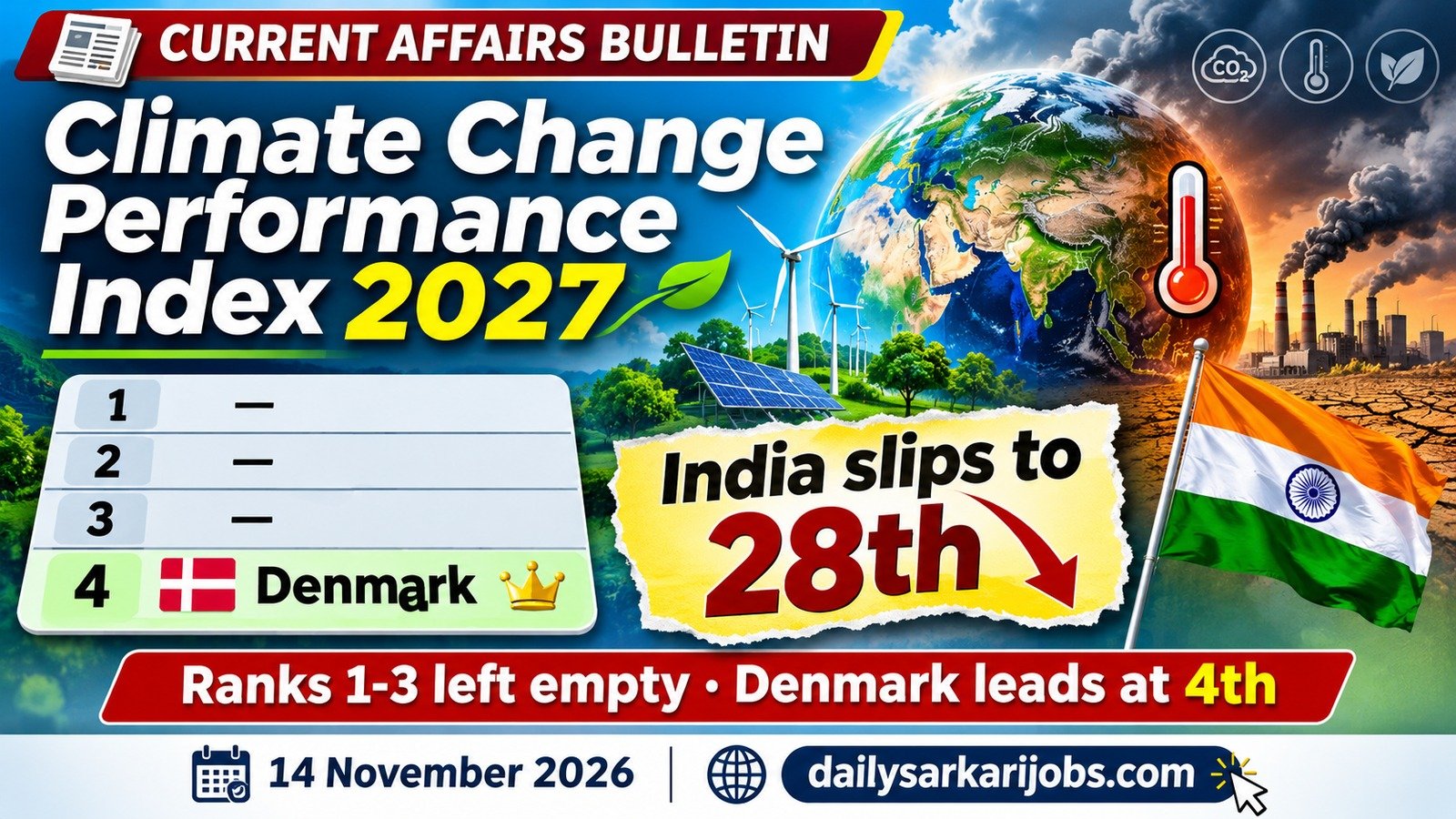
India has slipped to 28th in the Climate Change Performance Index 2027, released at COP31 in Antalya on 12 November 2026. Before you learn the rank, learn the odd thing about the list it sits on — because it is the detail examiners like most.
Nobody Has Ever Finished First
The top three places on this index are empty, and they are empty every single year. They are not vacant because of a tie or a disqualification. The compilers leave them unfilled on purpose, because no country has ever scored well enough to earn a Very High rating.
So the country at the top of the published table is ranked fourth. This year that is Denmark, with 84.05 points, followed by Lithuania, Luxembourg, the United Kingdom, Morocco and Chile. Denmark is the best performer in the world and is officially in fourth place.
The index is built to make a point rather than to crown a winner. Its own summary says no country is doing enough to prevent dangerous climate change, and the three blank lines at the top are how it says so without words. Read India’s 28th place against that: it is 28th on a list with no first, second or third.
Jargon, Defined Once
- An index here is a score built by combining several measurements into one number, so that countries can be put in order.
- Germanwatch and the NewClimate Institute are non-governmental research organisations. This is not a United Nations ranking, and that matters.
- Greenhouse gas emissions are the gases that trap heat in the atmosphere; energy use is how much energy a country consumes per person.
- Non-fossil installed capacity is the share of a country’s power-generating capacity that does not burn coal, oil or gas. Capacity is what is built, not what is actually generated.
- Transmission and distribution is the grid — the wires that carry electricity from where it is made to where it is used. Power that cannot be moved is power that is not used.
How the Score Is Built
| Category | Weight |
|---|---|
| Greenhouse Gas Emissions | 40 per cent |
| Renewable Energy | 20 per cent |
| Energy Use | 20 per cent |
| Climate Policy | 20 per cent |
Emissions carry twice the weight of anything else, which is the single most useful fact about the methodology. A country can have excellent policy on paper and still rank poorly if the emissions number does not move.
Where India Stands
- 28th place, 60.85 points, rated Medium overall. Down from 23rd in the previous edition.
- Rated Medium on Greenhouse Gas Emissions, Energy Use and Climate Policy.
- Rated Low on Renewable Energy overall, although the trend indicator within that category is High — the direction is good, the level is not yet.
- The bright spot: non-fossil sources reached 50 per cent of installed electricity capacity in 2025.
- The weak spot: transmission and distribution. The report points to grid security, transmission failures and distribution losses — renewable power that is generated but cannot be reliably delivered.
Put those two together and you have India’s climate story in one line. The country has been very good at building generation and much less good at moving the electricity afterwards. Half the capacity is non-fossil; the grid has not kept pace with it.
Exam Alert: Five Traps
- The index is published by Germanwatch and the NewClimate Institute, not by the United Nations, the UNFCCC or the World Bank. This is the most common wrong answer.
- Ranks 1 to 3 are vacant, so the best performer is 4th. A question asking who topped the CCPI has no country as its answer.
- India is 28th with 60.85 points, down from 23rd. Both numbers and the direction are asked.
- Emissions carry 40 per cent; the other three carry 20 per cent each.
- It was released at COP31 in Antalya. The index is launched at the climate COP each year, which is why the two topics turn up together.
Did You Know: The Index Is Older Than the Paris Agreement by a Decade
The Climate Change Performance Index has been published every year since 2005. That is ten years before the Paris Agreement of 2015, and it covers countries together responsible for more than 90 per cent of global greenhouse gas emissions.
Which means the empty podium is not a stunt invented for this year’s headlines. Those three lines have stayed blank through more than twenty editions, across the Kyoto years, the Paris negotiations and everything since. The same assessment has been made every year by the same method, and the answer has not changed once. That consistency is what gives the gesture its weight.
Why a Reader Should Care
Index and ranking questions are a staple of the Current Affairs section, because they come with a clean set of facts: who publishes it, what India’s rank is, which way it moved and what the index measures. This one sits with our explainer on COP31 at Antalya, where it was released, and with our capsules on the Air Quality Index and on CBD COP-17.
Today’s Static GK capsule is on India’s biodiversity hotspots, and the pair share an awkward quality. Neither measurement is designed to flatter. This index refuses to award a first place; a biodiversity hotspot is a label a region earns partly by having been destroyed. Both are built so that the number you get is a warning rather than a prize.
Practice Questions
Q1. The Climate Change Performance Index is published by
(a) The UNFCCC Secretariat (b) The World Bank and the IMF (c) Germanwatch and the NewClimate Institute (d) The United Nations Environment Programme
Answer: (c) Germanwatch and the NewClimate Institute They are non-governmental research organisations, and the index has appeared annually since 2005.
Q2. In the Climate Change Performance Index 2027, India was ranked
(a) 23rd (b) 28th (c) 10th (d) 45th
Answer: (b) 28th The score was 60.85 points with a Medium rating, a fall of five places from the previous edition.
Q3. Why are the first three ranks of the index left vacant?
(a) Those countries withdrew from the assessment (b) The data for them was incomplete (c) They are reserved for host countries of the climate COP (d) No country scored well enough to be rated Very High
Answer: (d) No country scored well enough to be rated Very High Denmark, the best performer in the 2027 edition, therefore appears at the fourth position with 84.05 points.
Q4. Which category carries the highest weight in the index?
(a) Greenhouse Gas Emissions (b) Renewable Energy (c) Energy Use (d) Climate Policy
Answer: (a) Greenhouse Gas Emissions It accounts for 40 per cent of the score, while the remaining three carry 20 per cent each.
Q5. The Climate Change Performance Index 2027 was released at
(a) The G20 summit (b) The World Economic Forum (c) COP31 at Antalya (d) The UN General Assembly
Answer: (c) COP31 at Antalya The index is launched at the annual climate conference, which ran in Turkiye from 9 to 20 November 2026.
30-Second Revision
- The hinge: ranks 1, 2 and 3 are deliberately empty — no country rates Very High, so the best performer is placed fourth.
- India: 28th, 60.85 points, Medium, down from 23rd.
- The publishers: Germanwatch and the NewClimate Institute, annually since 2005; released at COP31, Antalya, 12 November 2026.
- The weights: Emissions 40%, Renewable Energy 20%, Energy Use 20%, Climate Policy 20%.
- India’s split: non-fossil reached 50 per cent of installed capacity in 2025, but transmission and distribution are the weakness. Denmark 4th (84.05).
What Is Not Settled
The country count is reported two ways. One account gives 68 competing countries; another describes the index as covering 64 countries and the European Union, together responsible for more than 90 per cent of global emissions. The difference is almost certainly whether the EU and some smaller entries are counted separately. The 90-per-cent coverage figure is consistent across sources, so quote that rather than a head count.
Second, India’s rank within each individual category was not given in the sources used here, only the rating band. Medium, Medium, Medium and Low is what can be said safely; a category-wise rank number should come from the CCPI’s own country page before it is quoted.
Sources
- Reporting of 12 November 2026 on the release of the Climate Change Performance Index 2027 — India’s rank of 28th with 60.85 points and a Medium rating, the fall from 23rd, the vacancy of ranks one to three because no country achieved a Very High rating, Denmark at 4th with 84.05 points followed by Lithuania, Luxembourg, the United Kingdom, Morocco and Chile, publication by Germanwatch and the NewClimate Institute with support from Climate Action Network International, annual publication since 2005, the presentation of the edition at COP31 in Antalya, and coverage of countries responsible for over 90 per cent of global greenhouse gas emissions.
- The same reporting for the four assessment categories and their weightings — GHG Emissions 40 per cent, Renewable Energy 20 per cent, Energy Use 20 per cent and Climate Policy 20 per cent — India’s category ratings, the figure of 50 per cent non-fossil installed electricity capacity in 2025, and the report’s observations on grid security, transmission failures and distribution losses.
- Where the number of countries covered differs between sources, the difference is stated above rather than resolved silently.