
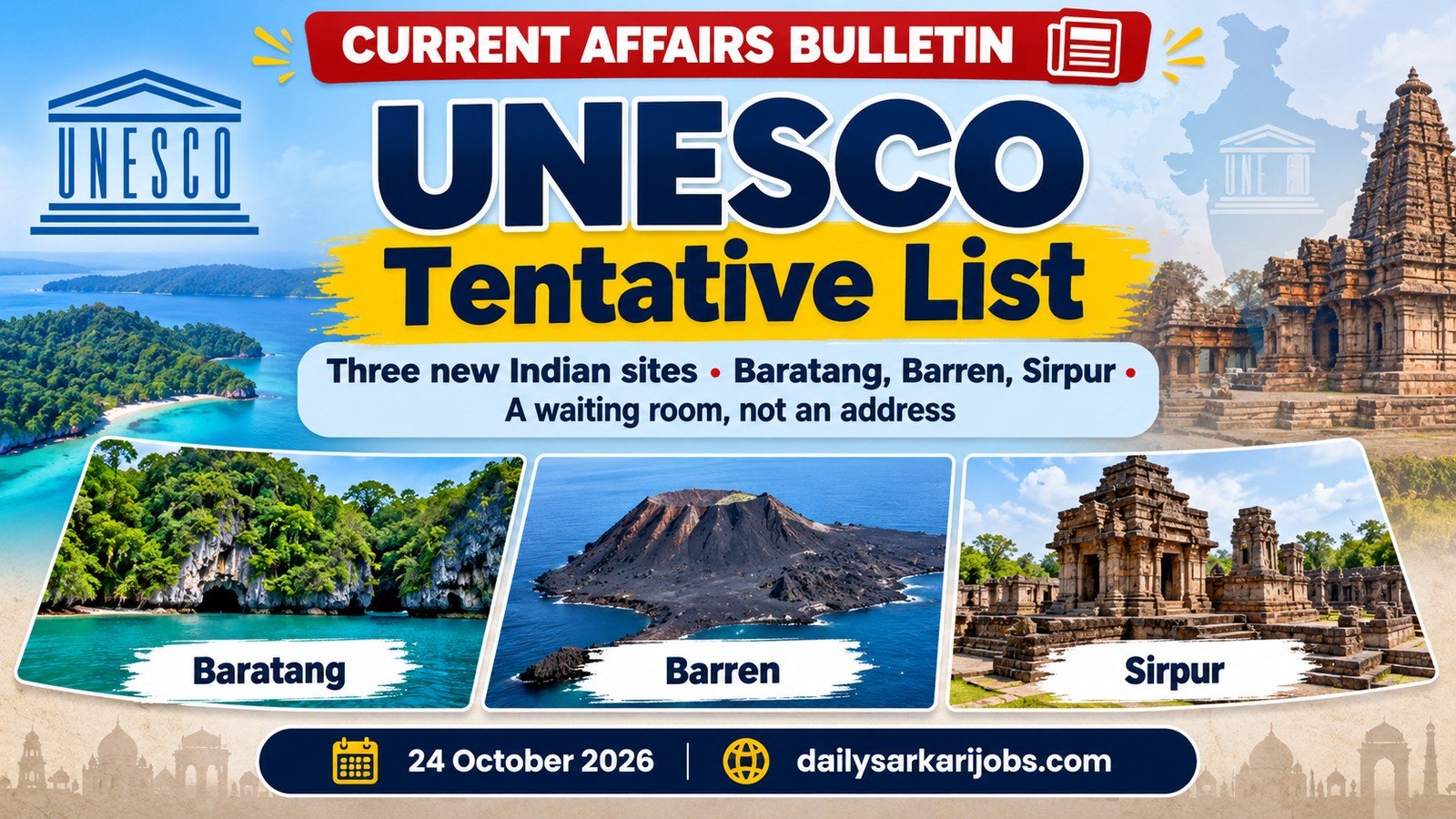
Three Indian sites have been added to UNESCO’s Tentative List, the addition announced on 21 October 2026. Two are volcanic landscapes in the Andaman and Nicobar Islands and one is an ancient city in Chhattisgarh. None of them is a World Heritage Site, and that distinction is the whole point of this page.
This is a Current Affairs explainer written in plain language for SSC, RRB NTPC, banking exams, State PSC and UPSC Prelims.
The Hinge: a Tentative List Is a Waiting Room, Not an Address
Headlines will say three Indian sites have been recognised by UNESCO. They have not. The Tentative List is the list of places a country says it intends to nominate. A site cannot even be considered for World Heritage status unless it is on that list first — so being added is permission to apply, not an award.
And the gap between the two can be enormous. The Ancient Buddhist Site of Sarnath was inscribed as a World Heritage Site in July 2026. It had been sitting on India’s Tentative List since 1998. Twenty-eight years in the waiting room.
So the transferable habit is simple: when something is added to a list, find out what the list actually entitles you to. The capsule on the National Akademis ended on who does the recognising; this is the step before that, where somebody is only applying to be recognised.
The Three Sites, and Why Two of Them Are Geology Questions
| Site | Where | Why it is unusual |
|---|---|---|
| Karst-Mud-Volcano Complex of Baratang | Andaman and Nicobar Islands | Limestone caves together with India’s only mud volcanoes |
| Andaman Subduction Volcanoes | Narcondam and Barren Islands | Includes Barren Island, India’s only active volcano; Narcondam is dormant and has a hornbill found nowhere else |
| Sirpur Cultural and Archaeological Landscape | Chhattisgarh | An ancient city with Buddhist, Hindu and Jain remains |
Learn the volcano pair, because it is one of the most reliably asked facts in Indian geography. Barren Island is India’s only active volcano. Baratang has India’s only mud volcanoes, which are a completely different thing — they push out mud and gas rather than molten rock. Narcondam is dormant. Three islands, three different states of the same word.
The word subduction in the second name is doing real work. It means one slab of the Earth’s crust sliding underneath another, and that collision is what melts rock and builds volcanoes. The Andaman islands sit on exactly such a boundary — which is also why the region is earthquake-prone.
The Third Site Is in the News Twice This Week
Sirpur is in Chhattisgarh, and so was yesterday’s explainer, on Bastar Dussehra. A State that is usually written about only for Naxalism has produced two cultural stories in two days — one a living festival, the other a city that stopped being lived in centuries ago. Both are the same argument about where heritage actually sits.
What the Numbers Are, and Where They Disagree
| Figure | Number |
|---|---|
| India’s World Heritage Sites | 45 |
| India’s Tentative List after these three | About 81 |
| When India joined the Convention | 14 November 1977 |
| India’s newest World Heritage Site | Sarnath, inscribed July 2026 |
One caution, and it teaches something. UNESCO’s own country page for India was still showing 44 sites and 70 Tentative List entries when this was written, because that page had not caught up with its own Committee’s decisions. UNESCO’s news article on the Sarnath inscription says 45 in plain words. So the official site disagrees with the official announcement — and the rule that settles it is to prefer the page that is republished when something changes over the one that is maintained occasionally.
Why a Reader Should Care
Because UNESCO questions are a guaranteed appearance and a guaranteed trap. The trap is almost always the same: a paper names a Tentative List entry and asks whether it is a World Heritage Site. Today’s Static GK capsule sets out all 45 of India’s World Heritage Sites, how the criteria work and which is the only mixed site.
And because the natural sites on that list are the ones a reader already knows by another name. Kaziranga, Keoladeo, Manas, the Sundarbans, Nanda Devi and the Western Ghats are all in the national parks capsule — they are protected twice over, once by Indian law and once by an international convention. The capsule on international organisations places UNESCO itself, which is where the other half of these questions comes from.
The honest caution. No PIB release on these three additions was found; the announcement was reported from the Permanent Delegation’s submission and carried by national newspapers. The figure of 81 is the one given in those reports, and it should be rechecked against UNESCO’s own list once that page is updated.
Practice Questions
Q1. Being added to UNESCO’s Tentative List means that a site
(a) Has become a World Heritage Site (b) May now be nominated for World Heritage status (c) Receives UNESCO funding automatically (d) Is protected under Indian law for the first time
Answer: (b) May now be nominated for World Heritage status A place must appear on that list before any nomination can even be considered, so the addition is permission to apply rather than an award.
Q2. Which is India’s only active volcano?
(a) Narcondam Island (b) Baratang Island (c) Barren Island (d) Little Andaman
Answer: (c) Barren Island One of the other options is dormant and another has mud volcanoes instead, which is exactly the confusion the question is built on.
Q3. The Sirpur Cultural and Archaeological Landscape is in which State?
(a) Odisha (b) Chhattisgarh (c) Madhya Pradesh (d) Jharkhand
Answer: (b) Chhattisgarh The same State was in the news the previous day for a seventy-five-day festival, and all the wrong options border it.
Q4. How many World Heritage Sites does India have?
(a) 38 (b) 40 (c) 45 (d) 50
Answer: (c) 45 The most recent addition was the Ancient Buddhist Site of Sarnath, inscribed in July 2026 at the 48th session of the World Heritage Committee.
Q5. India’s only mud volcanoes are found at
(a) Baratang (b) Barren Island (c) Narcondam (d) Car Nicobar
Answer: (a) Baratang Mud volcanoes push out mud and gas rather than molten rock, so they are a different phenomenon from the active volcano in the same island group.