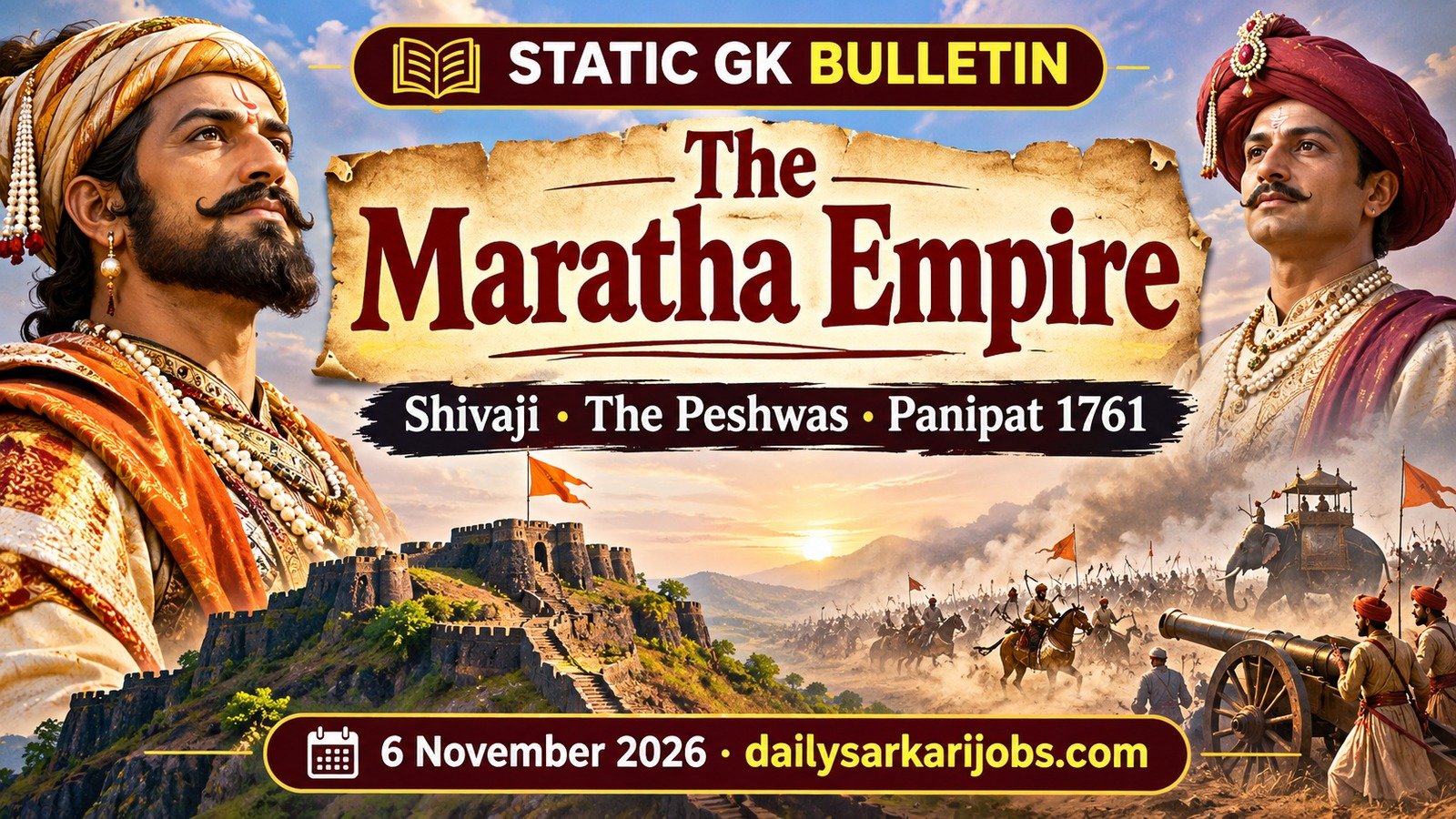
The Marathas are usually taught as the power that broke the Mughals. That is true, but it misses the odd thing about them — and the odd thing is the easiest way to remember the whole chapter.
Power Moved from the King to His Prime Minister, and Nobody Changed the Title
Shivaji was crowned Chhatrapati in 1674. His descendants held that title for another century and a half. But from about 1713 onward the person who actually ran the Maratha state was the Peshwa — originally just the chief minister — operating from Pune, while the Chhatrapati sat at Satara with the crown and very little else.
The office became hereditary, and the throne became ceremonial, and the arrangement simply never got renamed. So when you read that the Marathas lost at Panipat in 1761, the man who lost was not a king. He was a prime minister’s general.
Hold on to that split and the rest follows. Compare it with the Mughal Empire, where the emperor was the state and everything ran through mansabs granted by him personally. The Marathas built the opposite: a system that outgrew the person at the top, which is why it survived defeats that would have ended a conventional dynasty — and also why it eventually pulled itself apart.
Jargon, Defined Once
- Chhatrapati is the Maratha royal title Shivaji took at his coronation. Literally, lord of the umbrella — the umbrella being an old Indian symbol of sovereignty.
- Peshwa means chief minister. Under Balaji Vishwanath the office became hereditary, and the real power moved into it.
- Chauth was a levy of one-fourth of the revenue of a territory, paid to keep the Marathas out of it. Sardeshmukhi was a further one-tenth, claimed as a hereditary right.
- A confederacy is an alliance of largely self-governing chiefs under a common head, as against an empire run from one capital.
Shivaji: What Is Actually Asked
- Born at the hill fort of Shivneri, to Shahaji Bhonsle and Jijabai.
- Crowned at Raigad in 1674, taking the title Chhatrapati. Raigad was the capital.
- The Treaty of Purandar, 1665, was signed with Raja Jai Singh I, acting for Aurangzeb; Shivaji surrendered a large number of forts under it.
- He died in 1680, and was succeeded by his son Sambhaji, who was captured and executed by the Mughals in 1689.
- His navy and his forts are the point of him. A power with a long coastline and hill country behind it does not need to win pitched battles; it needs to hold the places that control movement.
The Ashtapradhan: Eight Ministers
| Office | What it covered |
|---|---|
| Peshwa | Chief minister; later the real head of the state |
| Amatya | Finance and accounts |
| Sachiv | Correspondence and royal papers |
| Mantri | The king’s personal affairs and records |
| Senapati | Commander of the army |
| Sumant | Foreign affairs |
| Nyayadhish | Justice |
| Panditrao | Religious affairs and charities |
The one to remember is the first. Seven of these offices stayed what they were. One of them quietly became the government.
The Peshwas and the Confederacy
- Balaji Vishwanath became Peshwa in 1713 and made the office hereditary.
- Baji Rao I (1720–1740) carried Maratha power north and is the architect of the confederacy’s expansion.
- Balaji Baji Rao, known as Nana Saheb, was Peshwa at the time of the catastrophe at Panipat.
- The great houses of the confederacy are worth learning as a set: the Gaekwads at Baroda, the Holkars at Indore, the Scindias at Gwalior, the Bhonsles at Nagpur, and the Peshwa at Pune.
- Each house ran its own territory and its own army. That is the strength and the weakness in one sentence: the system could lose a battle without losing the state, and it could also fail to turn up as one army when it mattered most.
Third Battle of Panipat, 1761
Fought in 1761 against Ahmad Shah Abdali, and lost heavily. It did not end Maratha power — the confederacy recovered within a decade — but it destroyed a generation of its leadership and ended any prospect of a Maratha empire over the whole of north India.
Keep the three battles of Panipat apart; this is the most common mix-up in the whole syllabus.
| Battle | Year | Who won |
|---|---|---|
| First Panipat | 1526 | Babur over Ibrahim Lodi — the Mughal empire begins |
| Second Panipat | 1556 | Akbar’s forces over Hemu |
| Third Panipat | 1761 | Ahmad Shah Abdali over the Marathas |
The Three Anglo-Maratha Wars
| War | Years | How it ended |
|---|---|---|
| First | 1775–1782 | The Treaty of Salbai, broadly a draw |
| Second | 1803–1805 | British gains; followed the Treaty of Bassein, 1802 |
| Third | 1817–1818 | Maratha power ends; the Peshwa is pensioned off |
The hinge of the end is the Treaty of Bassein, 1802. Peshwa Baji Rao II accepted a subsidiary alliance — British troops stationed in his territory, paid for by him, and no independent dealings with other powers. He kept his title and signed away the thing the title stood for. The other Maratha houses would not accept it, and the Second Anglo-Maratha War followed almost at once.
Exam Alert: Four Traps
- Chhatrapati against Peshwa. Shivaji’s line held the title; the Peshwas held the power. A question asking who ruled the Marathas in 1760 is testing whether you know the difference.
- Chauth is one-fourth, sardeshmukhi is one-tenth. Chauth and “chaar” share a sound, which is the memory hook.
- Panipat 1761 is the third, and the Marathas lost it. 1526 and 1556 are the other two and have nothing to do with them.
- Bassein 1802 is the treaty that began the end; Salbai 1782 ended the first war. Both are Maratha treaties with the British, twenty years apart, and they are swapped constantly.
Did You Know: They Taxed Territory They Did Not Govern
Chauth was not a tax on Maratha subjects. It was collected from territories the Marathas did not rule. A region paid one-fourth of its revenue, and in exchange Maratha armies left it alone and, in principle, protected it from others.
That one arrangement explains how a power based in the western hills drew income from across much of India without administering it. It also explains the fragility: an income that depends on the threat of your arrival has to be re-collected by force every year, and the moment your armies are beaten somewhere else, it stops arriving.
Why a Reader Should Care
The Marathas are the bridge between medieval and modern Indian history, and almost every question about the eighteenth century touches them. They complete the thread running through our capsules on the Delhi Sultanate and the Mughal Empire: a throne won by the sword, then a throne that counted its empire, then an empire whose throne stopped mattering.
The geography is not incidental either. Our capsule on India’s physiography describes the Western Ghats and the Konkan coast — and that terrain, hills behind a narrow coastal strip, is precisely what made a fort-and-navy strategy work.
Today’s Current Affairs explainer is on India’s new grid-scale energy storage scheme. The Marathas’ insight was that holding the right places beats holding the most ground. A storage scheme applies the same thinking to time rather than territory.
Practice Questions
Q1. Shivaji was crowned Chhatrapati in which year?
(a) 1627 (b) 1674 (c) 1707 (d) 1761
Answer: (b) 1674 The coronation took place at Raigad, which served as his capital.
Q2. Chauth, as levied by the Marathas, was a share of revenue amounting to
(a) One-tenth (b) One-half (c) One-fourth (d) One-sixth
Answer: (c) One-fourth Sardeshmukhi was the additional one-tenth, claimed as a hereditary right of the chief headman.
Q3. The council of eight ministers under Shivaji was known as
(a) The Ashtapradhan (b) The Diwan-i-Am (c) The Mansabdari (d) The Ashtadiggaja
Answer: (a) The Ashtapradhan Its first office was the Peshwa, which in the eighteenth century grew into the real head of the Maratha state.
Q4. The Third Battle of Panipat, in 1761, was fought between the Marathas and
(a) Babur (b) Akbar’s forces (c) The British East India Company (d) Ahmad Shah Abdali
Answer: (d) Ahmad Shah Abdali The first battle of Panipat in 1526 and the second in 1556 involved the early Mughals and had nothing to do with the Marathas.
Q5. By the Treaty of Bassein of 1802, Peshwa Baji Rao II
(a) Accepted a subsidiary alliance with the British (b) Defeated the Nizam of Hyderabad (c) Ceded Gwalior to the Scindias (d) Ended the first Anglo-Maratha War
Answer: (a) Accepted a subsidiary alliance with the British The other Maratha houses refused to accept it, and the Second Anglo-Maratha War began the following year.
30-Second Revision
- The hinge: power moved from the Chhatrapati to the Peshwa and the titles never caught up. The crown stayed at Satara; the government moved to Pune.
- Shivaji: born at Shivneri to Shahaji and Jijabai; Treaty of Purandar 1665 with Jai Singh I; crowned at Raigad in 1674; died 1680; the Ashtapradhan was his council of eight.
- Money: chauth is one-fourth, sardeshmukhi is one-tenth, both collected from territory the Marathas did not govern.
- The confederacy: Gaekwad – Baroda, Holkar – Indore, Scindia – Gwalior, Bhonsle – Nagpur, Peshwa – Pune. Balaji Vishwanath made the Peshwa’s office hereditary in 1713.
- The fall: Third Panipat 1761 against Abdali; Salbai 1782 ends the first war; Bassein 1802 brings the subsidiary alliance; 1818 ends Maratha power.
What Is Not Settled
One honest note on a date. Shivaji’s year of birth is genuinely disputed — 1630 is the figure most textbooks now use, while 1627 appears in older works and some state syllabi still follow it. The coronation year, 1674, is not in doubt, which is why questions are far likelier to ask for that one. If a paper offers both birth years, answer the way your own syllabus teaches it.
Sources
- NCERT and standard history material on the Marathas — Shivaji’s parentage and coronation, the Ashtapradhan and its offices, chauth and sardeshmukhi, the Treaty of Purandar, the rise of the Peshwas from 1713, the houses of the confederacy, the Third Battle of Panipat, and the three Anglo-Maratha wars with the treaties of Salbai and Bassein.
- The description of the Maratha state as a confederacy of largely self-governing houses under the Peshwa’s leadership, rather than a centrally administered empire, follows the standard treatment of the period at syllabus level.
- Where a date is disputed between textbooks, the disagreement is stated above rather than quietly resolved.