
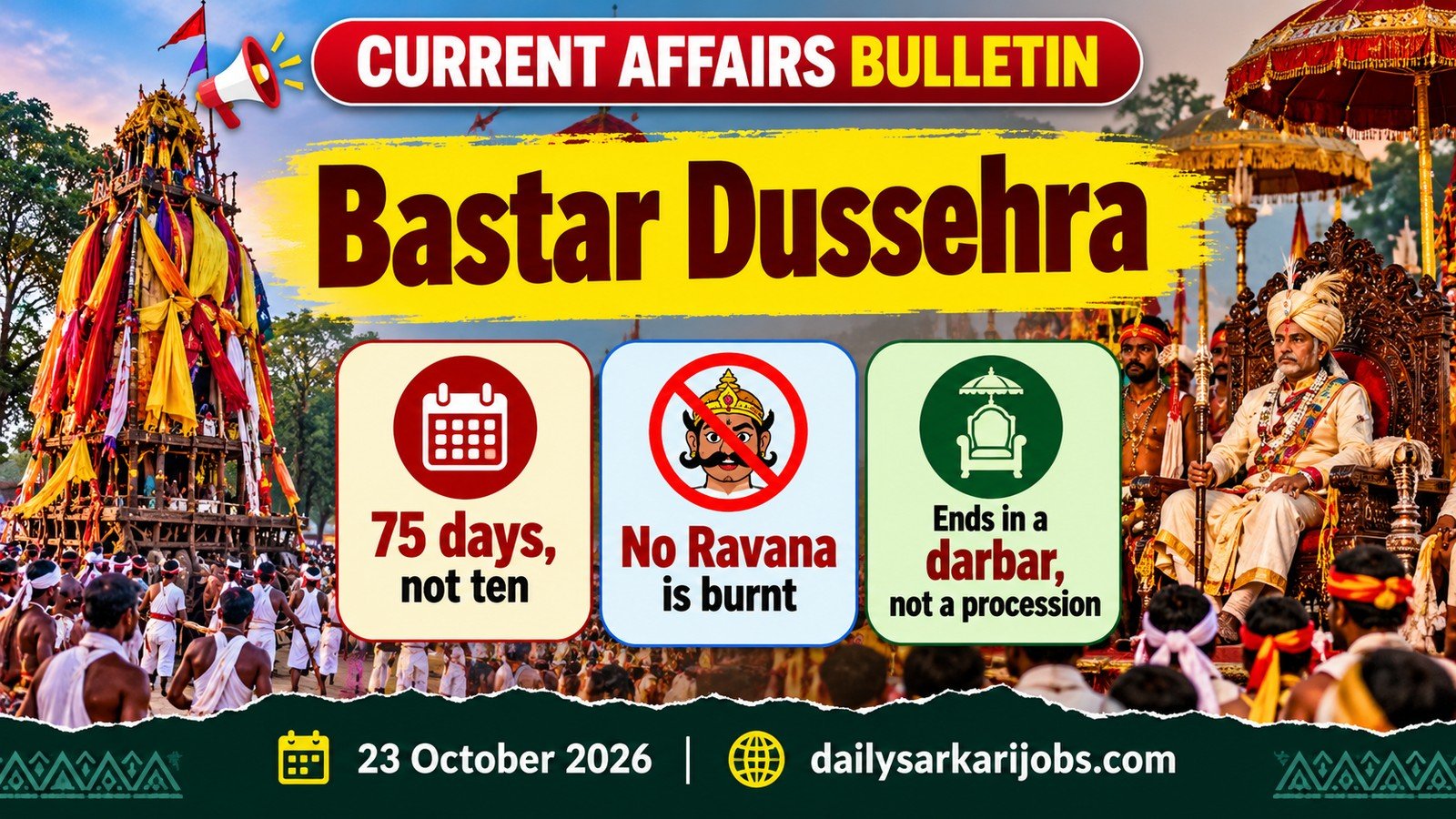
On 23 October 2026 the President of India was at Jagdalpur in Chhattisgarh for Bastar Dussehra. She offered prayers at the Maa Danteshwari temple, met the Manjhi and Chalki at the Muria Darbar, and addressed a public gathering. The festival she was attending has almost nothing to do with the Dussehra most of India knows.
This is a Current Affairs explainer written in plain language for SSC, RRB NTPC, banking exams, State PSC and UPSC Prelims.
The Hinge: the Name Is Not the Festival
Everywhere else in India, Dussehra means the tenth day, the end of Ramlila and an effigy of Ravana going up in flames. In Bastar, none of that happens. No Ravana effigy is burnt here. The festival is built around goddess worship and around the deities of Bastar’s villages, not around the Ramayana at all.
So the shared name hides two completely different things, and that is the most useful idea on this page. A festival name can travel across a country while the festival underneath it stays local. The capsule on India’s dances and festivals is full of this pattern — the same date, the same word, and a different ritual in every region.
The transferable habit: when something is called by a familiar name in an unfamiliar place, ask what it is actually doing there before assuming you know.
Seventy-Five Days: Do the Arithmetic
The usual Dussehra is a ten-day affair. Bastar Dussehra runs for about seventy-five. In 2026 it began on 12 August with the Pat Jatra, the ritual cutting and worship of the wood from which the chariot is built, and the principal days fell in the third week of October.
That is roughly two and a half months, or about seven and a half times the length of the festival everyone else is celebrating. A festival that long is not an event; it is a season, and it needs an organisation behind it — which is exactly what Bastar has had since the fifteenth century.
The Sequence, in Order
| Ritual | What happens |
|---|---|
| Pat Jatra | Wood is brought from the forest and worshipped; the chariot work begins |
| Deri Gadai | The posts are planted and the chariot is built |
| Kachhin Gadi | A girl of the Mirgan community represents Kachhin Devi and gives permission for the festival to proceed |
| Jogi Bithai | A person sits in meditation for nine days through Navratri |
| Mavli Parghav | The goddess Mavli is formally welcomed |
| Rath Yatra | The chariot is drawn through Jagdalpur |
| Bhitar Raini and Bahar Raini | The inner and outer night processions, the festival’s principal days |
| Muria Darbar | A community assembly that concludes the festival |
Look at the third row again, because it is the one worth remembering. The festival cannot go forward until a girl from one named community gives permission. A ritual that hands a veto to a particular community is not decoration; it is a rule about who belongs.
The Muria Darbar, and Why a Festival Ends in a Meeting
The closing ritual is not a procession. It is an assembly. At the Muria Darbar, village headmen — the Manjhi and Chalki the President met — gather with the administration. It is the part of the festival where the community speaks and the State is expected to listen.
That is a remarkable thing for a religious festival to contain, and it is the bridge to today’s Static GK capsule. Bastar is a Scheduled Area under the Fifth Schedule of the Constitution, and the Constitution’s own answer to the same question — how do tribal communities get heard? — is a body called the Tribes Advisory Council. The Panchayati Raj capsule covers the village end of that machinery. One of these arrangements is six hundred years old and the other is seventy-five, and they are answering the same question.
What the President Said
- She called the festival a living emblem of Chhattisgarh’s cultural pride and said the participation of the whole community in it was extraordinary.
- She said its rituals build kinship across different sections of society.
- She said Chhattisgarh had long suffered from Naxalism, that coordinated Central and State effort had ended Naxal violence in the region, and that it is now progressing quickly.
- She said support for tribal entrepreneurs — financial help and market linkages — had recently been stepped up.
- She said tribal communities worship nature as a source of life, and urged that development learn from that way of living.
The fourth point is the practical one. The explainer on the Agri Welfare Portal made the same argument from the other side: for someone far from a district headquarters, the barrier is usually distance rather than willingness, and a market linkage is simply distance solved by somebody else.
Why a Reader Should Care
Because festivals are examined as facts, not as feelings. Papers ask which State, which deity, how many days, which ritual opens it. Bastar Dussehra supplies an unusual set of all four, and its seventy-five days make it the kind of figure an examiner likes.
And because it quietly corrects a common assumption. Yesterday’s capsule on the National Akademis ended on the question of who decides what counts as classical. Bastar Dussehra is the other half of that question: a festival that almost nobody outside one region would recognise, running longer than any of the ones everybody knows. Recognition and importance are not the same measurement.
The honest caution. The official release records the President’s visit and her remarks; it gives no duration for the festival, no ritual list and no history, and those come from the Government’s own tourism and cultural pages. Bastar Dussehra is also commonly described as the longest Dussehra in the world, but that claim is not made in any official source seen here, so this page states the seventy-five days and leaves the superlative alone.
Practice Questions
Q1. Bastar Dussehra is celebrated in which State?
(a) Odisha (b) Jharkhand (c) Chhattisgarh (d) Madhya Pradesh
Answer: (c) Chhattisgarh Jagdalpur is its centre, and all the wrong options are neighbouring States with large tribal populations, which is what makes the question worth setting.
Q2. The festival is centred on which deity?
(a) Maa Danteshwari (b) Maa Vaishno Devi (c) Maa Kamakhya (d) Maa Chamunda
Answer: (a) Maa Danteshwari The President offered prayers at that deity’s temple during her 2026 visit, and the local goddesses of Bastar’s villages are welcomed through the festival.
Q3. Approximately how long does Bastar Dussehra last?
(a) Ten days (b) Twenty-one days (c) Forty days (d) Seventy-five days
Answer: (d) Seventy-five days The usual Dussehra lasts for the first of those options, so the comparison is the whole point of the question.
Q4. Which ritual opens Bastar Dussehra?
(a) Muria Darbar (b) Pat Jatra (c) Jogi Bithai (d) Bhitar Raini
Answer: (b) Pat Jatra Wood is brought from the forest and worshipped so that the chariot can be built, and one of the other options is the ritual that closes the festival instead.
Q5. Which of the following does NOT happen at Bastar Dussehra?
(a) A chariot procession (b) A nine-day meditation (c) The burning of a Ravana effigy (d) A community assembly of village headmen
Answer: (c) The burning of a Ravana effigy Its focus is goddess worship rather than the Ramayana, which is the single fact that separates it from Dussehra everywhere else.