Last updated: September 17, 2026 at 10:16 PM
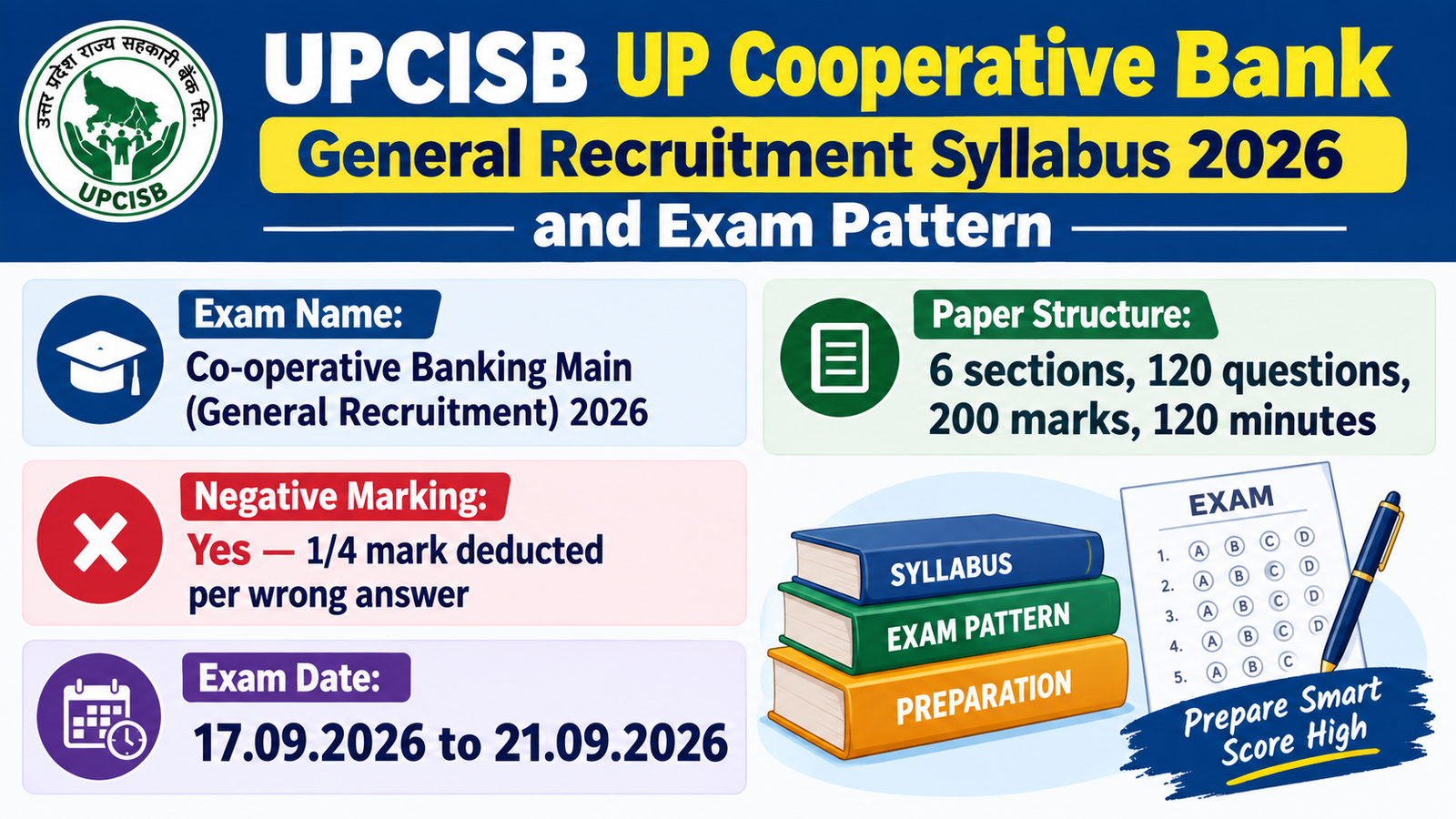
The U.P. Co-operative Institutional Service Board (UPCISB), Lucknow has released the Information Handout for the Combined Co-operative Banking, Non-Banking and Technical Services Examination (General Recruitment) – 2026, held under Advertisement No. A-2/G.R./2026 dated 14.04.2026. The handout, dated 11.09.2026, sets out the complete Main examination pattern for all the posts covered by this recruitment, and the Main exam is scheduled from 17.09.2026 to 21.09.2026. Three separate test structures apply depending on which post you applied for, and each of them carries 120 questions for 200 marks in 120 minutes with sectional timing and negative marking.
Quick Navigation
- Syllabus and Exam Pattern Overview
- Important Dates
- Exam Pattern 1 — Manager, Junior Manager, Assistant Manager (General), Assistant Engineer and Assistant Manager (Computer)
- Exam Pattern 2 — Junior Engineer, Accountant, Assistant Accountant and Accounts Clerk
- Exam Pattern 3 — Assistant Manager (General) Cat. 3, Stenographer, Junior Assistant, Assistant / Cashier, Assistant / Typist and Clerk / Typist
- Topic-wise Syllabus
- Marking Scheme and How Your Score Is Calculated
- Exam Day Rules That Affect Your Strategy
- Important Links
- Common Mistakes to Avoid
- Frequently Asked Questions
Syllabus and Exam Pattern Overview
| Exam Name | Combined Co-operative Banking, Non-Banking and Technical Services Examination (General Recruitment) – 2026 — Main Examination |
| Organization | U.P. Co-operative Institutional Service Board (UPCISB), Lucknow |
| Notification / Advertisement No. | Advertisement No. A-2/G.R./2026 dated 14.04.2026 (Information Handout dated 11.09.2026) |
| Location | Uttar Pradesh |
| Exam Mode | Online (computer based), objective type multiple choice |
| Total Questions / Marks | 120 questions / 200 marks — same for every post group |
| Total Duration | 120 minutes, with each test separately timed (allow about 180 minutes at the venue) |
| Number of Sections | 6 sections in every paper |
| Language / Version | Bilingual (Hindi and English), except the Hindi Language and English Language tests |
| Negative Marking | Yes — one fourth (1/4) of the marks assigned to a question is deducted for every wrong answer |
| Cut-off | May be applied at two stages — on individual test scores and on the total score |
| Exam Date | 17.09.2026 to 21.09.2026 |
| Official Information Handout | Download Information Handout PDF |
| Official Website | upcisb.upsdc.gov.in |
Important Dates
| Event | Date |
|---|---|
| Advertisement No. A-2/G.R./2026 issued | 14.04.2026 |
| Online application window | 25.04.2026 to 15.05.2026 |
| Information Handout (latest version) released | 11.09.2026 |
| Call letter / admit card download opens | 15.09.2026 |
| Main examination | 17.09.2026 to 21.09.2026 |
| Call letter / admit card download closes | 21.09.2026 |
The handout lays out three different Main exam structures. Find the group your post belongs to and prepare for that pattern only — the section weightages are very different between the officer-grade papers and the Category 3 clerical papers.
Exam Pattern 1 — Manager, Junior Manager, Assistant Manager (General), Assistant Engineer and Assistant Manager (Computer)
Posts covered: Manager (Category 1), Junior Manager (Category 2), Assistant Manager (General) (Category 2), Assistant Engineer – Civil (Category 2), Assistant Engineer – Electrical (Category 2), Assistant Manager (Computer) (Category 2).
| Sr. No. | Name of the Test | Questions | Marks | Duration |
|---|---|---|---|---|
| 1 | Reasoning Ability / Mental Ability | 20 | 20 | 20 minutes |
| 2 | Numerical Ability / Quantitative Aptitude | 20 | 20 | 20 minutes |
| 3 | General Awareness | 15 | 15 | 10 minutes |
| 4 | Co-operative | 15 | 15 | 10 minutes |
| 5 | Language — Hindi (5) and English (5) | 10 | 10 | 10 minutes |
| 6 | Subject Knowledge as per post — Civil Engineering / Electrical Engineering / Computer Science and IT / Managerial Skill (Banking 30 questions plus Computer Knowledge 10 questions) | 40 | 120 | 50 minutes |
| Total | 120 | 200 | 120 minutes |
Note how heavily this paper is weighted: Subject Knowledge is only 40 of the 120 questions but carries 120 of the 200 marks, which means each question there is worth 3 marks while every other question is worth 1 mark.
Exam Pattern 2 — Junior Engineer, Accountant, Assistant Accountant and Accounts Clerk
Posts covered: Junior Engineer – Electrical (Category 3), Junior Engineer – Civil (Category 3), Accountant (Category 3), Assistant Accountant (Category 3), Assistant Accountant (Category 3) – UPSS, Assistant Accountant (Category 3) – PCU, Accounts Clerk (Category 3).
| Sr. No. | Name of the Test | Questions | Marks | Duration |
|---|---|---|---|---|
| 1 | Reasoning Ability / Mental Ability | 20 | 20 | 20 minutes |
| 2 | Numerical Ability / Quantitative Aptitude | 20 | 20 | 20 minutes |
| 3 | General Awareness | 15 | 15 | 10 minutes |
| 4 | Co-operative | 15 | 15 | 10 minutes |
| 5 | Language — Hindi (5) and English (5) | 10 | 10 | 10 minutes |
| 6 | Subject Knowledge as per post — Civil Engineering / Electrical Engineering / Commerce and Accountancy | 40 | 120 | 50 minutes |
| Total | 120 | 200 | 120 minutes |
Exam Pattern 3 — Assistant Manager (General) Cat. 3, Stenographer, Junior Assistant, Assistant / Cashier, Assistant / Typist and Clerk / Typist
Posts covered: Assistant Manager (General) (Category 3), Stenographer (Category 3) – UPRNSS, Stenographer (Category 3) – PCU, Assistant / Stenographer (Category 3) – DCB, Assistant / Stenographer (Category 3) – UPCB, Junior Assistant (Category 3), Junior Assistant (Category 3) – PCU, Assistant / Cashier (Banking Assistant) / Clerical Staff (Category 3), Assistant / Cashier (Category 3), Assistant / Typist (Category 3) – DCB, Assistant / Typist (Category 3) – UPCB, Clerk / Typist (Category 3).
| Sr. No. | Name of the Test | Questions | Marks | Duration |
|---|---|---|---|---|
| 1 | Reasoning Ability / Mental Ability | 20 | 40 | 25 minutes |
| 2 | Numerical Ability / Quantitative Aptitude | 20 | 40 | 25 minutes |
| 3 | Computer Knowledge | 20 | 40 | 15 minutes |
| 4 | Language — Hindi (10) and English (10) | 20 | 40 | 20 minutes |
| 5 | General Awareness | 20 | 20 | 15 minutes |
| 6 | Co-operative | 20 | 20 | 20 minutes |
| Total | 120 | 200 | 120 minutes |
Topic-wise Syllabus
The handout does not print a chapter list. What it does give is a set of official sample questions for every section, and those samples show exactly which topics the paper is drawn from. The table below maps each section to the topics its sample questions cover. The board also states plainly that the actual exam will contain questions of a higher difficulty level and may include types not shown in the handout, so treat this as the confirmed core rather than the outer boundary.
| Subject | Topics indicated by the official sample questions |
|---|---|
| Reasoning Ability / Mental Ability | Direction sense and relative position puzzles; ranking and order in a row, including position after interchange; letter rearrangement and meaningful word formation; conditional coding rules; series; analogy; blood relations; seating arrangement |
| Numerical Ability / Quantitative Aptitude | Speed and accuracy with numbers; simplification and missing-number questions; multiplication, fractions and decimals; divisibility and exact multiples; percentages; quantitative reasoning; interpretation of tables and graphs (data interpretation) |
| General Awareness | Static general knowledge on Indian states, cities and historical or mythological places; banking and financial terminology such as tangible net worth and evergreening of sticky loans; core accounting concepts such as accrual, going concern, matching and conservatism |
| English Language | Choosing the most appropriate word to complete a sentence; prepositions and phrasal usage; spotting grammatical errors in a sentence split into parts; vocabulary and word usage; the No error option |
| Hindi Language | हिंदी भाषा में प्रवीणता, शब्दभंडार, वाक्य रचना, शब्द प्रयोग, समानार्थक तथा विपरीतार्थी शब्द, अनेकार्थी शब्द, वर्तनी त्रुटि, लोकोक्तियाँ, मुहावरे, वाक्यांश के लिए एक शब्द |
| Computer Knowledge | Hardware versus software; input and output devices; full forms and abbreviations such as LAN and RAM; basic components of a computer system; everyday computer operation |
| Co-operative | Co-operative Societies Act provisions; dual control of co-operative credit institutions by the State Government and RBI or NABARD, and the Banking Regulation Act; credit and non-credit co-operatives including production, marketing, processing and dairy societies; definition of an apex society; restrictions on the use of a society’s immovable property; the role of co-operatives in rural development |
| Banking (inside Managerial Skill, 30 questions) | RBI IRAC norms and NPA classification including long duration crop loans; banker’s right of lien, set-off and appropriation; MSMED Act 2006 classification limits for micro, small and medium enterprises; negotiable instruments and material alteration of a cheque; general banking practice |
| Subject Knowledge (Pattern 1 and 2 only) | Civil Engineering, Electrical Engineering, Computer Science and Information Technology, Commerce and Accountancy, or Managerial Skill (Banking 30 questions plus Computer Knowledge 10 questions), depending on the post. The handout states these follow the syllabus printed in the advertisement. |
Marking Scheme and How Your Score Is Calculated
| Item | Detail |
|---|---|
| Question type | Objective multiple choice, four options, exactly one correct answer selected by mouse click |
| Marks for a correct answer | As assigned to that question — 1, 2 or 3 marks depending on the section and pattern |
| Penalty for a wrong answer | One fourth (1/4) of the marks assigned to that question is deducted |
| Corrected Score | Number of questions answered correctly in each objective test, after the wrong-answer penalty is applied |
| Equated Score | Corrected Scores are made equivalent across different sessions to adjust for minor differences in difficulty level between test forms |
| Score reporting | Test-wise scores and the total score are reported with decimal points up to two digits |
| Cut-off stages | Cut-offs may be applied twice — first on scores in individual tests, then on the total score |
| Answers that count | Only answers saved using Save and Next, or Mark for Review and Next, are considered for evaluation. A question marked for review with an answer selected is still evaluated. |
In plain terms: four wrong answers wipe out one correct answer of the same weight. In Pattern 1 and Pattern 2, a wrong guess in the Subject Knowledge section costs 0.75 marks, which is three times what a wrong guess costs elsewhere in the same paper — so that is the one section where blind guessing hurts most.
Exam Day Rules That Affect Your Strategy
| Rule | What it means for you |
|---|---|
| Sectional timing | Each test is separately timed. You can only attempt a section during its own time window, and you cannot return to it later. |
| Time at the venue | The paper is 120 minutes, but plan for roughly 180 minutes at the centre including login, admit card checking and instructions. |
| No early submission | You will not be allowed to finally submit until the full test time has run out. Answers are saved automatically when the clock ends, even if you never click Submit. |
| Do not touch the keyboard | Pressing any keyboard key once the exam starts will lock the exam. Use the mouse only. |
| Report Question button | An on-screen Report Question option is available if you want to flag an issue with a question during the exam. |
| Biometric and IRIS | Aadhaar-linked biometric authentication plus a left-eye IRIS scan are done before the exam. Carry your Aadhaar card, remove contact lenses (spectacles are preferred), and make sure your fingers are clean, dry and free of mehndi or ink. |
| Admit card and ID proof | Bring the admit card with a recent passport-size photograph pasted on it, a valid original photo ID, and a photocopy of that ID. Ration Card and Learner’s Driving Licence are not accepted. The name on your ID must match the admit card exactly. |
| Dress code | Light clothes without metal zippers or big buttons, half sleeves, no badges or brooches, and slippers or sandals rather than shoes and socks. Candidates in customary or religious dress should report well before the reporting time. |
| Not allowed | Calculators (separate or in a watch), books, notes and any electronic device. |
| What to carry for rough work | A ball point pen. A rough sheet is provided and must be handed back with the admit card before you leave. |
| PwBD candidates | Carry your UDID or disability certificate. Candidates using a scribe must submit the scribe declaration form and a copy of the scribe’s photo ID. Candidates covered under Section 2(s) of the RPwD Act 2016 with less than 40 percent disability and difficulty in writing may get 20 minutes compensatory time per hour on submitting the Appendix-I medical certificate. |
| Unfair means | The Public Examinations (Prevention of Unfair Means) Act 2024 and the Uttar Pradesh Public Examinations (Prevention of Unfair Means) Act 2024 (U.P. Act No. 8 of 2024) both apply. Answer patterns are analysed across candidates for similarity. |
Important Links
| Official Information Handout (PDF) | Download Information Handout dated 11.09.2026 |
| Download Admit Card / Call Letter | Download Call Letter (open 15.09.2026 to 21.09.2026) |
| Official Website | UPCISB Official Website |
| Telegram | Join Telegram Channel |
| Join WhatsApp Channel |
Common Mistakes to Avoid
- Preparing from the wrong pattern — the three structures differ sharply, and a Junior Assistant candidate studying the officer-grade Subject Knowledge paper is preparing for a section that does not exist in their exam.
- Guessing freely in the Subject Knowledge section of Pattern 1 and Pattern 2, where a wrong answer costs 0.75 marks against the 0.25 marks a wrong answer costs in the other sections.
- Planning to come back to an earlier section later — sectional timing makes that impossible, so a section you leave unfinished stays unfinished.
- Selecting an option but not clicking Save and Next — an unsaved answer is not evaluated at all.
- Touching the keyboard during the exam, which locks the test outright.
- Arriving with a name mismatch between the admit card and the photo ID, or with mehndi or ink on the fingers, either of which can stop you from being admitted.
- Downloading the call letter after 21.09.2026 — the download window closes on that date and does not reopen.
Frequently Asked Questions
1. When is the UPCISB General Recruitment 2026 Main examination?
The Main examination is scheduled from 17.09.2026 to 21.09.2026, and your exact date, shift and centre are printed on your call letter.
2. How many questions and marks does the Main exam carry?
Every paper in this recruitment carries 120 questions for 200 marks in 120 minutes, across six separately timed sections.
3. Is there negative marking in the UPCISB Main exam?
Yes — one fourth (1/4) of the marks assigned to a question is deducted for every wrong answer.
4. Which exam pattern applies to my post?
Manager, Junior Manager, Assistant Manager (General) Category 2, Assistant Engineer (Civil and Electrical) and Assistant Manager (Computer) follow Pattern 1; Junior Engineer, Accountant, Assistant Accountant and Accounts Clerk follow Pattern 2; and all the Category 3 clerical and stenographer posts including Junior Assistant, Assistant / Cashier, Assistant / Typist and Clerk / Typist follow Pattern 3.
5. Which section carries the most marks?
In Patterns 1 and 2 the Subject Knowledge test carries 120 of the 200 marks from just 40 questions, so each question there is worth 3 marks; Pattern 3 has no Subject Knowledge test and instead gives 40 marks each to Reasoning, Numerical Ability, Computer Knowledge and Language.
6. In which languages is the paper set?
All tests are bilingual in Hindi and English, except the Hindi Language and English Language tests themselves.
7. How is the final score calculated?
Correct answers give the Corrected Score after the wrong-answer penalty, that score is then equated across sessions to adjust for difficulty differences, and the result is reported test-wise and in total to two decimal places.
8. Is there a cut-off in individual sections as well as overall?
Yes — the handout states that cut-offs may be applied in two stages, first on scores in individual tests and then on the total score, so a very weak section can end your candidature even with a good total.
Disclaimer: The information above has been compiled from the official notification for the convenience of job seekers. Candidates are advised to verify all details from the official website before applying.