Last updated: September 17, 2026 at 9:45 PM
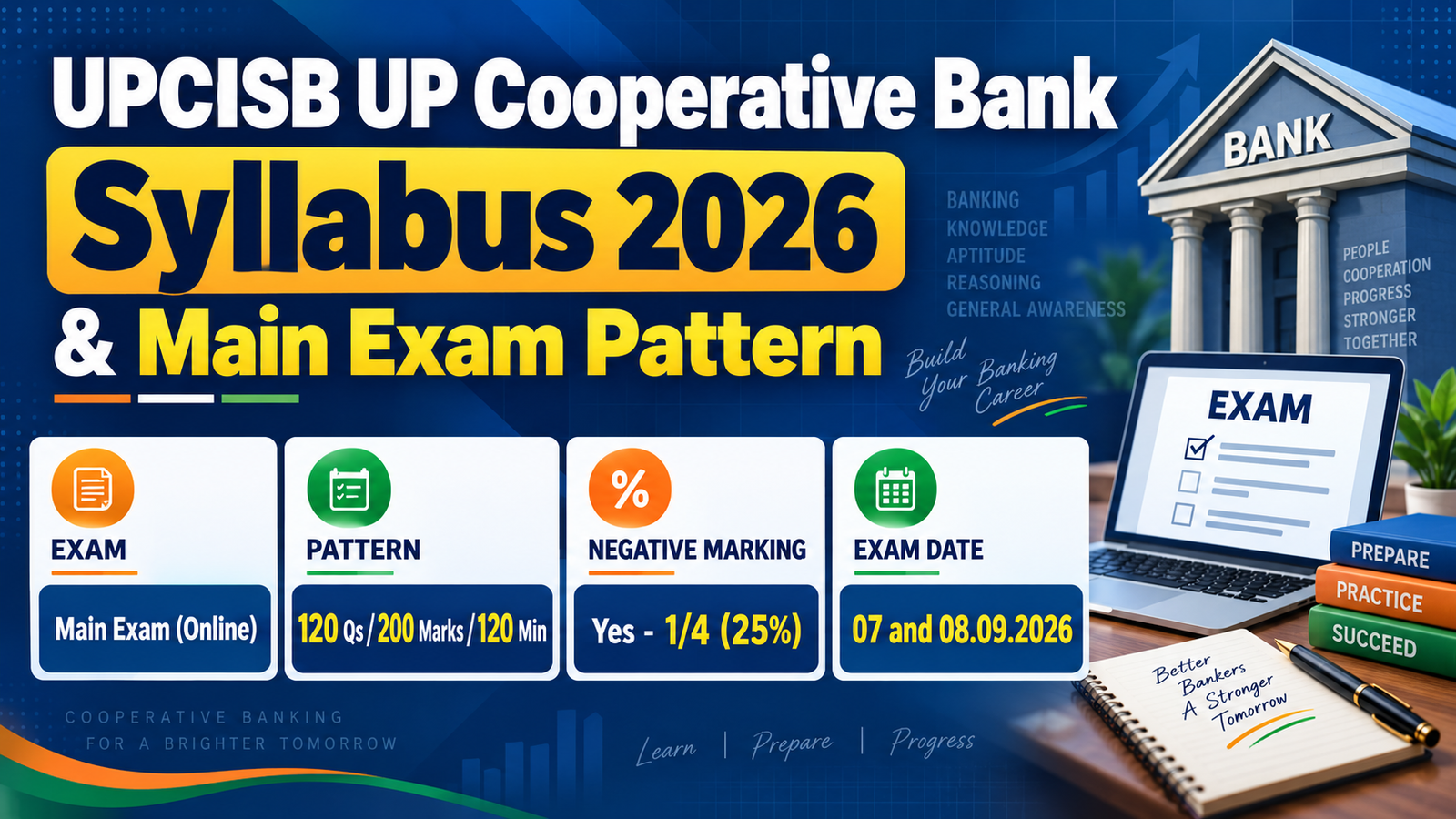
The U.P. Co-operative Institutional Service Board (UPCISB), Lucknow has released the official Information Handout for the Main Examination of the Combined Co-operative Banking and Technical Services Examination (Special Recruitment) 2026, published on 02.09.2026 in both English and Hindi. The handout confirms the complete exam pattern for all five posts advertised under Advt. No. A-1/S.R./2026, and the online Main Exam is scheduled for 07.09.2026 and 08.09.2026. Candidates get 120 questions for 200 marks in 120 minutes, with separately timed sections and a 1/4 negative marking penalty.
Quick Navigation
- Syllabus Overview
- Important Dates
- Exam Pattern — Manager and Junior Manager
- Exam Pattern — Assistant Engineer (Civil)
- Exam Pattern — Assistant/Cashier and Assistant/Typist
- Marking Scheme and Scoring Rules
- Topic-wise Syllabus — Manager, Junior Manager and Assistant Engineer (Civil)
- Topic-wise Syllabus — Assistant/Cashier and Assistant/Typist
- Selection Process
- Exam Day Rules You Should Know Before 07 September
- Important Links
- Common Mistakes to Avoid
- Frequently Asked Questions
Syllabus Overview
| Exam Name | Combined Co-operative Banking and Technical Services Examination (Special Recruitment) 2026 — Main Examination |
| Organization | U.P. Co-operative Institutional Service Board (UPCISB), Lucknow |
| Notification / Advertisement No. | Advt. No. A-1/S.R./2026 dated 24.03.2026 (Information Handout published 02.09.2026) |
| Location | Uttar Pradesh |
| Posts Covered | Manager, Junior Manager, Assistant Engineer (Civil), Assistant/Cashier (Banking Assistant/Clerical Staff), Assistant/Typist — 116 posts in total |
| Exam Date | 07.09.2026 and 08.09.2026 |
| Exam Mode | Online (computer-based), objective multiple choice |
| Total Questions / Marks | 120 questions / 200 marks |
| Duration | 120 minutes, sections separately timed (allow about 180 minutes at the venue) |
| Negative Marking | Yes — 1/4 (25%) of the marks assigned to a question is deducted for each wrong answer |
| Minimum Efficiency Standard | 35% for SC candidates, 40% for all other categories |
| Question Paper Language | Bilingual (Hindi and English), except the Hindi Language and English Language tests |
| Official Handout | Information Handout (English) PDF |
| Official Website | upcisb.upsdc.gov.in |
Important Dates
| Event | Date |
|---|---|
| Advertisement published (Advt. No. A-1/S.R./2026) | 24.03.2026 |
| Online application window | 25.03.2026 to 15.04.2026 (closed) |
| Exam city intimation sent by email and SMS | 31.08.2026 |
| Information Handout published (English and Hindi) | 02.09.2026 |
| Call letter download opens | 05.09.2026 |
| Main Examination (online) | 07.09.2026 and 08.09.2026 |
| Call letter download closes | 08.09.2026 |
Exam Pattern — Manager and Junior Manager
This pattern applies to Manager (Category-1) and Junior Manager (Category-2) of the District Co-operative Bank Limited.
| Sr. | Name of the Test | Questions | Max. Marks | Duration |
|---|---|---|---|---|
| 1 | Reasoning Ability / Mental Ability | 20 | 20 | 20 minutes |
| 2 | Numerical Ability / Quantitative Aptitude | 20 | 20 | 20 minutes |
| 3 | General Knowledge / Financial Awareness | 15 | 15 | 10 minutes |
| 4 | Co-operative | 15 | 15 | 10 minutes |
| 5 | Language — Hindi (5) and English (5) | 10 | 10 | 10 minutes |
| 6 | Managerial Skill — Banking (30) and Computer Knowledge (10) | 40 | 120 | 50 minutes |
| Total | 120 | 200 | 120 minutes |
Exam Pattern — Assistant Engineer (Civil)
This pattern applies to Assistant Engineer (Civil), Category-2, under the U.P. State Construction Co-operative Federation Limited. Sections 1 to 5 are identical to the Manager pattern; only the subject paper changes.
| Sr. | Name of the Test | Questions | Max. Marks | Duration |
|---|---|---|---|---|
| 1 | Reasoning Ability / Mental Ability | 20 | 20 | 20 minutes |
| 2 | Numerical Ability / Quantitative Aptitude | 20 | 20 | 20 minutes |
| 3 | General Knowledge / Financial Awareness | 15 | 15 | 10 minutes |
| 4 | Co-operative | 15 | 15 | 10 minutes |
| 5 | Language — Hindi (5) and English (5) | 10 | 10 | 10 minutes |
| 6 | Civil Engineering | 40 | 120 | 50 minutes |
| Total | 120 | 200 | 120 minutes |
Exam Pattern — Assistant/Cashier and Assistant/Typist
This pattern applies to Assistant/Cashier (Banking Assistant/Clerical Staff) and Assistant/Typist, both Category-3, under the District Co-operative Bank Limited. Note that the section weightages here are quite different from the officer-level pattern above.
| Sr. | Name of the Test | Questions | Max. Marks | Duration |
|---|---|---|---|---|
| 1 | Reasoning Ability / Mental Ability | 20 | 40 | 25 minutes |
| 2 | Numerical Ability / Quantitative Aptitude | 20 | 40 | 25 minutes |
| 3 | Computer Knowledge | 20 | 40 | 15 minutes |
| 4 | Language — Hindi (10) and English (10) | 20 | 40 | 20 minutes |
| 5 | General Knowledge | 20 | 20 | 15 minutes |
| 6 | Co-operative | 20 | 20 | 20 minutes |
| Total | 120 | 200 | 120 minutes |
Marking Scheme and Scoring Rules
| Rule | Detail |
|---|---|
| Question type | Objective, multiple choice. Four options per question, exactly one correct. |
| Negative marking | 1/4 (25%) of the marks assigned to that question is deducted for every wrong answer. |
| Multiple answers | Treated as an incorrect answer, and the same negative marking applies — even if one of the marked options is correct. |
| Unattempted questions | No negative marking for a question left unanswered. |
| Answers counted | Only answers saved with “Save and Next” or “Mark for Review and Next” are evaluated. A selected option that is never saved does not count. |
| Section timing | Each test is separately timed. A question can only be attempted during the time allotted to its own section. |
| Corrected Score | Number of correct answers after the wrong-answer penalty is applied. |
| Equated Score | Corrected Scores are equated across sessions to adjust for minor differences in difficulty level between test batteries. |
| Score reporting | Test-wise scores and the total are reported with decimals up to two digits. |
| Cut-offs | May be applied at two stages — on scores in individual tests, and on the total score. |
| Minimum Efficiency Standard | 35% for SC candidates and 40% for candidates of all other categories. Anyone below this is not included in the merit or selection list. |
| Final submission | Candidates cannot finally submit until the full test time is exhausted. After 120 minutes answers are saved automatically, even without clicking Submit. |
Topic-wise Syllabus — Manager, Junior Manager and Assistant Engineer (Civil)
| Subject | Topics |
|---|---|
| Reasoning Ability / Mental Ability | Alphabetical order and misc. series; Coding Decoding; Direction and Distance; Blood Relation; Order and Ranking; Sitting Arrangement; Puzzle; Data Sufficiency; Syllogism; Input Output; Data Inequality; Decision Making; Problem and Course of Action; Statement and Assumption; Cause and Effect; Statement and Argument; Combined logical; Clock; Calendar; Cube and Dice; Figure Series; Odd one Out Figure; Images and Water images; Figure Matrix; Paper Folding, Cutting and Unfolding; Non-Verbal Reasoning |
| Numerical Ability / Quantitative Aptitude | Simplification; Number series; Percentage; Profit and Loss, Discount; Simple and Compound Interest; Average; Ratio and Proportion; Problems on Ages; Partnership; Mixture and Allegation; Time and Work; Speed, Time and Distance; Pipe and Cistern; Problems based on Trains; Boat and Stream; Inequality; Probability; Permutation and Combination; Mensuration (Cone, Sphere, Cylinder); Data Sufficiency; Data Interpretation (Bar graph, Pie Chart, Line Chart, Tabular); Quadratic Equation; Basic Algebra; Basic Trigonometry; Measure of Central Tendency; Indices and Logarithms |
| General Knowledge / Financial Awareness | Structure, role and development of Co-operative Banks in UP; Reserve Bank of India and Monetary Policies; NPA and Basel Norms; Inflation and National Income; Indian Money Market and Capital Markets; Foreign Trade and Foreign Regulations; Financial Planning; Contemporary Welfare Schemes; Insurance and Miscellaneous; General information related to Uttar Pradesh; Indian History; Indian Polity and Constitution; General Science; Current Affairs (National and International); Geography of India |
| Hindi Language | अपठित बोध; अनेक शब्दों की जगह एक शब्द का प्रयोग; वाक्य शुद्धि; अवतरण और रचयिता; रचना और रचयिता; अशुद्ध वर्तनी के शब्दों का शुद्ध रूप; उपयुक्त शब्द का चयन; मुहावरे और लोकोक्तियाँ; पर्यायवाची शब्द; विलोम शब्द; शब्द शुद्धि; रिक्त स्थानों की पूर्ति; समास; संधि; उपसर्ग; प्रत्यय; रूप में समान प्रतीत होने वाले शब्द; पिंगल (छंद) परिचय; अलंकार; रस विवेचन |
| General English / English Language | Vocabulary; Tenses Rules; Grammar; Idioms and Phrases; Reading Comprehension; Fill in the blanks; Spotting Errors; Cloze Test; Jumbles; Synonyms; Antonyms; Using of words; Sentence improvement; Sentence Correction; Para and sentence completion |
| Co-operative | Origin and Development of Cooperatives; National Level Important Cooperatives; Formation of the Union Ministry of Cooperation; Prosperity through co-operation; Development of Cooperatives in Uttar Pradesh; Co-operative Societies in Uttar Pradesh; Innovations in Cooperatives |
| Managerial Skill — Banking and Computer Knowledge (Manager and Junior Manager only) | 40 questions carrying 120 marks, split as Banking 30 questions and Computer Knowledge 10 questions. Questions are set as per the syllabus mentioned in Advt. No. A-1/S.R./2026. |
| Civil Engineering (Assistant Engineer (Civil) only) | Engineering Mechanics; Strength of Materials; Structural Analysis; Structural Steel; Reinforced Concrete; Building Materials; Construction Technology, Planning and Management; Geotechnical Engineering and Foundation Engineering; Fluid Mechanics; Hydraulic Machines and Hydropower; Hydrology; Ground Water Flow; Highway Engineering; Railway Engineering; Environmental Engineering |
Topic-wise Syllabus — Assistant/Cashier and Assistant/Typist
| Subject | Topics |
|---|---|
| Reasoning Ability / Mental Ability | Alphabetical order and misc. series; Coding Decoding; Direction and Distance; Blood Relation; Order and Ranking; Sitting Arrangement; Data Sufficiency; Syllogism; Input Output; Data Inequality; Decision Making; Problem and Course of Action; Statement and Assumption; Combined logical; Clock; Calendar; Figure Series; Images and Water images; Figure Matrix; Paper Folding, Cutting and Unfolding |
| Numerical Ability / Quantitative Aptitude | Simplification; Number series; Percentage; Profit and Loss, Discount; Simple and Compound Interest; Average; Ratio and Proportion; Problems on Ages; Partnership; Time and Work; Speed, Time and Distance; Problems based on Trains; Boat and Stream; Inequality; Probability; Mensuration; Data Sufficiency; Data Interpretation |
| General Knowledge | Structure, role and development of Co-operative Banks in UP; Reserve Bank of India and Monetary Policies; NPA and Basel Norms; Inflation and National Income; Indian Money Market and Capital Markets; Foreign Trade and Foreign Regulations; Financial Planning; Contemporary Welfare Schemes; Insurance and Miscellaneous; General information related to Uttar Pradesh; Indian History; Indian Polity and Constitution; General Science; Current Affairs (National and International); Geography of India |
| Hindi Language | अपठित बोध; अनेक शब्दों की जगह एक शब्द का प्रयोग; वाक्य शुद्धि; अवतरण और रचयिता; रचना और रचयिता; अशुद्ध वर्तनी के शब्दों का शुद्ध रूप; उपयुक्त शब्द का चयन; मुहावरे और लोकोक्तियाँ; पर्यायवाची शब्द; विलोम शब्द; शब्द शुद्धि; समास; संधि; रूप में समान प्रतीत होने वाले शब्द; अलंकार |
| General English / English Language | Vocabulary; Tenses Rules; Grammar; Idioms and Phrases; Fill in the blanks; Spotting Errors; Cloze Test; Jumbles; Synonyms; Antonyms; Sentence Correction |
| Computer Language | Basics of Hardware and Software; Operating System; Internet and associated topics; Microsoft Office and other word processing software (MS Word, MS Excel, MS PowerPoint); History of Computer; Basic Computer Networking; Basics of Databases; Basics of Cyber Security tools and process |
| Co-operative | Origin and Development of Cooperatives; National level important co-operative societies (Amul, IFFCO, KRIBHCO and others); Development of Cooperatives in Uttar Pradesh; Top Co-operative Societies in Uttar Pradesh; Formation of a separate Ministry of Cooperation; Prosperity through co-operation; Innovations in Cooperatives |
Selection Process
| Stage | Details |
|---|---|
| Stage 1 — Preliminary Examination (if required) | Objective multiple choice, 100 questions for 100 marks in 90 minutes. Sections: Numerical Ability 35, Reasoning Ability 35, Hindi and English Language 20, Co-operative 10. Negative marking 1/4 (25%). Held only when the Service Board decides it is required. |
| Stage 2 — Main Examination | Objective multiple choice, 120 questions for 200 marks in 120 minutes, held online on 07.09.2026 and 08.09.2026. Negative marking 1/4 (25%). Minimum Efficiency Standard of 35% (SC) or 40% (other categories) must be met to enter the merit list. This is the stage the current handout covers. |
| Stage 3 — Interview / Personality Test | Applies to Employee Category-1 and Category-2 posts, that is Manager, Junior Manager and Assistant Engineer (Civil). |
| Stage 3 (alternative) — Proficiency Test | Applies to Employee Category-3 posts, that is Assistant/Cashier and Assistant/Typist, where a compulsory qualification is prescribed. |
Exam Day Rules You Should Know Before 07 September
| Item | What the handout says |
|---|---|
| Reporting | Report at the time printed on the admit card. Latecomers are not allowed to appear. Budget about 180 minutes at the venue in total. |
| Admit card | Carry the admit card with a recent passport-size photograph pasted on it, preferably the same photograph you uploaded with the application. |
| Photo ID | Original plus one photocopy. Accepted: PAN Card, Passport, Permanent Driving Licence, Voter ID with photograph, Bank Passbook with photograph, photo ID issued by a Gazetted Officer or People’s Representative on official letterhead, valid College or University ID, Aadhaar or e-Aadhaar with photograph, Employee ID, Bar Council ID. Ration Card and Learner’s Driving Licence are not accepted. |
| Name match | The name on the admit card must exactly match the name on the photo ID. Candidates who changed their name must produce the original Gazette notification, marriage certificate or affidavit. |
| Aadhaar and biometrics | Carry your Aadhaar Card for Aadhaar-linked biometric authentication. Thumb impression is captured at the venue — fingers must be clean, dry and free of mehndi or ink. |
| IRIS scan | The left eye IRIS is captured for every candidate. Remove contact lenses and spectacles during capture; wearing spectacles rather than lenses is advised. No touch involved, half a foot between scanner and eye. |
| Dress code | Light clothes with no metal zips or buttons, half sleeves without big buttons, badges or brooches, and slippers or sandals rather than shoes and socks. Candidates in customary or religious dress and PwBD candidates should report well before the reporting time for frisking. |
| Not allowed | Calculators (separate or built into a watch), books, notebooks, written notes and any electronic device. |
| Stationery | Bring a ball point pen. A rough sheet is provided and must be handed back with the admit card before leaving. |
| Keyboard warning | Do not press any keyboard key once the exam starts — this locks the exam. |
| Unfair means | The Public Examinations (Prevention of Unfair Means) Act, 2024 and the U.P. Public Examinations (Prevention of Unfair Means) Act, 2024 (U.P. Act No. 8 of 2024, notified 06 August 2024) apply. Answer-pattern similarity analysis is carried out across candidates. |
Important Links
| Resource | Link |
|---|---|
| Information Handout (English) | Download PDF |
| सूचना पुस्तिका (Hindi Handout) | Download PDF |
| Official Advertisement (Advt. No. A-1/S.R./2026) | Download PDF |
| Download Call Letter (Admit Card) | Open IBPS Call Letter Portal |
| Official Website | upcisb.upsdc.gov.in |
| Telegram Channel | Join Telegram Channel |
| WhatsApp Channel | Join WhatsApp Channel |
Common Mistakes to Avoid
- Preparing from the officer-level pattern when you have applied for Assistant/Cashier or Assistant/Typist — the Category-3 paper has 2 marks per question in four sections and no Managerial Skill paper at all.
- Guessing freely to fill the paper. With 1/4 negative marking and a subject section worth 3 marks per question, wrong answers in section 6 cost 0.75 marks each.
- Selecting an option but never clicking “Save and Next” — an unsaved answer is not evaluated, no matter how confident you were.
- Planning to come back to an earlier section later. Every test is separately timed and closes when its own time runs out.
- Aiming only at the overall total. Cut-offs can be applied on individual tests as well as on the total score, and the Minimum Efficiency Standard of 35% for SC and 40% for other categories applies on top of that.
- Skipping the Co-operative section in preparation because it is only 15 or 20 questions — it is entirely syllabus-bound and among the easiest marks to secure.
- Touching the keyboard during the exam, which locks the test, or expecting to submit early — final submission is only possible after the full 120 minutes.
Frequently Asked Questions
Q1. When is the UPCISB Main Examination 2026 being held?
The online Main Examination is scheduled for 07.09.2026 and 08.09.2026.
Q2. How many questions and marks are there in the Main Exam?
All five posts have the same overall size — 120 questions for 200 marks in 120 minutes — but the section-wise split differs between officer-level and Category-3 posts.
Q3. Is there negative marking in the UPCISB Main Exam?
Yes, 1/4 (25%) of the marks assigned to a question is deducted for every wrong answer, and marking more than one option counts as wrong.
Q4. What is the minimum qualifying mark in the Main Examination?
The Minimum Efficiency Standard is 35% for SC candidates and 40% for candidates of all other categories, below which a candidate is not included in the merit or selection list.
Q5. In which language will the question paper be set?
Every test is bilingual in Hindi and English except the Hindi Language and English Language tests themselves, which appear only in their own language.
Q6. Which subject paper carries the highest weightage?
For Manager, Junior Manager and Assistant Engineer (Civil), section 6 — Managerial Skill or Civil Engineering — carries 120 of the 200 marks at 3 marks per question.
Q7. Can I move between sections during the exam?
No, the tests are separately timed and you can only attempt a question during the time allotted to that particular test.
Q8. What happens after the Main Examination?
Manager, Junior Manager and Assistant Engineer (Civil) candidates go to an Interview or Personality Test, while Assistant/Cashier and Assistant/Typist candidates face a Proficiency Test where a compulsory qualification is prescribed.
Disclaimer: The information above has been compiled from the official notification for the convenience of job seekers. Candidates are advised to verify all details from the official website before applying.