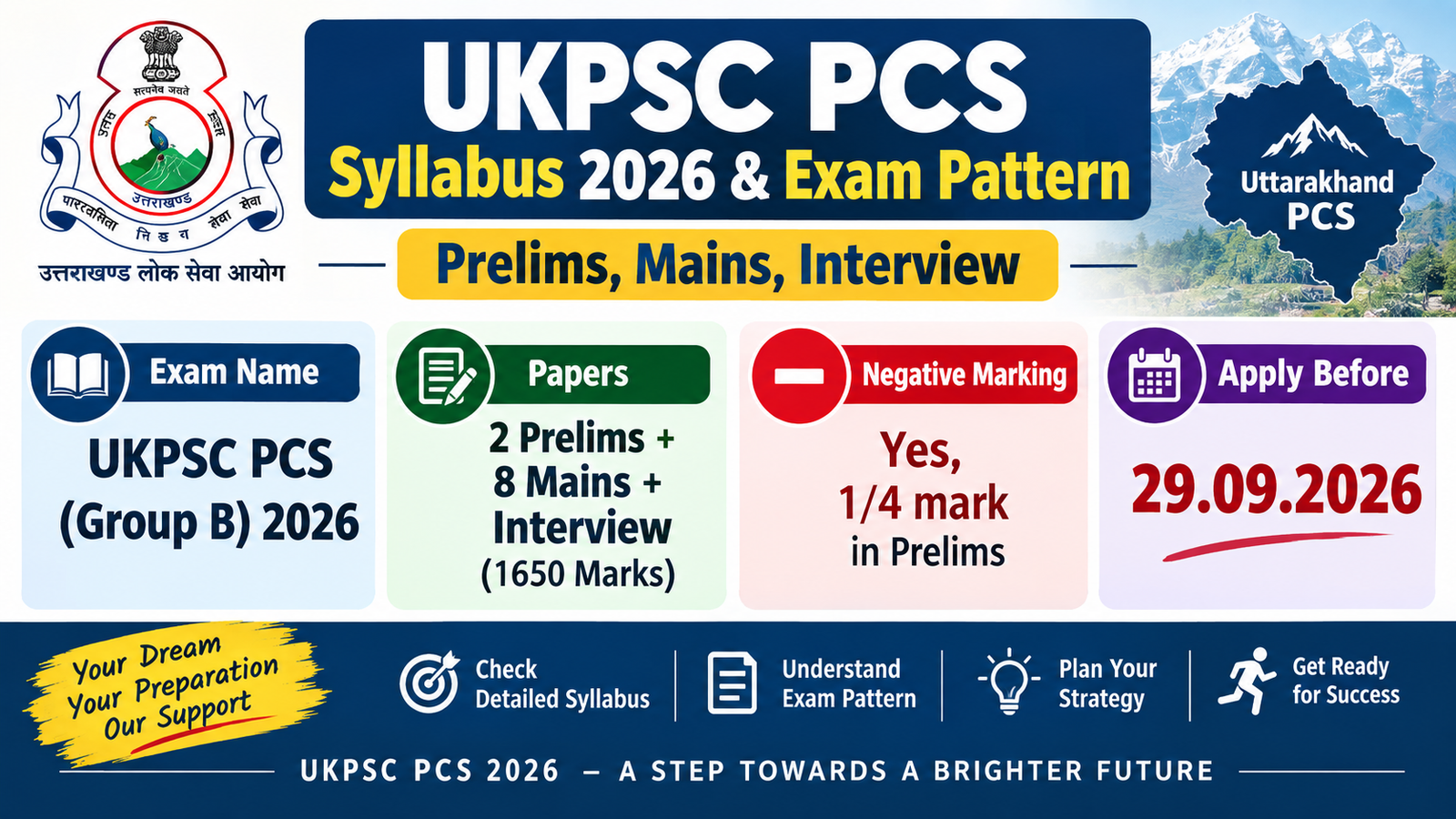
Uttarakhand Public Service Commission (UKPSC) has released the complete syllabus and examination scheme for the Uttarakhand Combined State Civil / Upper Subordinate Services Examination 2026 (Advt. No. A-1/E-1/2026-27) as part of its detailed advertisement. The selection runs through three stages — a Preliminary objective exam, a Mains written exam of eight papers, and an Interview / Personality Test carrying a combined 1650 marks. Given below is the full stage-wise exam pattern, the category-wise minimum qualifying marks, and the complete topic-wise syllabus for both Prelims and Mains.
2 papers — General Studies (150 marks) and General Aptitude Test (150 marks, qualifying)
Mains Papers
8 papers — 1500 marks total
Interview Marks
150 marks
Grand Total (Mains + Interview)
1650 marks
Negative Marking
Yes — one-fourth (1/4) of the marks for each wrong answer in the Preliminary Exam
Exam Mode
Offline (pen and paper); calculators are prohibited in both Prelims and Mains
Exam Date
Not specified in notification
Official Website
psc.uk.gov.in
Important Dates
Event
Date
Advertisement Publication Date
09.09.2026
Online Application Start Date
09.09.2026
Last Date to Apply Online
29.09.2026 (up to 11:59:59 PM)
Last Date for Fee Payment
29.09.2026 (up to 11:59:59 PM)
Application Correction / Edit Window
07.10.2026 to 16.10.2026 (up to 11:59:59 PM)
Preliminary Exam Date
Not specified in notification
Mains Exam Date
Not specified in notification
UKPSC PCS Exam Pattern 2026
The examination is conducted in three sequential stages. The Preliminary Exam is only a screening test — its marks are not added to the final merit. The final merit list is prepared from the Mains written exam (1500 marks) plus the Interview (150 marks).
Stage 1 — Preliminary Exam (Objective Type)
Paper
Subject
No. of Questions
Marks
Duration
Paper 1
General Studies
150 (1 mark each)
150
2 Hours
Paper 2
General Aptitude Test
100 (1.5 marks each)
150
2 Hours
Total
250
300
4 Hours
Negative marking: one-fourth (1/4) of the marks allotted to a question is deducted for every wrong answer. Marking more than one option counts as a wrong answer even if one of them is correct. No penalty for an unattempted question.
Paper 2 is qualifying only: every candidate, of every category and sub-category, must score at least 33% in the General Aptitude Test. The Prelims merit list is prepared solely on Paper 1 (General Studies) marks.
Uttarakhand weightage: at least one-third of the 150 General Studies questions (a minimum of 50 questions) will be based on the state of Uttarakhand.
Use of a calculator is prohibited in both the Preliminary and the Mains examination.
Stage 2 — Mains Exam (Written Type)
Paper
Subject
Duration
Marks
Paper 1
General Hindi
3 Hours
150
Paper 2
Essay
3 Hours
150
Paper 3
General Studies-I (Indian Heritage and Culture, History and Geography of the World and Society)
3 Hours
200
Paper 4
General Studies-II (Governance, Constitution, Polity, Social Justice and International Relations)
3 Hours
200
Paper 5
General Studies-III (Technology, Economic Development, Biodiversity, Environment, Security and Disaster Management)
3 Hours
200
Paper 6
General Studies-IV (Ethics, Integrity and Aptitude)
3 Hours
200
Paper 7
General Studies-V (Knowledge of State of Uttarakhand)
3 Hours
200
Paper 8
General Studies-VI (Knowledge of State of Uttarakhand)
3 Hours
200
Total Written Examination
1500
All eight question papers are compulsory.
Scoring a minimum of 35% in the General Hindi paper is mandatory. That paper is set at High School level.
Two full papers (GS-V and GS-VI, 400 marks together) are devoted entirely to Uttarakhand, making state-specific preparation the single highest-weightage area in the Mains.
Stage 3 — Interview / Personality Test
Stage
Marks
Mains Written Examination
1500
Interview / Personality Test
150
Grand Total (Written + Interview)
1650
Minimum Qualifying Marks (Category-wise)
As per Appendix-07 of the notification, a candidate must obtain these minimum percentages at each stage to be considered for the merit list. This is a separate requirement from the Prelims Paper 2 cut-off of 33%.
Category / Sub-category
Preliminary Exam
Mains (Written)
Final Result (Written + Interview)
Unreserved (General) and related sub-categories
35%
40%
45%
Other Backward Class (OBC) and related sub-categories
30%
35%
40%
Economically Weaker Section (EWS) and related sub-categories
30%
35%
40%
Scheduled Caste (SC) and related sub-categories
25%
30%
35%
Uttarakhand Freedom Fighter Dependants
25%
30%
35%
Divyangjan (Persons with Benchmark Disability)
20%
25%
30%
Uttarakhand Ex-Servicemen
25%
30%
35%
Note: In every Mains paper other than General Hindi, the same category-wise minimum percentages (35% UR, 30% OBC, 30% EWS, 25% SC, 25% Freedom Fighter Dependants and Ex-Servicemen, 20% Divyangjan) must be obtained for a candidate to be considered on merit for that post.
UKPSC PCS Prelims Syllabus 2026 (Topic-wise)
Paper 1 — General Studies (150 Questions, 150 Marks)
Unit
Topics
Unit 1 — Indian History, Culture and National Movement
India: Pre-historic period, Harappan Civilization, Vedic Civilization and Sangam Age; Mahajanapadas and rise of Magadh; religious movements (Jainism, Buddhism, Bhagavatism, Shaivism); Persian and Greek contacts. Mauryan Empire (Chandragupta Maurya, Ashoka and his Dhamma, administration, economy, society, art); Kushanas. Gupta Empire (foundation, consolidation, decline; Chandragupta I, Samudragupta, Chandragupta II, Skandagupta; administration, society, economy, literature, art). Post-Gupta period (Harshavardhan, Pal, Pratihara, Rashtrakuta, Chola, Pallava, Chandel, Paramar, Chauhan; developments 650–1200 AD). Advent of Islam (Iltutmish, Balban, Alauddin Khalji, Muhammad bin Tughlaq, Feroze Tughlaq, Sikandar Lodi, Ibrahim Lodi; Delhi Sultanate administration and decline; Indo-Islamic architecture; Vijaynagar Empire; Sufism; Bhakti movement). Mughal Empire (Babar, Shershah Suri, Akbar, Shahjahan, Aurangzeb, decline; Jagirdari and Mansabdari systems; literature, art, architecture; Maratha, Sikh and Jat). Advent of Europeans (Portuguese, French, Dutch, British East India Company; British administration 1758–1857); economic impact of British rule; 19th century socio-religious reform movements; Viceroys of India (1858–1947); First War of Independence (1857); tribal, non-tribal, caste and peasant movements; Government of India Act 1858. Growth of nationalism; Indian National Congress (foundation, Moderates and Extremists); Partition of Bengal, Swadeshi movement, Muslim League, Surat Split (1907), Morley-Minto Reform (1909); First World War and Home Rule Movement, Lucknow Pact (1916), August Declaration 1917, revolutionary movements. Gandhian era: Government of India Act (1919), Rowlatt Act, Jallianwala Bagh (13 April 1919), Khilafat and Non-Cooperation Movements, Chauri Chaura, Swaraj Party, Simon Commission, Nehru Report, Jinnah’s 14 Points, Lahore Session (1929), Civil Disobedience Movement, Round Table Conferences, Gandhi-Irwin Pact, Communal Award and Poona Pact. Government of India Act (1935), demand for Pakistan, Cripps Mission, Quit India Movement, Cabinet Mission Plan, Indian National Army, Interim Government, Mountbatten Plan, Indian Independence Act (1947), Partition, India after Independence.
Uttarakhand: Pre-historic and proto-historic period; ancient tribes; Kuninda and Yaudheya; Kartikeypur dynasty; Katyuri dynasty; Parmar dynasty of Garhwal; Chand dynasty of Kumaon; Gorkha invasion and rule; British rule; Tehri Estate; freedom movement in Uttarakhand and the 1857 revolt; role of Uttarakhand in the national movement; people’s movements of Uttarakhand.
Unit 2 — Indian and World Geography
World Geography: important branches; Earth and Solar System; lithosphere; latitudes, longitudes and time; rotation and revolution; eclipses; continents, mountains, plateaus, plains; hydrosphere, lakes and rocks; atmospheric layers, composition, solar insolation, humidity; oceanic relief, currents, tides, temperature and salinity; agriculture, plants, insects, livestock breeding; power and mineral resources; industries; population, species and tribes; migration; transport and communication; international boundary lines; environment and world trade (regional economic groups); geographical glossary.
Geography of India: geographic introduction; relief and structure; climate; drainage system; vegetation, plants, insects, livestock breeding; irrigation; power; soils; water resources; agriculture; minerals; industries; population and urbanization; transport and communication; foreign trade; Scheduled Castes and Tribes; social ecologies; domicile and pollution.
Geography of Uttarakhand: geographical location; relief and structure; climate; drainage system; vegetation; wildlife; minerals; agriculture; animal husbandry; irrigation; major cities and tourist places; population; Scheduled Castes and Tribes; transport network; power resources and industrial development; natural hazards.
Unit 3 — Indian Polity
National: parliamentary system; coalition politics; regionalism, casteism, communalism, terrorism and Naxalism; welfare of SC/ST/OBC and minorities; gender politics (equality, reservation, empowerment, welfare and safety); electoral reforms; governance institutions and processes; national integration; nuclear policy; environmental concerns; economic and financial reforms (LPG) and their impact, planning machinery, banking sector (RBI, NABARD, IDBI); institutional reforms such as MNREGA, NRHM, JNNURM, PPP mode; citizen participation; civil society; Lokpal and Lokayukta.
International: United Nations; international organizations; global environmental concerns; SAARC, ASEAN, SAFTA and other regional groups; India’s approach to disarmament, human rights and globalization; BRICS and its importance for India.
Constitution of India: constitutional development; Constituent Assembly; Preamble; basic features (parts, important articles and schedules); Fundamental Rights and Duties; Directive Principles; amendment procedure and important amendments; federal and parliamentary system; Parliamentary Committees (Public Accounts, Estimates, Joint Parliamentary); constitutional bodies (Election Commission, CAG); judiciary (Supreme Court and High Courts).
Indian Polity: Union Executive (President, Prime Minister and Council of Ministers, Cabinet Secretariat, Central Secretariat, PMO); State Executive (Governor, Chief Minister and Council of Ministers, State Secretariat, Chief Secretary); Union Parliament and State Legislatures; election machinery and process; political parties and pressure groups; politician–civil servant relationships; political culture; agencies of political socialization; growth of the administrative system; re-organization of states; administration of Union Territories; administrative reforms and important committees and commissions; district administration.
Panchayati Raj: 73rd and 74th Constitutional Amendment Acts; State Finance Commission; devolution of powers; types of local bodies (Municipal Corporations, Municipal Councils, Nagar Panchayat, Gram Panchayat, Panchayat Samiti, Zila Parishad).
Public Policy: good governance, Citizen Charter and e-Governance; prevention of corruption, Lokpal and Lokayukta; Right to Information; Right to Education; Right to Services.
Issues Concerning Rights: Fundamental Rights; Protection of Civil Rights Act 1955; rights pertaining to SCs, STs, minorities, women, children and old persons.
Political System of Uttarakhand: governance, Governor, legislation, Chief Minister and Council of Ministers; Centre-State relations; public services and Public Service Commission; auditing; Advocate General; High Court and its jurisdiction; provisions for minorities and SC/ST; special state selection criteria; official language; Consolidated Fund and Contingency Fund; political parties and elections; local government and Panchayati Raj; community development; public policy; rights-related issues (education, employment, development); governance (prevention of corruption, Lokayukta, Citizen Charter, e-Governance, RTI, Samadhan Yojna).
Unit 4 — Economic and Social Development
National: economic policy and reforms in India, Liberalization, Privatization and Globalization; Foreign Direct Investment, inflation, inclusive growth, economic development versus environmental conservation; poverty and unemployment eradication programmes, Human Development Index; census and main features of India’s population, population and economic development, urbanization issues; main features of the Union Budget; main features of the Indian economy; natural and energy resources, trade (external sector), commerce, industries, schemes and projects, direction of economic growth; tax reform and banking business; planned development; National Development Council; national income; Indian agriculture (agricultural productivity, livestock, Green Revolution, food security, food grain prices, buffer stock, agricultural policy, crop insurance schemes); Indian financial, money, capital and security markets; insurance sector, tax structure, public finance and fiscal policy; concepts such as rolling plan, sweat shares, hawala, gilt-edged market, black market and black money.
International: WTO, IBRD, IMF, World Bank, SAARC, ASEAN, SAPTA, BRICS, OPEC and other regional economic and commercial organizations; international flow of capital, human resources and technology; FERA, FEMA and PMLA; World Human Development Index; glossary.
Uttarakhand: main features of the state economy and budget; natural and energy resources; trade, commerce and industries; schemes and projects; tax and economic reforms; planned development; agriculture; livestock; food security; public finance and fiscal policy; census; Human Development Index; tourism; role of herbs and culture in economic development.
Unit 5 — General Science and Technology
General appreciation and understanding of science, including matters of everyday observation and experience. Science and Technology in India: history and contribution. Current affairs: national and international awards, prizes, discoveries, inventions, science congresses and conferences, solar technology, new technology for human welfare, health and medicine, environmental awareness, natural bio-resources. Scientific and research organizations: IUCN, WWF, IPCC, WHO, UNESCO. Information technology and computers in daily life, e-governance. Ecology and environment: habitat, community ecosystem, structure and function, adaptations; plants and their classification; traditional, commercial and commercialized agriculture; agricultural crop production and regional distribution; problems in agriculture; agricultural diversity. Natural resources: soil, water, air, forests, grasslands, wetlands, marine; planning and management of renewable and non-renewable energy. Biodiversity: threats, conservation, ethics and usage. Environmental crisis: air, water, soil and space pollution; laws and acts; global warming; global climate change causes and effects. Remote sensing and GIS applications; weather forecasting; spreadsheet and database applications. Physical Science: fundamentals of computers and information processing, basic computer organization, Boolean algebra, logic gates, problem-solving techniques and computer languages, business data processing, data communication, computer networks and security, internet and multimedia, cloud computing, software packages, basics of cyber law. Chemistry: matter and its states, acids, bases and salts, origin and distribution of elements, hard and soft water, heavy water, purification, batteries, fuel cells, corrosion, nuclear fission and fusion, elements of symmetry, polymers, carbohydrates, proteins, nucleic acids, lipids, hormones, vitamins, medicines and healthcare, dyes, cosmetics, food chemistry. Physics: mechanics, general properties of matter, wave motion, sound and electromagnetic waves, heat, light, magnetism, electricity, atomic and nuclear physics, astronomy and space physics, X-rays and semiconductor technology. Life Science: branches and contributions, natural resources and their management, biodiversity, biotechnology, nanotechnology, bio-products, vaccines, immunization, healthcare, genetically modified organisms, global warming and climate change, livestock breeding, plants and human welfare. Scientific glossary. Natural resources of Uttarakhand and their contribution to national and international climate change.
Unit 6 — Current Events
Current events of State, National and International importance: continents and nations; important space events; wonders of the world; religions of the world; Indian states; famous books and writers of the world and India; famous scientists; important awards; Indian defence system; health and family welfare; scientific and technical development; education; national symbols; protocol in India; important human rights and welfare organizations; important religious places; important passes; dances of India; cultural institutes; music; drawing; Indian languages; world heritage; important newspapers; important dates; sports landscape and important sports terms; conventions, exhibitions, festivals and conferences; important reports.
Paper 2 — General Aptitude Test (100 Questions, 150 Marks, Qualifying)
Unit
Topics
Unit 1 80 questions, 120 marks
1. Aptitude: statements and propositions, true and false statements (syllogism), analogies, similarities and differences, observation, mirror images. 2. Communication and Interpersonal Skills: word building, coding-decoding, numerical operations. 3. Logical and Analytical Ability: statement-arguments, statement-assumptions, statement-courses of action, statement-conclusions, deriving conclusions from passages, theme detection, question-statements, Venn diagrams, arithmetic number series, arithmetical reasoning, figural classification, relationship concepts. 4. Decision Making and Problem Solving: problem solving, decision making, visual memory, discrimination, assertion and reason. 5. General Mental Ability: direction sense test, social intelligence, emotional intelligence, critical thinking, puzzle test, alphabet test, data sufficiency, inserting the missing character. 6. Numerical Identification: numbers and their classification, tests of divisibility, general properties of divisibility, test of prime numbers, division and remainder, remainder rules, two-line number series, sum rules on natural numbers. 7. Statistical Analysis: presentation of data through charts, graphs and tables; sufficiency of data.
Unit 2 20 questions, 30 marks
8. English Language Comprehension (7 questions): a long English passage followed by 3 objective questions testing comprehension of the ideas in the passage, plus 4 questions on language and grammar covering vocabulary, antonyms, synonyms, one-word substitution, phrases and phrasal verbs, and transformation of sentences. 9. Hindi Language Comprehension (13 questions): an unseen Hindi passage followed by 6 objective questions based on its subject matter, language and grammar, plus 7 questions on the theme, title, purpose and language of the passage covering lokokti and muhavare, alankar, shabd-vivek (tatsam, tadbhav, deshaj and videshi words, synonyms, antonyms, word meanings), upsarg, pratyay, sandhi, samas and kriya-roop.
UKPSC PCS Mains Syllabus 2026 (Topic-wise)
Paper
Topics
Paper 1 — General Hindi 150 marks, 3 hours
1. Shabd Rachana (15 marks): upsarg and pratyay, sandhi and samas, vachan and ling, grammatical categories (sangya, sarvanam, kriya, visheshan, kriya-visheshan, avyay), vachya parivartan (kartrivachya, karmavachya, bhaavvachya). 2. Shabd Vivek (15 marks): shabd-bhed — tatsam, tadbhav, deshaj, videshi, sankar, rudh, yaugik, yogrudh, paryayvachi, samanarthi, vilom, anekarthi, samuhvachi, samroop kintu bhinnarthak, one word for a sentence or phrase; shabd-shuddhi. 3. Vakya Rachana (15 marks): sentence transformation by structure (saral, mishra, sanyukt) and by grammar (prashnvachak, vismayadibodhak, sakaratmak, nakaratmak), viram chinh, vakya shuddhi, slogan writing. 4. Muhavare and Lokoktiyan (10 marks): meaning and use in sentences. 5. Patra Lekhan (15 marks): informal and formal letters. 6. (a) Prativedan Lekhan (10 marks): preparing authentic reports on events in government and non-government offices, schools and organizations. (b) Translation of Hindi administrative terms into English (10 marks). 7. Bodhan (15 marks): answering comprehension questions on an unseen passage. 8. Saar Lekhan / Sankshepan (15 marks): condensing a detailed article, essay, report, speech or letter to about one-third of its length. 9. Pallavan (10 marks): explanation and expansion of famous aphorisms, sentences, sayings and proverbs. 10. Translation of a Hindi passage into English (10 marks). 11. Translation of an English passage into Hindi (10 marks). Minimum 35% marks are mandatory in this paper. It is set at High School level.
Paper 2 — Essay 150 marks, 3 hours
Three sub-sections, A, B and C. The candidate writes one essay of 700–800 words from each sub-section in the opted language, each carrying 50 marks. Section A: 1. Literature and Culture. 2. Social sphere. 3. Political sphere. 4. Economic sphere — agriculture, industry and trade. Section B: 1. Science, Environment and Technology. 2. National and International Events. 3. Natural Calamities — landslide, earthquake, deluge, drought. 4. National Development Programmes and Projects. Section C: 1. Social structure of Uttarakhand. 2. History, culture, art and literature in Uttarakhand. 3. Economic and geographic scenario of Uttarakhand, tourism and migration. 4. Environment, disaster and disaster management in Uttarakhand. 5. Women empowerment in Uttarakhand. Evaluation considers accuracy of language and grammar, word selection and handwriting; originality of thought; multi-dimensional understanding; systematic and reasoned presentation; and clarity, expression and summarization ability.
Paper 3 — General Studies-I 200 marks, 3 hours (Indian Heritage and Culture, History and Geography of the World and Society)
Salient aspects of Indian art forms, literature and architecture from ancient to modern times. Modern Indian history from about the middle of the eighteenth century to the present — significant events, personalities and issues. The Freedom Struggle, its various stages and important contributors from different parts of the country. Post-independence consolidation and reorganization within the country. World history from the 18th century — industrial revolution, world wars, re-drawal of national boundaries, colonization and decolonization, political philosophies such as communism, capitalism and socialism, their forms and effect on society. Salient features of Indian society and the diversity of India. Role of women and women’s organizations; population and associated issues; poverty and developmental issues; urbanization, its problems and remedies. Effects of globalization on Indian society. Social empowerment, communalism, regionalism and secularism. Salient features of world physical geography. Distribution of key natural resources across the world, including South Asia and the Indian sub-continent; factors responsible for the location of primary, secondary and tertiary sector industries. Important geophysical phenomena such as earthquakes, tsunami, volcanic activity and cyclones; geographical features and their location; changes in critical geographical features including water bodies and ice caps, changes in flora and fauna, and the effects of such changes.
Paper 4 — General Studies-II 200 marks, 3 hours (Governance, Constitution, Polity, Social Justice and International Relations)
Indian Constitution — historical underpinnings, evolution, features, amendments, significant provisions and basic structure. Functions and responsibilities of the Union and the States; issues and challenges pertaining to the federal structure; devolution of powers and finances to local levels and challenges therein. Separation of powers between organs, dispute redressal mechanisms and institutions. Comparison of the Indian constitutional scheme with other countries. Parliament and State Legislatures — structure, functioning, conduct of business, powers, privileges and issues arising. Structure, organization and functioning of the Executive and the Judiciary; ministries and departments; pressure groups and formal and informal associations and their role in the polity. Salient features of the Representation of the People Act. Appointment to various constitutional posts; powers, functions and responsibilities of constitutional bodies. Statutory, regulatory and quasi-judicial bodies. Government policies and interventions for development and issues arising out of their design and implementation. Development processes and the development industry — role of NGOs, SHGs, groups and associations, donors, charities and institutional stakeholders. Welfare schemes for vulnerable sections by the Centre and States and their performance; mechanisms, laws, institutions and bodies for the protection and betterment of these sections. Issues relating to development and management of social sector services relating to health, education and human resources. Issues relating to poverty and hunger. Important aspects of governance, transparency and accountability; e-governance applications, models, successes, limitations and potential; citizens charters and institutional measures. Role of civil services in a democracy. India and its neighbourhood relations. Bilateral, regional and global groupings and agreements involving India or affecting India’s interests. Effect of policies and politics of developed and developing countries on India’s interests; Indian diaspora. Important international institutions, agencies and fora, their structure and mandate.
Paper 5 — General Studies-III 200 marks, 3 hours (Technology, Economic Development, Biodiversity, Environment, Security and Disaster Management)
Indian economy and issues relating to planning, mobilization of resources, growth, development and employment. Inclusive growth and issues arising from it. Government budgeting. Major crops and cropping patterns in various parts of the country; types of irrigation and irrigation systems; storage, transport and marketing of agricultural produce and related constraints; e-technology in the aid of farmers. Issues related to direct and indirect farm subsidies and minimum support prices; Public Distribution System — objectives, functioning, limitations and improvement; buffer stocks and food security; technology missions; economics of animal rearing. Food processing and related industries in India — scope and significance, location, upstream and downstream requirements, supply chain management. Land reforms in India. Effects of liberalization on the economy; changes in industrial policy and their effects on industrial growth. Infrastructure — energy, ports, roads, airports, railways. Investment models. Science and Technology — developments, applications and effects in everyday life. Achievements of Indians in science and technology; indigenization of technology and developing new technology. Awareness in the fields of IT, space, computers, robotics, nano-technology and bio-technology, and issues relating to intellectual property rights. Conservation, environmental pollution and degradation, environmental impact assessment. Disaster and disaster management. Linkages between development and the spread of extremism. Role of external state and non-state actors in creating challenges to internal security. Challenges to internal security through communication networks; role of media and social networking sites; basics of cyber security; money laundering and its prevention. Security challenges and their management in border areas; linkages of organized crime with terrorism. Various security forces and agencies and their mandate.
Paper 6 — General Studies-IV 200 marks, 3 hours (Ethics, Integrity and Aptitude)
This paper tests the candidate’s attitude and approach to issues relating to integrity and probity in public life, and the problem-solving approach to conflicts faced in dealing with society. Questions may use the case study approach. Ethics and Human Interface: essence, determinants and consequences of ethics in human actions; dimensions of ethics; ethics in private and public relationships; human values and lessons from the lives and teachings of great leaders, reformers and administrators; role of family, society and educational institutions in inculcating values. Attitude: content, structure and function; its influence and relation with thought and behaviour; moral and political attitudes; social influence and persuasion. Aptitude and foundational values for civil service: integrity, impartiality and non-partisanship, objectivity, dedication to public service, empathy, tolerance and compassion towards weaker sections. Emotional intelligence: concepts, utilities and application in administration and governance. Contributions of moral thinkers and philosophers from India and the world. Public and civil service values and ethics in public administration: status and problems; ethical concerns and dilemmas in government and private institutions; laws, rules, regulations and conscience as sources of ethical guidance; accountability and ethical governance; strengthening of ethical and moral values in governance; ethical issues in international relations and funding; corporate governance. Probity in Governance: concept of public service; philosophical basis of governance and probity; information sharing and transparency in government; Right to Information; Codes of Ethics and Codes of Conduct; Citizen’s Charters; work culture; quality of service delivery; utilization of public funds; challenges of corruption. Case studies on the above issues.
Paper 7 — General Studies-V 200 marks, 3 hours (Knowledge of State of Uttarakhand)
History of Uttarakhand: prehistoric and proto-historic period; major archaeological sites; ancient tribes; Kunindas and Yaudheyas; Katyuri dynasty; Parmar dynasty in Garhwal (rule, administration, society, economy); Chand dynasty of Kumaon (rule, administration, society, economy); Gorkha invasion and administration. British Rule in Uttarakhand: administrative system, land revenue, forest management, economy, education and health system; growth of vernacular journalism; Tehri state (rule, administration, society, economy, religion and culture); Uttarakhand and the national movement; prominent freedom fighters of Uttarakhand; merger of the Tehri state. Popular Movements: Coolie Begar Movement, Dola Palki Movement, Chipko Movement, Anti-Liquor Movement, social reformers, anti-princely Tehri State movement, movement for a separate Uttarakhand state and its immediate and long-term consequences. Society and Culture: family, marriage and kinship systems; caste system and caste mobility; Scheduled Castes, Scheduled Tribes and OBCs in Uttarakhand; rural power structure; urbanization and industrialization; prominent folk songs, folk dances and crafts; prominent folk singers and artists; musical instruments, paintings, costumes and food habits; religious places and temples; fairs and festivals; dialects and crafts. Political, Local Administration and Public Policy: political system in Uttarakhand, party politics, regional parties, pressure groups. Administrative system: structure of the state government, cabinet and departments, administrative agencies, district and tehsil level administration, State Public Service Commission, Lokayukta, State Vigilance Agency; local self government — urban local bodies and Panchayati Raj institutions, State Finance Commission, State Election Commission; public policy, good governance, Citizen’s Charter and e-governance, prevention of corruption, Lokpal and Lokayukta, Right to Information, Right to Education, Right to Service, women empowerment, MNREGA, soldiers’ welfare and rehabilitation; important Ayog in Uttarakhand. Current events in the context of Uttarakhand state.
Paper 8 — General Studies-VI 200 marks, 3 hours (Knowledge of State of Uttarakhand)
Geography of Uttarakhand: location, extent and strategic importance; structure and relief; climate; drainage system; natural vegetation; soil; glaciers, lakes and climate change. Resources — forest, water, minerals and land; agriculture, irrigation, horticulture, animal husbandry, industry. Transport — road, rail and air. Hydro-electric projects, water scarcity and solutions. Tourism — problems and prospects. National parks and wildlife sanctuaries. Population — growth rate, density, distribution, sex ratio, literacy; migration pattern, problems and solutions; rural settlement types and patterns; urbanization and cities; smart city; tribal habitat; Human Development Index. Economy of Uttarakhand: main features of the state economy; natural resources — water, forests, minerals; economic profile — state domestic product and its components, per capita income; major sources of income including agriculture and horticulture, medicinal plants, forest products and tourism; industrial development — state MSME policy, large, medium, small, cottage and handicraft industries, investment scenario, problems and possibilities; infrastructure — road, rail and air transport, banking and financial institutions, education, health, energy, communication, Self Help Groups; economic planning and policies — state annual plans, development programmes, schemes and policies, decentralized planning through Panchayati Raj Institutions and Urban Local Bodies; public finance — revenue receipts, state taxes, public expenditure, Uttarakhand’s budget; major economic problems — poverty, migration, natural disasters, environmental degradation; welfare programmes — youth, child and women welfare, poverty alleviation, MNREGA, food and civil supply, soldiers’ welfare and rehabilitation. Disaster Management: nature, types and effects of disaster; important factors of natural disaster and efforts to reduce it; denudation, earthquake, cloudburst, forest fire, drought and avalanche; difficulties in disaster management; ecologically sensitive areas; role of NDRF and SDRF.
Exam Centres
Candidates choose a preferred Preliminary Exam city from the 24 centres listed in Appendix-1 of the notification. The Mains examination is held only at Haldwani and Haridwar.
City (Code)
City (Code)
City (Code)
City (Code)
Almora (01)
Ranikhet (02)
Champawat (03)
Pithoragarh (04)
Ramnagar (05)
Haldwani (06)
Rudrapur (07)
Kashipur (08)
Khatima (09)
Bageshwar (10)
Pauri (11)
Srinagar (12)
Kotdwar (13)
Gopeshwar (14)
Karnaprayag (15)
New Tehri (16)
Rudraprayag (17)
Uttarkashi (18)
Dehradun (19)
Vikasnagar (20)
Rishikesh (21)
Haridwar (22)
Laksar (23)
Roorkee (24)
Note: The number of centre cities may be increased or decreased according to the number of candidates. The Commission will try to allot a centre from the candidate’s chosen options, but may allot a different city in unavoidable circumstances. No request for a change of exam centre is entertained once centres are allotted.
How to Apply
Applications for this examination are open until 29.09.2026. The short version of the process:
Read the detailed advertisement on the official website psc.uk.gov.in or pscuk.net.in.
Go to pscuk.net.in, open How to Apply from the menu bar, review the advertisement details and instructions, then click Apply Now.
Complete the Registration form, create a password, verify your details and submit. You will receive the registration confirmation on your registered mobile number and email.
Log in, fill the Educational Details page, select the post or posts you are eligible for, upload your photograph and signature, tick the declaration and continue.
Check the filled data carefully, tick the final declaration, submit the form, pay the fee through Net Banking / Debit Card / Credit Card / UPI, and take a printout of the application.
Note: No data can be modified after Final Submission, except during the Edit/Correction window from 07.10.2026 to 16.10.2026. The registered mobile number cannot be edited at all once registration is complete. For technical issues while applying, candidates may email ukpschelpline@gmail.com.
Treating Paper 2 of the Prelims as unimportant because it is qualifying — failing to reach 33% in it disqualifies you no matter how high your General Studies score is.
Guessing blindly in the Prelims: every wrong answer costs one-fourth of that question’s marks, and marking two options counts as wrong even if one of them is correct.
Underestimating Uttarakhand-specific study — at least one-third of Prelims General Studies questions and two entire Mains papers (400 marks) are on the state alone.
Ignoring the General Hindi paper — scoring below 35% there ends your candidature regardless of your marks in the General Studies papers.
Assuming the Prelims score carries forward: it does not. The final merit is built only from the 1500-mark Mains and the 150-mark Interview.
Overlooking the category-wise minimum qualifying marks in Appendix-07, which apply at each stage in addition to the merit cut-off.
Carrying a calculator to the exam hall — it is prohibited in both the Preliminary and the Mains examination.
Frequently Asked Questions
Q1. What is the exam pattern for UKPSC PCS 2026? The exam has three stages — a Preliminary objective exam of two papers (150 + 150 marks), a Mains written exam of eight papers totalling 1500 marks, and an Interview of 150 marks.
Q2. Is there negative marking in the UKPSC PCS Prelims? Yes, one-fourth (1/4) of the marks assigned to a question is deducted for each wrong answer, and marking more than one option is treated as a wrong answer even if one of them is correct.
Q3. How many questions come from Uttarakhand in the Prelims? A minimum of one-third of the 150 General Studies questions — that is, at least 50 questions — will be based on the state of Uttarakhand.
Q4. Is the General Aptitude Test paper counted in the merit list? No, Paper 2 is purely qualifying and requires 33% marks from every category; the Prelims merit list is prepared only from Paper 1 (General Studies) marks.
Q5. What are the minimum qualifying marks for UKPSC PCS 2026? In the Prelims they are 35% for Unreserved, 30% for OBC and EWS, 25% for SC, Freedom Fighter Dependants and Ex-Servicemen, and 20% for Divyangjan candidates, with higher thresholds at the Mains and final stages.
Q6. Is the General Hindi paper compulsory to pass? Yes, obtaining a minimum of 35% marks in the General Hindi paper is mandatory, and the paper is set at High School level.
Q7. Where will the UKPSC PCS Mains exam be held? The Mains examination is conducted only at exam centres in Haldwani and Haridwar, while the Prelims is held across 24 cities in Uttarakhand.
Q8. When is the UKPSC PCS 2026 exam date? The exam date has not been announced in this notification; UKPSC will publish the Prelims date, time and centre details through the online admit card on psc.uk.gov.in and in daily newspapers.
Disclaimer: The information above has been compiled from the official notification for the convenience of job seekers. Candidates are advised to verify all details from the official website before applying.