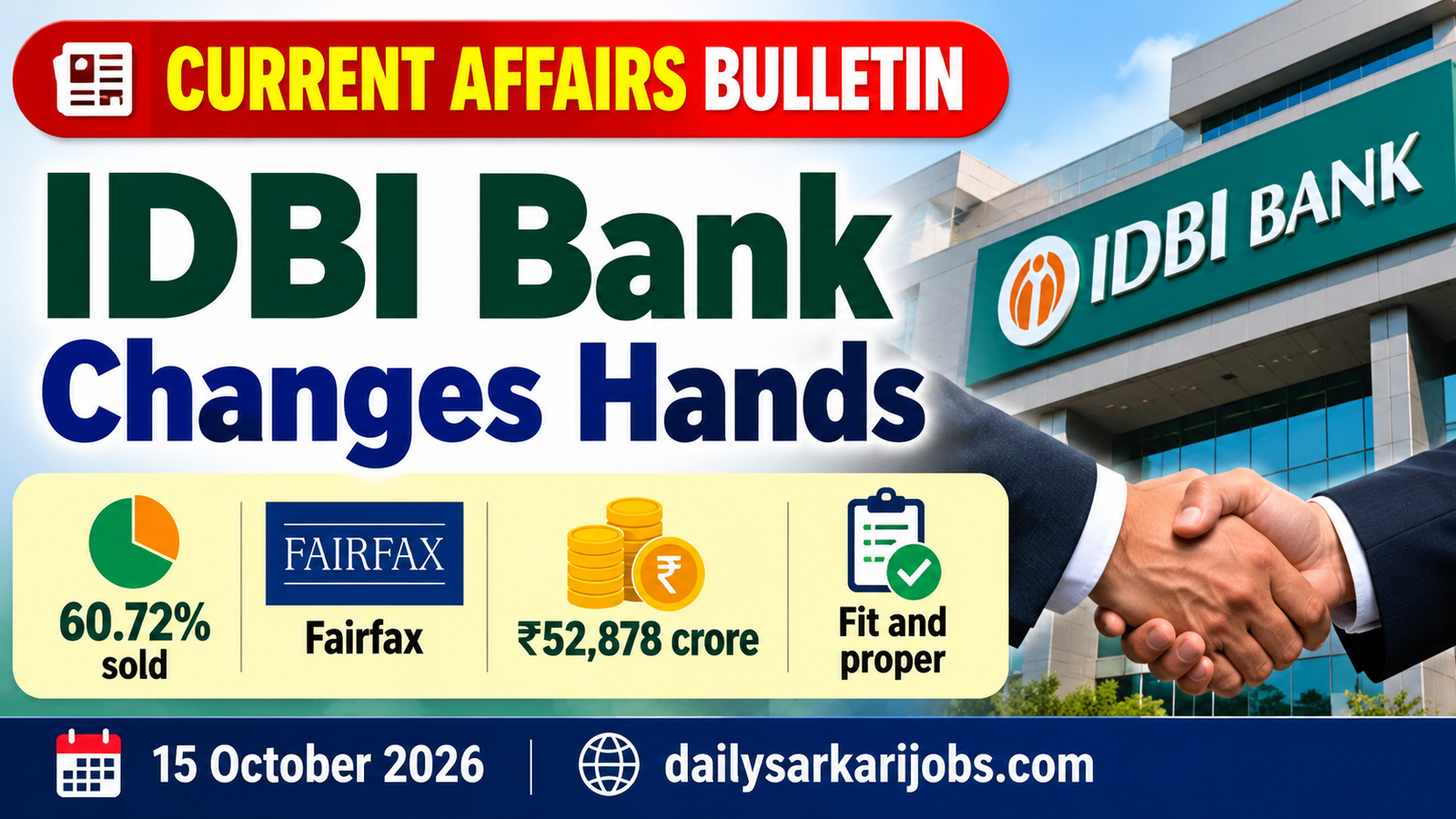
On 14 October 2026 the Cabinet Committee on Economic Affairs approved the sale of a 60.72 per cent stake in IDBI Bank to a strategic buyer, for about ₹52,878 crore. The buyer is 10955230 Canada Inc., a company whose parent is Fairfax Financial Holdings.
It is being called a privatisation, and the word needs reading carefully. Of the 60.72 per cent being sold, the Government of India is selling 30.48 per cent and the Life Insurance Corporation is selling 30.24 per cent — almost exactly half. This explainer is about what that tells you.
⚡ QUICK FACTS
Decision
Cabinet Committee on Economic Affairs, 14 October 2026
Stake being sold
60.72 per cent
Who is selling
Government of India 30.48 per cent, LIC 30.24 per cent
The Hinge: Read Who Owns It, Not What It Is Called
Do the arithmetic the release invites. The Government is selling 30.48 per cent and keeping 15 per cent, so it held about 45.48 per cent. LIC is selling 30.24 per cent and keeping 19 per cent, so it held about 49.24 per cent. LIC was the larger shareholder, not the Government.
And after the sale is done, the Government still holds 15 per cent and LIC still holds 19 per cent — 34 per cent between them. A bank that is being privatised will, on the day it changes hands, remain a third owned by the Indian state and a state-owned insurer.
Holder
Before, by the release’s own arithmetic
Selling
Keeping
Government of India
About 45.48 per cent
30.48
15
Life Insurance Corporation
About 49.24 per cent
30.24
19
Together
About 94.72 per cent
60.72
34
This is the same habit the taxation capsule asked for, pointed at ownership instead of revenue:read where the money actually sits, not the label on it. A headline says privatisation; the shareholding says a controlling block is moving while the state keeps a large minority. Both are true, and only one of them is on the front page.
How LIC Came to Own a Bank
The oddity in this story is not the sale. It is that an insurance company was the biggest owner of a bank in the first place.
IDBI Bank spent years in difficulty. The Reserve Bank placed it under the Prompt Corrective Action framework in May 2017, on bad loans and losses, and lifted those restrictions in March 2021, subject to conditions. In between, the bank needed repeated injections of capital — first from the Government, and then from LIC.
That is the Prompt Corrective Action framework working in the open, and it is worth recognising.The banking capsule described PCA as a thermostat — restrictions that switch on automatically when capital, bad loans or leverage cross a line, and switch off when they come back. IDBI went in, was recapitalised, came out, and is now valuable enough that somebody will pay ₹52,878 crore for control of it. The framework is usually discussed as a punishment. This is what it looks like when it works.
It Has Been a Private Sector Bank Since 2019
Here is the fact that turns this story around. The Reserve Bank announced that IDBI Bank was categorised as a “Private Sector Bank” for regulatory purposes with effect from 21 January 2019, consequent upon the Life Insurance Corporation acquiring 51 per cent of its paid-up equity share capital.
So a bank majority-owned by a state-owned insurer has been officially private for seven years. Read that sentence twice, because it contains the whole lesson. The Reserve Bank classifies a bank by who controls it, not by whether the controller is itself state-owned — and LIC, though owned by the Government, is a company that has to answer to its own policyholders rather than a department of state.
Which means October 2026 is not the moment IDBI became a private bank. It is the moment the owner stopped being Indian and state-linked. The regulatory label changed in 2019; the economic reality is changing now. When a classification and a common-sense description disagree, find out which question each one is answering — here, one asks who controls the bank and the other asks who owns the controller.
Who Is Allowed to Buy a Bank
The most instructive part of this decision is not the price. It is how few people were permitted to bid.
Stage
What happened
Preliminary Information Memorandum and expression of interest
Issued 7 October 2022
Expressions of interest received
Five
Cleared to bid
Only parties found “Fit and Proper” by the Reserve Bank and cleared by the Ministry of Home Affairs
Qualified bidders
Two
Initial bids
Invited in 2025-26 and not approved
Best-offer bids
Invited in 2026-27
Winning bid
₹81 per share, against a benchmark of ₹75.99 from two independent valuations
Five became two before a single rupee was discussed. The Reserve Bank’s fit and proper test asks whether a person or group is suitable to own a bank at all — integrity, financial soundness, record — and the Home Ministry’s clearance adds a security screen on top.
That is the transferable idea, and it is the same shape as yesterday’s.The securities regulator controls who may ask the public for money; the banking regulator controls who may hold the public’s money. In both cases the serious gate is not the price or the product — it is permission to be in the room.
The Process, and Why It Took Four Years
The sale was first announced in October 2022 and approved in October 2026. Three bodies sat between the two dates.
The Core Group of Secretaries on Disinvestment — officials who run the process
The Inter-Ministerial Group — which examines the transaction across departments
The Alternative Mechanism — a group of Cabinet Ministers empowered to take decisions on a disinvestment without returning to the full Cabinet each time
The Alternative Mechanism is the term most worth learning, because it appears in every large disinvestment. It exists to stop a transaction from stalling for want of a Cabinet slot, while keeping the decision political rather than official. It may also sell the Government’s remaining 15 per cent in the open market later.
Note also what did not happen: the first round of bids was not accepted. Bids were invited in 2025-26 and rejected, and fresh best offers were called in 2026-27. A government that is willing to say no once gets a better price the second time, and the final bid cleared the valuation benchmark by about five rupees a share.
What the Words Mean
Term
In plain words
Strategic sale
Selling a controlling block to one buyer who will run the company, rather than selling shares to the public
Disinvestment
The Government selling part of what it owns in a company
Fit and proper
The regulator’s test of whether someone is suitable to own or run a bank at all
Alternative Mechanism
A group of Ministers empowered to take disinvestment decisions without a full Cabinet meeting each time
Prompt Corrective Action
Automatic restrictions on a weak bank, triggered by its capital, bad loans or leverage
Open offer
The requirement that whoever buys a controlling stake in a listed company must offer to buy from small shareholders too
Why a Reader Should Care
Selling a bank is not like selling a factory, and the difference is the reason this took four years. A factory’s buyer inherits machines. A bank’s buyer inherits other people’s money — deposits that the public handed over on the understanding that somebody responsible was holding them.
That is why the regulator sits in the middle of every step here: deciding who may bid, assessing the winner’s credentials afterwards, and requiring a roadmap for regulatory compliance before anything completes. The Government may own the shares, but it cannot by itself decide who the next owner is.
And for the public finances, the ₹52,878 crore is a receipt, not revenue. A Budget treats the sale of an asset differently from a tax, because the asset can only be sold once. A bad year can be made to look better by selling something; the following year it cannot be sold again.
Practice Questions
Q1. The stake in IDBI Bank approved for sale in October 2026 is (a) 50.00 per cent (b) 60.72 per cent (c) 45.48 per cent (d) 30.48 per cent Answer: (b) 60.72 per cent One of the wrong options is the share the Government alone is selling, and the Life Insurance Corporation is selling almost exactly as much again.
Q2. After the sale, the Government of India and LIC together will retain (a) Nothing (b) 15 per cent (c) 34 per cent (d) 49 per cent Answer: (c) 34 per cent The Government keeps 15 per cent and the insurer keeps 19 per cent, which is why the word privatisation has to be read carefully in this case.
Q3. IDBI Bank was placed under the Prompt Corrective Action framework by the Reserve Bank in (a) May 2017 (b) January 2019 (c) March 2021 (d) October 2022 Answer: (a) May 2017 The restrictions were lifted in March 2021; one of the other dates is when the sale process formally began.
Q4. Before bidding for IDBI Bank, a party had to be cleared as fit and proper by (a) The Securities and Exchange Board of India (b) The Reserve Bank of India (c) The Competition Commission of India (d) The Department of Financial Services Answer: (b) The Reserve Bank of India A separate security clearance from the Ministry of Home Affairs was also required, and between them the two screens cut five expressions of interest down to two bidders.
Q5. In a disinvestment, the Alternative Mechanism refers to (a) An alternative method of valuing shares (b) A group of Cabinet Ministers empowered to take decisions on the transaction (c) The stock exchange route for selling government shares (d) A committee of the Reserve Bank Answer: (b) A group of Cabinet Ministers empowered to take decisions on the transaction It exists so that a long transaction need not return to the full Cabinet at every stage, and it may also handle the sale of the Government’s remaining holding later.