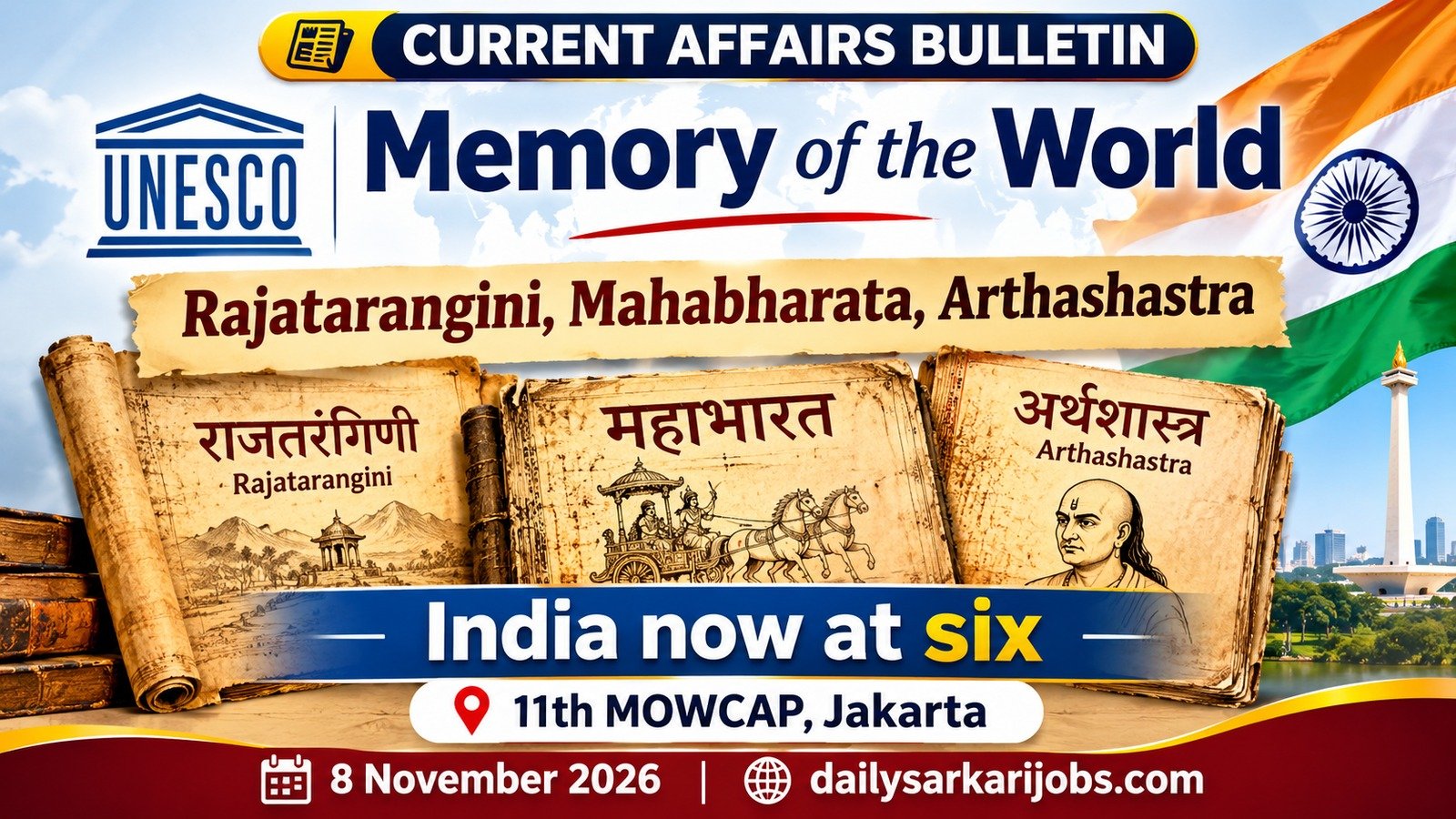
Three Indian manuscripts have been added to UNESCO’s Memory of the World Register for Asia and the Pacific, announced in early November 2026 after the 11th session of MOWCAP in Jakarta. Most readers will file this next to the Taj Mahal and move on. That is the mistake.
This List Protects Paper, Not Places — and One Copy, Not the Work
UNESCO runs several lists and they are not the same thing.The famous one protects places. This one protects documents.
UNESCO list
What it protects
Indian example
World Heritage List
Places — monuments, sites, natural areas
The Taj Mahal, Kaziranga
Intangible Cultural Heritage
Living practices — music, dance, ritual, craft
Yoga, Durga Puja in Kolkata
Memory of the World
Documents — manuscripts, archives, recordings
The three inscribed this year
Now the second half of the hinge, and it is the part almost everyone gets wrong.UNESCO did not inscribe the Mahabharata. It inscribed a manuscript of the Mahabharata.
The entry is a physical object — a particular copy, written at a particular time, on particular material, sitting in a particular collection. The epic itself is not a document; it exists in hundreds of versions. What the register recognises is one surviving artefact that carries it.Memory of the World is a list of things you could, in principle, drop.
Jargon, Defined Once
MOWCAP is the Memory of the World Committee for Asia and the Pacific — the regional body that maintains the regional register.
Inscription is the word for adding an item to a UNESCO register. Nothing is physically moved or handed over; it is recognition, not transfer.
A recension is a particular version of a text that has come down through a particular region or tradition. The Mahabharata has several; the inscribed manuscript carries the Kashmiri one.
Sarada is an old script of Kashmir and the north-west, used for Sanskrit long before Devanagari took over there.
IGNCA is the Indira Gandhi National Centre for the Arts, which prepared all three nomination dossiers.
The Three Manuscripts
Manuscript
Who and when
What it is
Rajatarangini
Kalhana, 12th century
A Sanskrit chronicle of the kings of Kashmir, often called India’s first work of written history
Mahabharata
A manuscript about 400 years old
Written on birch bark in Sarada script, carrying the Kashmiri recension of the epic
Arthashastra
Kautilya; a 16th-century palm-leaf copy
The classic treatise on statecraft, revenue, law and diplomacy
Notice what the three have in common.All three are Sanskrit, and two of the three are Kashmiri. This is not a random selection — it is a group of documents that survived in one of the most disturbed regions of the subcontinent, on materials that rot.Birch bark and palm leaf are not paper; they are organic, and they decay.That fragility is the argument for the list.
The Numbers Worth Carrying
21 new items were added to the Asia-Pacific regional register in this cycle, three of them India’s.
India now has six inscriptions on the Asia-Pacific regional register.
The Memory of the World Programme was launched by UNESCO in 1992, to guard against what it called collective amnesia — the quiet loss of archives nobody noticed was happening.
The separate International Register holds about 570 entries from 193 countries.
The nomination dossiers were prepared by the IGNCA, and the Ministry of External Affairs welcomed the decision.
Exam Alert: Four Traps
Three different UNESCO lists.World Heritage is places, Intangible Cultural Heritage is living practice, Memory of the World is documents.A question that puts the Taj Mahal and the Rajatarangini on the same list is wrong.
Regional register, not the International one.The figure of six is India’s count on the Asia-Pacific register. The International Register is a separate list with its own count.
Kalhana wrote the Rajatarangini; Kautilya wrote the Arthashastra.Both are Sanskrit, both got inscribed together, and the names get swapped.
1992 is the programme; 2026 is this inscription.Two dates in the same answer.
Did You Know: The Rajatarangini Argues With Its Own Sources
Kalhana’s chronicle is treated as India’s first work of written history, and the reason is not that it is the oldest account of the past.It is that Kalhana said where he got things from, weighed one source against another, and told the reader when he doubted what he had been handed.
That habit — evidence, comparison, stated doubt — is what separates history from chronicle and legend.It is a twelfth-century text behaving the way a modern historian is trained to behave, which is why it keeps being singled out.
Why a Reader Should Care
UNESCO decisions are reliable Current Affairs material, and this one carries a conceptual distinction that gets tested. It sits directly beside our capsule on India’s UNESCO World Heritage Sites, and reading the two together is the fastest way to stop confusing the lists. Our capsule on the National Akademis covers the institutions that look after culture at home, and the Indus Valley Civilisation capsule covers the script we still cannot read — the opposite problem to this one.
Today’s Static GK capsule is on Indian classical music, and the pair make a point together. These manuscripts survived because somebody wrote them down and the material lasted. Indian classical music survived for centuries with almost nothing written down at all. Two completely different answers to the same question — how do you carry something across time?
Practice Questions
Q1. The Memory of the World Register maintained by UNESCO protects (a) Monuments and natural sites (b) Living traditions such as dance and ritual (c) Documentary heritage such as manuscripts and archives (d) Endangered languages Answer: (c) Documentary heritage such as manuscripts and archives Places go on the World Heritage List and living practices on the Intangible Cultural Heritage list, which are separate registers.
Q2. The Rajatarangini, inscribed in 2026, was composed by (a) Kautilya (b) Kalhana (c) Banabhatta (d) Sharngadeva Answer: (b) Kalhana It is a twelfth-century Sanskrit chronicle of the kings of Kashmir, often described as India’s first work of written history.
Q3. After this inscription, how many Indian entries are on the Memory of the World Asia-Pacific regional register? (a) Three (b) Twelve (c) Twenty-one (d) Six Answer: (d) Six Twenty-one items in all were added to the regional register in this cycle, of which three were India’s.
Q4. The Mahabharata manuscript inscribed at the 11th MOWCAP session is written on (a) Birch bark in Sarada script (b) Palm leaf in Grantha script (c) Handmade paper in Devanagari (d) Copper plates in Brahmi Answer: (a) Birch bark in Sarada script The Arthashastra manuscript inscribed alongside it is the palm-leaf one, dating from the sixteenth century.
Q5. The nomination dossiers for all three Indian manuscripts were prepared by (a) The Archaeological Survey of India (b) The National Archives of India (c) The Indira Gandhi National Centre for the Arts (d) The Sahitya Akademi Answer: (c) The Indira Gandhi National Centre for the Arts The decision itself was taken at the eleventh session of the regional committee, held in Jakarta.
30-Second Revision
The hinge:this list protects paper, not places — and it protects one copy, not the work. UNESCO inscribed a manuscript of the Mahabharata, not the Mahabharata.
The three:Rajatarangini (Kalhana, 12th century), the Mahabharata (birch bark, Sarada script, about 400 years old), and the Arthashastra (Kautilya, 16th-century palm leaf).
The numbers:21 added in the cycle, India now at six on the Asia-Pacific regional register; programme launched 1992; International Register about 570 entries.
Who and where:11th MOWCAP session, Jakarta; dossiers by the IGNCA.
The trap:World Heritage = places, Intangible = practices, Memory of the World = documents.
What Is Not Settled
Two honest notes. First, the exact date of the 11th MOWCAP session is reported loosely — the announcement and the ministry statements come from early November 2026, and that is how the date is given here. Use the month rather than a day unless you have the official record.
Second, counts of India’s UNESCO entries are easy to get wrong because there are several registers. The figure of six is specifically the Asia-Pacific regional register, as stated by the Ministry of Culture. Do not add it to the International Register count or to the World Heritage Site count; they are different lists.
Sources
Agency reporting of the Ministry of Culture and Ministry of External Affairs statements, early November 2026 — the inscription of the Rajatarangini, the Mahabharata manuscript and the Arthashastra at the 11th MOWCAP session in Jakarta, India’s total of six on the Asia-Pacific regional register, and the preparation of all three dossiers by the IGNCA.
Reference material on the Memory of the World Programme — its launch by UNESCO in 1992, its purpose of preserving documentary heritage, the 21 items added to the regional register in this cycle, and the scale of the separate International Register.
Descriptions of the three manuscripts — the twelfth-century date and authorship of the Rajatarangini, the birch-bark and Sarada-script Mahabharata carrying the Kashmiri recension, and the sixteenth-century palm-leaf Arthashastra.