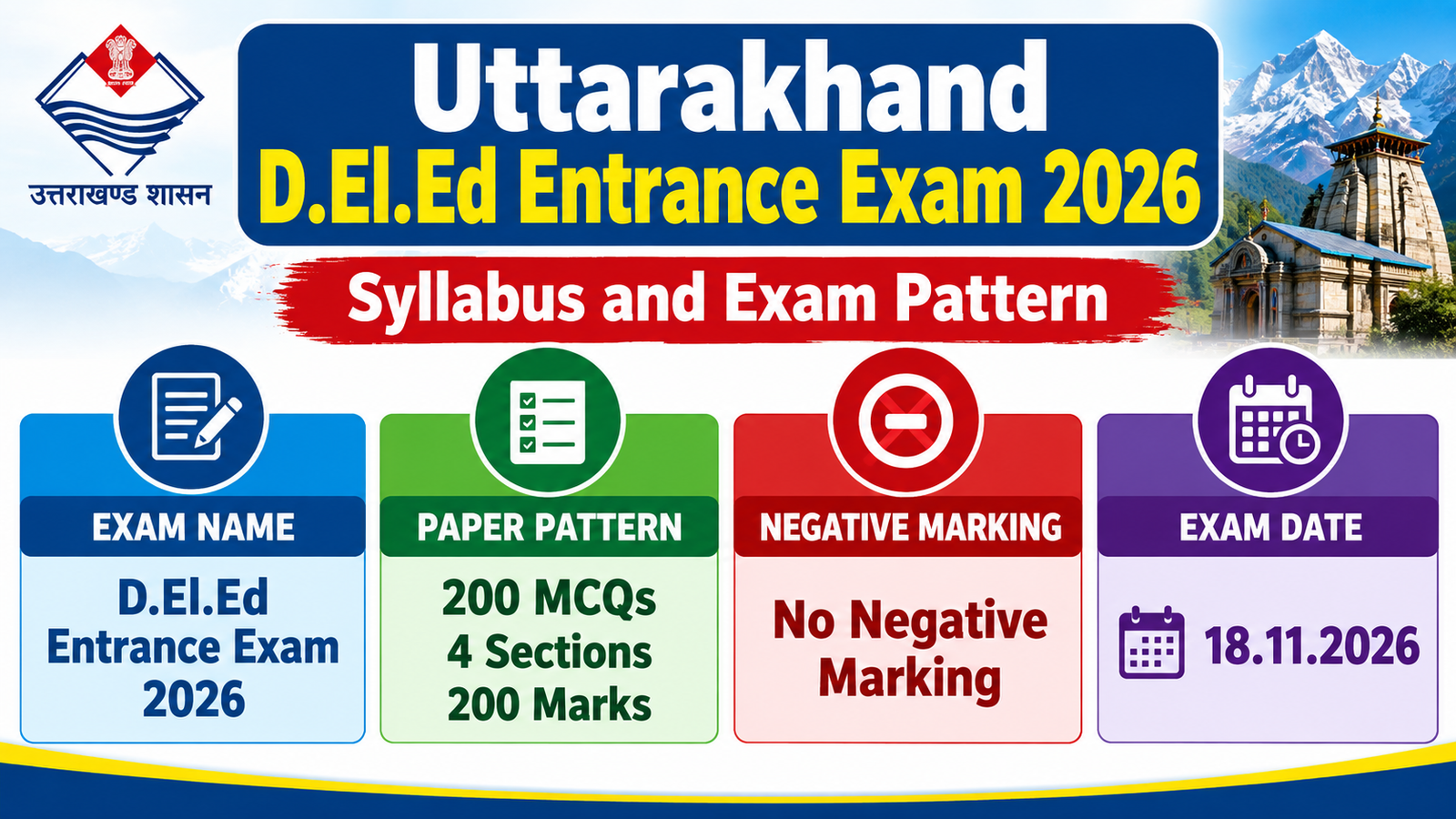
The Uttarakhand Board of School Education (UBSE), Ramnagar, Nainital has released the official syllabus and exam pattern for the Two-Year D.El.Ed (Diploma in Elementary Education) Entrance Exam 2026. The entrance test will carry 200 multiple-choice questions for 200 marks across four compulsory sections, will run for 2 hours 30 minutes, and carries no negative marking. The paper will be bilingual — set in both Hindi and English. Given below is the complete section-wise exam pattern and the full topic-wise syllabus exactly as listed in the official UBSE syllabus document.
Quick Navigation
Uttarakhand D.El.Ed Entrance Exam 2026 Syllabus — Overview
| Exam Name | Two-Year D.El.Ed Training Entrance Exam 2026 (द्विवर्षीय डी0एल0एड0 प्रशिक्षण हेतु प्रवेश परीक्षा) |
| Organization | Uttarakhand Board of School Education (UBSE), Ramnagar, Nainital — उत्तराखण्ड विद्यालयी शिक्षा परिषद |
| Notification / Advertisement No. | Not specified in notification — the syllabus document carries no reference number (parent notice: Vigyapti-2026 dated 15.09.2026) |
| Location | Uttarakhand |
| Course | Two-Year Diploma in Elementary Education (D.El.Ed), conducted at Uttarakhand DIETs |
| Exam Date | 18.11.2026, 10:00 AM to 12:30 PM |
| Total Questions / Marks | 200 questions / 200 marks (1 mark per question) |
| Exam Duration | 2 hours 30 minutes (150 minutes) |
| Negative Marking | No — no marks will be deducted for a wrong answer |
| Medium of Question Paper | Bilingual — Hindi and English |
| Sections in the Paper | General Knowledge → General Intelligence and Reasoning → Numerical Ability → Teaching Aptitude (50 marks each, all compulsory) |
| Official Syllabus PDF | Download Syllabus PDF |
| Official Website / Apply Online | ukdeled.com |
Important Dates
The syllabus document itself states only the exam pattern. The dates below come from the official D.El.Ed Entrance Exam 2026 notification (Vigyapti-2026) published by UBSE on the same day.
| Event | Date |
|---|---|
| Syllabus published on UBSE website | 15.09.2026 |
| Online application starts | 15.09.2026, 11:00 AM |
| Last date to submit online application | 06.10.2026, 11:59 PM |
| Last date to pay application fee | 08.10.2026, 11:59 PM |
| Application correction window | 09.10.2026 to 11.10.2026 |
| Entrance exam date | 18.11.2026, 10:00 AM to 12:30 PM |
Uttarakhand D.El.Ed Entrance Exam Pattern 2026
| Feature | Detail |
|---|---|
| Type of questions | Objective — multiple choice questions (बहुविकल्पीय प्रश्न) |
| Total number of questions | 200 |
| Total marks | 200 |
| Marks per question | 1 mark |
| Negative marking | None — no marks are deducted for any wrong answer |
| Exam duration | 2 hours 30 minutes |
| Language of the paper | Bilingual — every question appears in both Hindi and English |
| Number of sections | 4 sections, all compulsory, 50 questions and 50 marks each |
| Mode of exam | Not specified in the syllabus document — confirm from the admit card |
Section-wise Marks Distribution
| Sr. No. | Subject (all compulsory) | No. of Questions | Marks |
|---|---|---|---|
| 1 | सामान्य ज्ञान / बोध — General Knowledge | 50 | 50 |
| 2 | सामान्य बुद्धिमत्ता एवं तर्कशक्ति — General Intelligence and Reasoning | 50 | 50 |
| 3 | संख्यात्मक योग्यता — Numerical Ability | 50 | 50 |
| 4 | शिक्षण अभिरुचि — Teaching Aptitude | 50 | 50 |
| — | Total (योग) | 200 | 200 |
Topic-wise Syllabus
Every topic listed below is reproduced from the official UBSE syllabus document, in both the original Hindi and the English version printed alongside it in the same document. Nothing has been shortened.
भाग : एक — Part One: General Knowledge (सामान्य ज्ञान / बोध) — 50 Marks
| विषय-वस्तु (हिन्दी) | Topic (English) |
|---|---|
| 1. राष्ट्रीय एवं अन्तर्राष्ट्रीय महत्व की सम-सामयिक घटनाएं। | 1. Current events of National and International importance. |
| 2. खेलकूद, मनोरंजन एवं विभिन्न पुरस्कार। | 2. Sports, Entertainment and various Awards. |
| 3. भारत का इतिहास, भारतीय राष्ट्रीय स्वतंत्रता आन्दोलन एवं समकालीन भारतीय समाज। | 3. Indian History, Indian National Freedom Movement and Contemporary Society of India. |
| 4. भारत एवं विश्व का भूगोल। | 4. Geography of India and The World. |
| 5. प्राकृतिक संसाधन, नियोजन, अर्थव्यवस्था एवं कृषि, सतत् एवं समावेशी विकास। | 5. Natural Resources, Planning, Economy and Agriculture, Sustainable and Inclusive Development. |
| 6. प्राकृतिक आपदाएं एवं आपदा प्रबन्धन। | 6. Natural Calamities and Disaster Management. |
| 7. भारत में मानव संसाधन विकास सूचकांक, सामाजिक विकास सूचकांक एवं यू0एन0डी0पी0 रिपोर्ट। | 7. Human Resource Development Index in India, Social Development Index and UNDP Report. |
| 8. भारतीय संविधान, राजनीतिक प्रणाली, शासन एवं प्रशासन व न्यायपालिका। | 8. Indian Constitution, Political System, Governance and Administration, Judiciary. |
| 9. सामान्य विज्ञान। | 9. General Science. |
| 10. विकास एवं पर्यावरण संबंधी समस्याएं। | 10. Problems related to Development and Environment. |
| 11. जैव-प्रौद्योगिकी। | 11. Biotechnology. |
| 12. विज्ञान एवं प्रौद्योगिकी, सूचना, संचार, अंतरिक्ष प्रौद्योगिकी, कम्प्यूटर इत्यादि। | 12. Science and Technology, Information, Communication, Space Technology, Computers etc. |
| 13. ऊर्जा एवं जल संसाधन। | 13. Energy and Water Resources. |
| 14. उत्तराखण्ड राज्य संबंधी सामान्य ज्ञान : सामान्य भूगोल, इतिहास, संस्कृति एवं उत्तराखण्ड राज्य निर्माण आंदोलन, प्राकृतिक एवं आर्थिक संसाधन, राजनीतिक व प्रशासनिक व्यवस्था, शिक्षा एवं संस्कृति, समाज सुधार आंदोलन, आर्थिक विकास, सरकारी एवं गैर-सरकारी कल्याणकारी एवं विकासपरक योजनाएं, महत्वपूर्ण समसामयिक घटनाएं, खेल कूद एवं मनोरंजन। | 14. General Knowledge related to the State of Uttarakhand: General Geography, History, Culture and Uttarakhand Rajya Nirman Andolan etc., Natural and Economic Resources, Political and Administrative Set up, Education and Culture, Social Reform Movements, Economic Development, Governmental and Non-Governmental welfare and developmental schemes, Important contemporary events, Sports and Entertainment. |
भाग : दो — Part Two: General Intelligence and Reasoning (सामान्य बुद्धिमत्ता एवं तर्कशक्ति) — 50 Marks
The official document presents this section as a single continuous paragraph rather than a numbered list. The topics are grouped below for readability — no topic has been added or left out.
| Group | Topics covered |
|---|---|
| शाब्दिक तर्कशक्ति Verbal Reasoning | सादृश्यता, वर्गीकरण, कोडिंग-डिकोडिंग, रक्त-सम्बन्ध, अंकगणितीय तर्कशक्ति-संक्रियाएं, श्रृंखला-वर्णमाला-क्रम-दिशा-समय-अनुक्रम-पहेली-आयु-कलैण्डर, सामान्य बुद्धिमत्ता परीक्षण Analogy, Classification, Coding-decoding, Blood relations, Arithmetical Reasoning-Operations, Series-Alphabet-Order-Direction-Time-Sequences-Puzzle-Age-Calendar, General Intelligence Test. |
| तार्किक एवं विश्लेषणात्मक तर्कशक्ति Logical and Analytical Reasoning | तार्किक-वेन आरेख एवं निगमन, विश्लेषणात्मक तर्कशक्ति, कथन-कारण व सत्यापन, लॉजिकल रिजनिंग, समानताओं तथा अंतरों, लुप्त संख्याएं, समस्या समाधान, निर्णय लेना Logical-Venn Diagrams and Deduction, Analytical Reasoning, Assertion-Reason and verification, Logical reasoning, similarities and differences, Missing numbers, Problem solving, Decision making. |
| अशाब्दिक तर्कशक्ति Non-Verbal Reasoning | ज्यामितीय आकृतियों, आव्यूहों, पासा, घड़ी, प्रतिबिम्ब, कागज मोड़ना एवं काटना, चित्र निर्माण, मार्ग-जालतंत्र, दृश्य स्मृति, विभेद, अवलोकन Geometric Shapes, Matrix, Dice, Clock, Images, Paper folding and Cutting, Figure Formation, Routes-Networks, Visual memory, Discrimination, Observation. |
| आंकड़े एवं संख्यात्मक तर्क Data and Numerical Reasoning | शाब्दिक एवं चित्रात्मक वर्गीकरण, आँकड़ों का प्रस्तुतीकरण एवं विश्लेषण, अंकगणितीय संख्या सारणी, अंकगणितीय तर्कशक्ति Verbal and figure classification, Data representation and analysis, Arithmetical number series, Arithmetical reasoning. |
| अमूर्त चिन्तन एवं स्थानिक तर्क Abstract and Spatial Reasoning | अभ्यर्थी के सामान्य विचार, तथ्य और अंकों, संकेतों और उनमें संबंध, अंकगणितीय एवं संख्यात्मक गणना तथा अन्य विश्लेषणात्मक, गणितीय एवं परिमाणात्मक कार्यों से संबंधित योग्यता के परीक्षण, स्थानिक तर्क Ability to deal with abstract ideas, Facts and figures, Symbols and their relationships, Arithmetical and numerical computations, other analytical, Mathematical and quantitative functions, Spatial Reasoning etc. |
| आकृति आधारित प्रश्न Figure and Shape based questions | आकृतियों के निर्माण, तार्किक क्रम, अपूर्ण पैटर्न, समूहीकरण, घूर्णन, आव्यूह, सन्निहित होना, श्रंखला-नियम पालन आदि Formation, Logical Sequence, Incomplete Pattern, Grouping, Rotation, Matrix, Embedded, Series-Rule Detection etc. of Figures/Shapes. |
भाग : तीन — Part Three: Numerical Ability (संख्यात्मक योग्यता) — 50 Marks
| विषय-वस्तु (हिन्दी) | Topic (English) |
|---|---|
| 1. संख्या पद्धति। | 1. Number system. |
| 2. लघुतम समापवर्त्य व महत्तम समापवर्तक। | 2. LCM and HCF. |
| 3. अनुपात व समानुपात, भिन्न एवं दशमलव संख्याएं। | 3. Ratio and proportion, Fractions and decimal numbers. |
| 4. लाभ / हानि, प्रतिशत, बट्टा एवं औसत। | 4. Profit/loss, Percentage, Discount and Average. |
| 5. साधारण ब्याज एवं चक्रवृद्धि ब्याज। | 5. Simple and compound interest. |
| 6. कार्य, समय, चाल एवं दूरी। | 6. Work and time, Speed and distance. |
| 7. प्रारम्भिक बीजगणित एवं सरल रेखीय समीकरण। | 7. Elementary Algebra and Simple linear equations. |
| 8. वर्ग एवं वर्गमूल। | 8. Square and Square root. |
| 9. घन एवं घनमूल। | 9. Cube and Cube root. |
| 10. घात एवं घातांक। | 10. Power and Exponents. |
| 11. रेखाएं एवं कोण। | 11. Lines and Angles. |
| 12. द्वि-विमीय एवं त्रिविमीय ज्यामितीय आकृतियां। | 12. Two-Dimensional and Three-Dimensional shapes. |
| 13. अनुक्रम व श्रेणी। | 13. Sequence and series. |
| 14. परिमाप, क्षेत्रफल एवं आयतन (त्रिभुज, आयत, वर्ग, चतुर्भुज, वृत्त, गोला, बेलन, प्रिज्म, शंकु, घन व घनाभ)। | 14. Perimeter, Area and Volume (Triangle, Rectangle, Square, Quadrilateral, Circle, Sphere, Cylinder, Prism, Cone, Cube and Cuboid). |
| 15. आंकड़ों का विश्लेषण। | 15. Data interpretation. |
| 16. प्रायिकता। | 16. Probability. |
भाग : चार — Part Four: Teaching Aptitude (शिक्षण अभिरुचि) — 50 Marks
| विषय-वस्तु (हिन्दी) | Topic (English) |
|---|---|
| 1. शिक्षण की अवधारणा : शिक्षण का अर्थ, प्रकृति, उद्देश्य और विशेषताएँ, शिक्षण व्यवसाय के प्रति अभिवृत्ति। | 1. Concept of Teaching: Meaning, Nature, Objectives and Characteristics of Teaching, Attitude towards teaching profession. |
| 2. शिक्षार्थी और व्यक्तिगत विभिन्नताएँ : छात्र अभिवृद्धि एवं विकास के प्रति अभिवृत्ति, बालक के विभिन्न विकासक्रमों के प्रति अभिवृत्ति, व्यक्तिगत विभिन्नताएँ, सीखने की शैलियाँ, बुद्धि, अभिरुचि और रचनात्मकता, अभिप्रेरण और अवधान। | 2. Learner and Individual Differences: Attitude towards Child’s growth and development, Attitude towards various sequential developments of the child, Individual differences, Learning styles, Intelligence, Aptitude and Creativity, Motivation and Attention. |
| 3. शिक्षक-अभिभावक-समुदाय संबंध : अभिभावक-शिक्षक संवाद, शिक्षा में समुदाय की भागीदारी, परामर्शदाता के रूप में शिक्षक की भूमिका, व्यवहार संबंधी और शैक्षणिक समस्याओं के लिए परामर्श। | 3. Teacher-Parent-Community Relationship: Parent Teacher Interaction, Community Participation in Education, Role of Teacher as a Counsellor, Counselling for behavioural and Academic Problems. |
| 4. रचनात्मकता और आलोचनात्मक सोच : रचनात्मक सोच, आलोचनात्मक सोच, समस्या समाधान। | 4. Creativity and Critical Thinking: Creative Thinking, Critical Thinking, Problem Solving. |
| 5. बाल अधिकार और संरक्षण : बाल अधिकार, बाल शोषण और संरक्षण, शिक्षा में लैंगिक समानता, सुरक्षित और बाल केन्द्रित विद्यालय वातावरण, राष्ट्रीय बाल अधिकार संरक्षण आयोग (NCPCR), राज्य बाल अधिकार संरक्षण आयोग (SCPCR)। | 5. Child Rights and Protection: Child Rights, Child Abuse and Protection, Gender Equality in Education, Safe and Child centred School Environment, National Commission for Protection of Child Rights (NCPCR), State Commission for Protection of Child Rights (SCPCR). |
| 6. शिक्षण दक्षता एवं सम्प्रेषण : शिक्षण कौशल, शिक्षण विधियों एवं तकनीक के प्रति अभिवृत्ति, परम्परागत एवं आधुनिक शिक्षण सहायक सामग्री, शिक्षण प्रक्रिया एवं सम्प्रेषण — सम्प्रेषण के प्रकार एवं अच्छे सम्प्रेषण की विशेषताएं। | 6. Teaching Efficiency and Communication: Teaching skills, Attitude towards teaching procedures and techniques, Traditional and Modern Teaching Aids, Teaching and Communication process — Types of Communication and Characteristics of Good Communication. |
| 7. मूल्य आधारित शिक्षा : मूल्यों के प्रकार — वैयक्तिक एवं सामाजिक मूल्य, मूल्यों के ह्रास के कारण, शिक्षा द्वारा मूल्यों का उन्नयन। | 7. Value Based Education: Types of Values — Individualistic and Social Values, Reasons for deterioration in Values, Inculcation of Values through Education. |
| 8. कक्षा कक्ष प्रबन्धन : कक्षा में व्यवहार, सहकारी एवं सहयोगात्मक अधिगम जैसी विभिन्न गतिविधियां एवं तकनीकें, सकारात्मक अनुशासन, विद्यालय अनुशासन, सक्रिय एवं सहभागितापूर्ण कक्षा, समावेशी कक्षा का निर्माण, समय प्रबन्धन, विघटनकारी व्यवहार से निपटना, शैक्षिक नियोजन एवं प्रबन्धन। | 8. Classroom Management: Classroom behaviour, different activities and techniques like cooperative and collaborative learning, positive discipline, school discipline, active and engaged classroom, creating inclusive class room, Time management, Handling disruptive behaviours, Educational Planning and Management. |
| 9. शिक्षक की भूमिका एवं उत्तरदायित्व : शिक्षक की जवाबदेही, एक प्रभावी शिक्षक के गुण, शिक्षकों की व्यक्तिगत एवं व्यावसायिक विशेषताएं, शैक्षिक नेतृत्व, हमारी महान प्राचीन परम्परा से प्राप्त मूल्य एवं नैतिकता, गुरु शिष्य परम्परा, शिक्षण व्यवसाय की नैतिकता, शिक्षण सुगमकर्ता एवं सह-अध्येता के रूप में, विद्यार्थियों के व्यक्तित्व विकास में शिक्षक की भूमिका। | 9. Role and Responsibilities of a Teacher: Teacher Accountability, Qualities of an Effective Teacher, Personal and professional characteristics of teachers, Educational leadership, Values and morals from our great ancient tradition, Guru-Shishya Parampara, Ethics of teaching profession, Teacher as a facilitator and co-learner, Role of teacher in personality development of students. |
| 10. आकलन एवं मूल्यांकन : आकलन का महत्व, सामान्य आकलन के विभिन्न प्रकार, अधिगम का आकलन, अधिगम के रूप में आकलन, अधिगम हेतु आकलन, मूल्यांकन के तत्व और प्रकार, मूल्यांकन में नवाचार, विशेष आवश्यकता वाले विद्यार्थियों के संदर्भ में समावेशी मूल्यांकन। | 10. Assessment and Evaluation: Importance of assessment, Various types of common assessment, Assessment of learning, Assessment as learning, Assessment for learning, Elements and types of Evaluation and Innovation in Education, Inclusive evaluation with special reference to students with special needs. |
| 11. शिक्षण-अधिगम प्रक्रिया : शिक्षण विधियां, आनन्दमय अधिगम, अनुभवात्मक अधिगम, रचनावादी शिक्षण अधिगम प्रक्रिया, बाल केन्द्रित अधिगम, कला एकीकृत शिक्षा, समावेशी शिक्षाशास्त्र, सक्रिय अधिगम, शिक्षण अधिगम में आने वाली समस्याएं आदि। | 11. Teaching-Learning Process: Teaching methods, Joyful learning, Experiential learning, Constructivist approach to teaching learning, Child centered learning, art integrated education, Inclusive pedagogy, Active learning, Problems in teaching-learning, etc. |
| 12. शिक्षा में ICT का प्रयोग : नवीनतम विकास एवं भविष्य की प्रौद्योगिकियां, DIKSHA, NISHTHA, SWAYAM, PM e-VIDYA, PRASHAST आदि जैसी सरकारी ICT पहल, सहायक प्रौद्योगिकी, डिजिटल सुरक्षा एवं साइबर नैतिकता आदि। | 12. Use of ICT in Education: Recent developments and future technologies, Government ICT initiatives like DIKSHA, NISHTHA, SWAYAM, PM e-VIDYA, PRASHAST etc., Assistive technology, Digital safety and cyber ethics etc. |
| 13. नवीन शैक्षिक पहलों के प्रति सामान्य जागरूकता : राष्ट्रीय शिक्षा नीति 2020 (NEP-2020), राष्ट्रीय पाठ्यचर्या रूपरेखा — बुनियादी स्तर 2022 (NCF-FS 2022), राज्य पाठ्यचर्या रूपरेखा — बुनियादी स्तर 2023 (SCF-FS 2023), राष्ट्रीय पाठ्यचर्या रूपरेखा — विद्यालयी शिक्षा 2023 (NCF-SE 2023), राज्य पाठ्यचर्या रूपरेखा विद्यालयी शिक्षा 2025 (SCF-SE 2025) : परिचयात्मक जानकारी एवं इनके आलोक में शिक्षक की भूमिका, दिव्यांगजन अधिकार अधिनियम 2016 (RPwD Act), बालिकाओं की शिक्षा एवं सामाजिक-आर्थिक रूप से वंचित समूहों की शिक्षा को बढ़ावा देने हेतु स्थानीय योजनाएं, भारत में शिक्षा से सम्बन्धित संवैधानिक प्रावधान, निःशुल्क एवं अनिवार्य बाल शिक्षा का अधिकार अधिनियम 2009 (RTE Act, 2009)। | 13. General Awareness about recent Educational Initiatives: NEP-2020, NCF-FS 2022, SCF-FS 2023, NCF-SE 2023, SCF-SE 2025: Introductory information and role of a teacher in context of these dimensions, RPwD Act 2016, Local schemes to promote girl education and education of SEDGs, Constitutional provisions for education in India, RTE Act 2009. |
| 14. स्कूली शिक्षा में सुधार हेतु संचालित विभिन्न महत्वपूर्ण योजनाएं : बी0ई0पी0, डी0पी0ई0पी0, सर्व शिक्षा अभियान, राष्ट्रीय माध्यमिक शिक्षा अभियान, समग्र शिक्षा अभियान, पी0एम0पोषण / मध्याह्न भोजन योजना आदि। | 14. Implementation of Important Schemes to improve School Education: BEP, DPEP, Sarva Shiksha Abhiyan, Rashtriya Madhyamik Shiksha Abhiyan, Samagra Shiksha Abhiyan, PM Poshan Scheme (MDM Scheme). |
Important Links
| Official Syllabus PDF | Download Syllabus and Exam Pattern (PDF) |
| UBSE Syllabus Page | View on UBSE Website |
| Entrance Exam Notification | Download Vigyapti-2026 (PDF) |
| Information Brochure | Download Information Brochure |
| Apply Online / Official Website | ukdeled.com |
| UBSE Official Website | ubse.uk.gov.in |
| Join Telegram Channel | Join Telegram Channel |
| Join WhatsApp Channel | Join WhatsApp Channel |
Common Mistakes to Avoid
- Do not ignore Part Four — Teaching Aptitude carries 50 marks, exactly one-quarter of the paper, and it is the section most candidates leave until last.
- Uttarakhand-specific General Knowledge is only item 14 of Part One, but it is by far the longest entry on that list — preparing national GK alone leaves a large gap.
- There is no negative marking, so leaving a question blank gains nothing; attempt all 200 questions.
- 200 questions in 150 minutes works out to about 45 seconds per question — practise with a timer, not just with the topic list.
- The official syllabus gives no chapter-wise or topic-wise mark weightage; treat any unofficial weightage chart as a guess, not as a plan.
- The paper is bilingual, but technical terms can read differently in the two versions — if a question seems ambiguous, check the other language before answering.
- The syllabus document does not state the exam mode (online or OMR); wait for the admit card rather than assuming.
Frequently Asked Questions
1. When will the Uttarakhand D.El.Ed Entrance Exam 2026 be held?
The entrance exam is scheduled for 18.11.2026 from 10:00 AM to 12:30 PM.
2. How many questions will be asked and what are the total marks?
The paper will have 200 multiple-choice questions carrying 1 mark each, for a total of 200 marks.
3. Is there negative marking in the D.El.Ed entrance exam?
No — the official syllabus states clearly that no marks will be deducted for any wrong answer.
4. How much time is given to complete the paper?
The exam duration is 2 hours 30 minutes.
5. Which sections are included in the syllabus?
Four compulsory sections of 50 marks each: General Knowledge, General Intelligence and Reasoning, Numerical Ability, and Teaching Aptitude.
6. In which language will the question paper be set?
The paper will be bilingual, with every question printed in both Hindi and English.
7. Is Uttarakhand General Knowledge part of the syllabus?
Yes — item 14 of Part One covers Uttarakhand geography, history, culture, the Rajya Nirman Andolan, natural and economic resources, administration, education, social reform movements and state welfare schemes.
8. Where can I download the official syllabus PDF?
The syllabus is published on the UBSE website and a direct download link is given in the Important Links table above.
Disclaimer: The information above has been compiled from the official notification for the convenience of job seekers. Candidates are advised to verify all details from the official website before applying.